Mostrar mensagens com a etiqueta TDK. Mostrar todas as mensagens
Mostrar mensagens com a etiqueta TDK. Mostrar todas as mensagens
domingo, 27 de setembro de 2015
Review: TDK A26 "Trek", Yamaha NX-P100, Panasonic SC-NA10 compared
This time I would like to present some recent portable Bluetooth speakers in the price range from 100-200$ and compare one to each other including my current favorite at this size: the Bose Soundlink Mini.

The smallest of the bunch is the TDK A26 "Trek", which looks like a smaller version of the great TDK A33 and can already be found for as low as 79$ on the US-Amazon store. The Trek costs a bit more in Germany though, where the lowest price is around 129€, which would make it twice as expensive when directly converted from the US-price.

The Yamaha NX-P100 seems to be a direct competitor of the Bose Soundlink not only in size but also in price, as at 199$ it costs about the same as the Bose and is also more or less equal in size.

Last not least the Panasonic SC-NA10, which is a bit bigger than the others, but remains still pretty portable as it is considerably smaller and lighter than the TDK A33 for example. Volumewise it should be only slightly larger than the Bose Soundlink Mini if the cover is not included. The Panasonic comes exactly in between pricewise, costing about 150€. I haven't found it on amazon,com yet though.

I won't cover all the details of each speaker this time as I would like to avoid too much blabla. Like so many they are simple Bluetooth speakers, all of them have handsfree included as well as NFC for faster pairing, the Yamaha and TDK being splash-resistant too.
The Yamaha and Panasonic have Apt-X codec built in for better streaming quality. And both Yamaha and Panasonic have an additional USB-port for charging external devices.
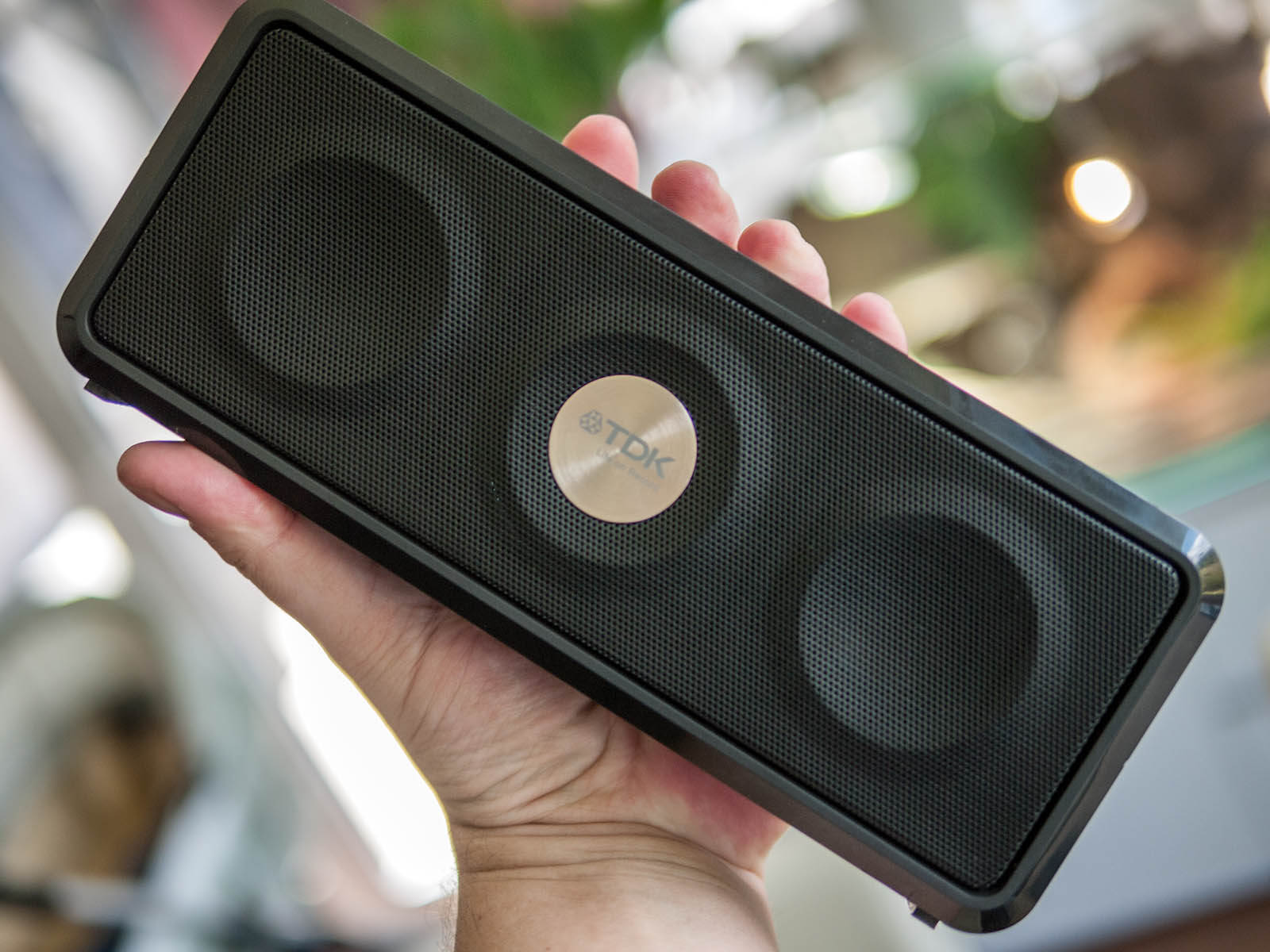
Build quality seems great on all of them. I also like the design of any of them. The TDK Trek feels great in your hand, it is neither too heavy nor too light. Compared to the Soundlink Mini the TDK weights maybe 40% less as I would also estimate the overall volume about 30-40% less. It has exactly the same length as the Bose, but it is flatter and higher at the same time. The overall design resembles much of the original A33. Just the volume indicator LED is missing, which I liked quite a lot on the A33, as you could always see how loud it is set.

The volume of the speaker is not synced to the player's volume, on neither of them by the way. So far only recent JBL/Harman Kardon speakers have a single master volume, as do the Jabra Solemate and Solemate Mini speakers. I think the Jamboxes with recent firmware versions also have this feature, and maybe there are other ones too, but I don't know all of them.
As the Trek is so thin (only 2.5cm) it doesn't stand very stable. There is a flip-out stand at the back that covers the passive radiator, very similar to the Soundmatters FoxL. If you pull the stand out too much, it will fall out completely. No idea if this was done as protection for not breaking the hinges or if this is just a design flaw.
When turning the speaker on you will hear some simple tone-progression, not too loud thank goodness. When paired there is another tone, pretty much like on many other bluetooth speakers and the speaker just beeps when maximum volume is reached.

The A26 also has a main power switch, just like the A33 to conserve battery life if not in use. The switch as well as auxilary and charging ports are covered by a soft rubber cap. If powered down with the power button at the top, the speaker is probably just in standby-mode. I have no idea if there is much battery drain when left like this for a longer time. I noticed some problems with the power button on my sample. I really had to press harder in order to turn it on or off, not so with the other buttons which worked well.
The TDK is also the only speaker that forces playback from the player after pairing with Bluetooth. After it reconnects with any device you should automatically hear some music playing. Not sure if this is desireable every time, so I thought I should mention it. According to the specs, the TDK should provide 6 hours of battery life. That is on par with the TDK A33 which I always found to be a bit short, as I never got more than 6.5 hours, despite listening at lower volumes.
I had highest expectations for the Yamaha NX-P100. It is really pricey for that kind of speaker that's why I thought it should also easily compete with the Bose soundwise. Let's find out later if it really did.
The Yamaha looks quite modern, the design is nice and it comes in different colors. It is about equal in size to the Bose Soundlink Mini, maybe even slightly bigger overall.

The body is made of metal covered with rubbered elements at the sides and at the top and bottom. First I thought the body would be made of plastic, but in fact it seems to be metal, it is just the used paint that has makes it feel a bit cheap. Overall it doesn't look that classy as the Bose Soundlink Mini which consists entirely of a "naked" not painted aluminium body. The Yamaha also weights less than the Bose, but has more heft to it than the TDK. At the bottom you can see some kind of vent-slots. I assume the passive radiator is hiding in there, but you cannot really discern it like that.

The side ports are protected with a rubber cover which is very hard to open. You really need to have long nails, but even then it is nearly impossible to flip the cover back. I only managed by hooking up a scissor blade or a screwdriver etc. No idea what Yamaha was thinking when designing this. The TDK also has the ports protected, but you can open the flap easily.

When I unpacked the speaker for the first time and tried pulling it out of the bag, one of the rubbered side covers came down easily. Not sure if this is really meant to be like that, but pulling the cover down doesn't do any harm as you can put it up again without much effort, still I wanted to mention it, as it rather decreases the overall impression I had for this speaker.

The Yamaha has no volume indicator either. It just beeps, when the lowest or highest volume level is reached. When turning the speaker on, you will hear some chords, when successfully paired with a bluetooth device there will be a voice prompt telling you that Bluetooth is now connected. The voice prompts and confirmation tones are not that annoying like on many other speakers and they are played with the current level of the speaker. So if you left the speaker at a lower volume, the next time you turn it on, the tones will also be played low. Battery life should be 8 hours according to the specs. When paired with an Iphone you will also get a battery life indicator in the top status bar.
The Panasonic is in a bit different category as it is larger. In case of emergency you could just put the TDK Trek inside your jeans pocket as it has the size of a "phablet" more or less, and there are many geeks around who carry theirs inside pockets day in day out. The Yamaha is also managable if you have larger side pockets, but the Panasonic will already need a Jacket or something similar. It is still pretty compact as a speaker though and quite light too.

It is even about 25% lighter than the Soundlink Mini and doesn't make the impression of being much heavier than the other two despite being larger. When having both Bose and Panasonic in your hand, the Bose feels like a heavy brick, while the Yamaha rather resembles a book.


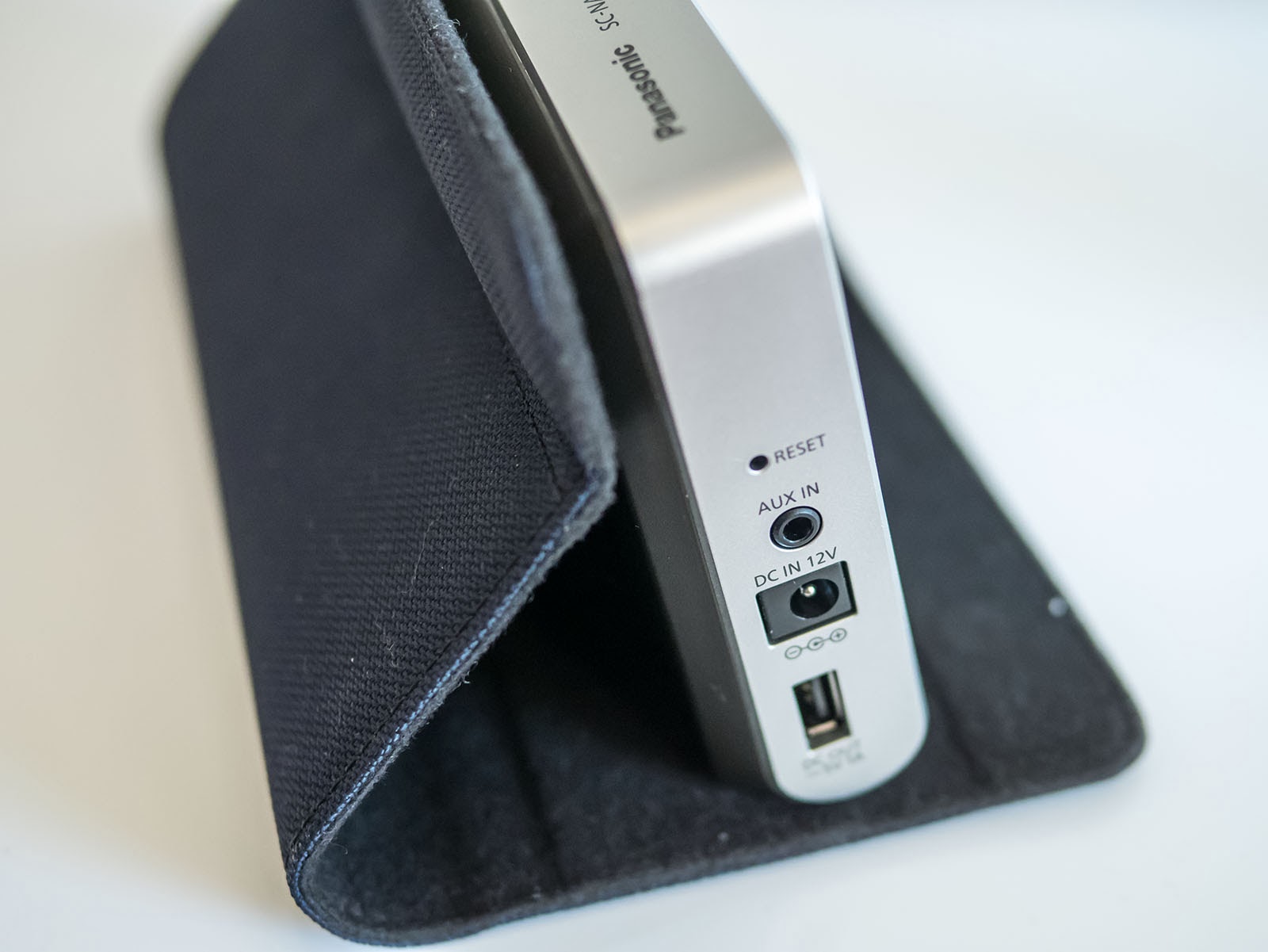
Only the Panasonic comes with built in protection in form of a a flip-cover, similar to the one found on the original Bose Soundlink which also holds firm due to built in magnets. You can easily remove it because it is just attached through a press-button, but without cover the speaker won't really stand upright.

If not in use you just flip the cover over like a book and have the front and back of the speaker automatically protected as the cover is padded to some degree like a cushion. The sides and top of the speaker are still prone to scatches, so just tossing it inside a rucksack could do harm to the glossy finish. Only the front grille of the Panasonic is made of metal, the edges as well as the back are pure plastic. Although the edges seem to be aluminium, in reality they are just painted to look like that. The Panasonic has a rotatable volume-button like a good old analog stereo. The button rotates endlessly, but when the speaker is turned on it automatically gets a beginning and an end through a confirmation tone if you reached the minimum or maximum. The Panasonic also plays some confirmation tones when powering on of off. But all the tones are really restrained and not too disturbing.

The Panasonic is the only speaker of the bunch that needs a proprietary charger. It cannot be charged through USB like the others. The charger is also pretty big, by far lager than the Soundlink Mini charger.
The Panasonic adds a battery level meter like the one from Yamaha to the Iphone display as soon as it is paired through Bluetooth. The Panasonic battery is rated for 20 hours in "LP"-mode. I only know this mode from my old VHS video recorder, where the tape was rotated with half the speed, so that you got double the space but with considerably worse quality. Maybe in LP-mode the Panasonic only uses half the bits or half the sample rate? ;-)
It doesn't look as if the battery was replaceable on any of these speakers. I haven't found any obvious way how to get access it.
What about sound?
The Yamaha SC-NA10 was the first I got, so I was able to listen to it first. As already mentioned I expected a performance at least close to the Bose if not even better. In reality the speaker just sounds like any mediocre 50$ Bluetooth speaker. There is hardly any bass to speak of, the one that's there is a kind of muddy mid-bass which sounds rather boomy, without much impact. The overall sound is pretty covered too, as if the speaker was playing inside an additional cartoon box, the treble has some unpleasant resonance frequency, and it tends to sound like a bad clock radio. Volumewise it can reach about 70% of the Soundlink Mini's volume, which is quite loud, but not really louder than a Jabra Solemate Mini that can be found for less than half. At top volume there are hints of distortion, but not too severe, but you can also notice dynamic compression. It sounds neither good at low nor high levels.
Overall the Yamaha disappointed me most. The speaker has neither the quality nor the sound to really justify the high price. If the price was down to 100$ it could be maybe worth considering, but even then there are better sounding speakers that cost less. To tell the truth, I have not heard that many speakers in this size or price range that sounded really worse.
The TDK A26 sounds just like the A33, but without bass. It sounds quite balanced in the upper frequencies, but it has even less bass than the Yamaha. The Bass is tuned differently, so that it doesn't have the boomy character but rather more impact. The sound is much more opened and also treble has quite a bit of sparkle, more than the Soundlink Mini without doubt, but compared to the Soundlink Mini it sounds thin and a bit anemic. There is no real bass below 100Hz, just added overtones, but no fundamental. You can even hear "something" at 60Hz, but these are just overtones not real bass. Maybe they did this in order to make the speaker sound fatter than it is in reality. And in fact you have the impression of hearing some low frequency, but listening closer you notice that there is hardly any power. The smaller FoxL put beside sounds remarkable similar to the TDK, but has a more punchy bass. You can really feel some low-bass with the FoxL, while with the TDK you only hear a bit more mid-bass. With good placement the FoxL manages to outplay the TDK easily as many bass driven songs will sound more engaging, although the FoxL won't play as loud as the TDK and distorts pretty quickly. If the TDK had at least half the bass of the Soundlink Mini it would be a really great sounding speaker for the size, but as it is now it just sounds like a small portable speaker.
Still I prefer the TDK over the Yamaha, as the TDK can play louder and sounds more powerful at higher levels than the Yamaha. The bass on the Yamaha tends to distort at high volume due to its boomy tuning. The TDK also distorts on top volume, but only noticeable with louder peaks like drum kicks etc. which start to crackle. In fact this can be quite disturbing, as I would prefer some slight distortion over crackling sounds, but lowering volume one or a few notches should make it go away.
The Panasonic would outplay both the others easily, at least at low levels the bass is deep and powerful, nearly on par with the Bose Soundlink Mini while at the same time clearer in mids and treble. The sound of the Panasonic was indeed impressive when I turned it on the first time, but the magic went away if I turned it a bit louder. When the volume was reaching pleasant listening levels strong distortion started creeping in. It sounded really severe with some bassheavy songs, the passive radiator was buzzing and farting around, while the speaker hasn't even reached 30% volume yet. The distortion became less again at higher levels, as the speaker seems to dial back bass at higher levels, but it was still noticeable. It was not that strong with songs not containing much bass, so I was not sure if this was a failure or a feature and I ordered a replacement to really get sure I have a representative sample for my review. But the replacement behaved in exactly the same way. You couldn't turn the speaker past 30% without getting heavily humming overdriven sound with many songs. Apart from the distortion the speaker would play quite loud, louder than the TDK A26, but not as loud as the Soundlink Mini. A pity that something seems to have gone wrong with the acoustic design, as otherwise the speaker could be indeed quite nice. I also tested the LP-mode but this just seems to reduce bass and maximum volume adding some stronger dynamic compression to achieve louder levels, while distortion still remains high.
Ignoring the distortion, the Panasonic is tuned quite nicely. Although it has less bass overall than the Soundlink Mini, it is still strong enough to sound convincing as a speaker unlike the Yamaha or TDK, which sound rather flat and tinny. The mids and treble sound clearer on the Panasonic and are less directional. The sound starts to fall apart quite a bit at higher volume levels, where the Soundlink Mini still manages to deliver a compelling sound. If one didn't like the Bose sound because of excessive or "overblown" bass as many claim it, the Panasonic could have been a real alternative, not much bigger, but lighter at the same time. Unfortunately the distortion problems with the passive radiator make it rather useless as a speaker. I ask myself how such a flaw could have made it into a final product?
I prepared a video where you can hear all of them including the Bose Soundlink Mini as reference. I chose again the same track from the Youtube audio library in order to avoid any copyright issues. This time audio was recorded with a Zoom H2n audio recorder. Volume level was set to about 60% on the Soundlink Mini, and all other speakers were matched more or less volumewise. You can hear severe distortion from the Panasonic, as well as pumping effects and clipping from the Yamaha.
Conclusion: The Panasonic SC-NA10 could have been in fact the best of the bunch by far, but fails due to excessive distortion problems with its passive radiator even at low volumes.
The Yamaha NX-P100 is a total failure delivering sound not really better than any clock-radio. It has a nice design and all the features you could be asking for, but listening to it makes me cry, especially when considering the price Yamaha is asking for!
If I got the TDK A26 for 79$ I would definitely choose it over the others. The TDK produces a nicely balanced sound only falling short of delivering some deeper bass, but the sound still remains pleasant with only disturbing crackling sounds at top volume. I am not sure about the battery, but this could be another weak point. The battery doesn't seem to be easily replaceable on any of them, thus making them paperweights after some years and heavy usage.
Ler mais »

The smallest of the bunch is the TDK A26 "Trek", which looks like a smaller version of the great TDK A33 and can already be found for as low as 79$ on the US-Amazon store. The Trek costs a bit more in Germany though, where the lowest price is around 129€, which would make it twice as expensive when directly converted from the US-price.

The Yamaha NX-P100 seems to be a direct competitor of the Bose Soundlink not only in size but also in price, as at 199$ it costs about the same as the Bose and is also more or less equal in size.

Last not least the Panasonic SC-NA10, which is a bit bigger than the others, but remains still pretty portable as it is considerably smaller and lighter than the TDK A33 for example. Volumewise it should be only slightly larger than the Bose Soundlink Mini if the cover is not included. The Panasonic comes exactly in between pricewise, costing about 150€. I haven't found it on amazon,com yet though.

I won't cover all the details of each speaker this time as I would like to avoid too much blabla. Like so many they are simple Bluetooth speakers, all of them have handsfree included as well as NFC for faster pairing, the Yamaha and TDK being splash-resistant too.
The Yamaha and Panasonic have Apt-X codec built in for better streaming quality. And both Yamaha and Panasonic have an additional USB-port for charging external devices.
Build quality seems great on all of them. I also like the design of any of them. The TDK Trek feels great in your hand, it is neither too heavy nor too light. Compared to the Soundlink Mini the TDK weights maybe 40% less as I would also estimate the overall volume about 30-40% less. It has exactly the same length as the Bose, but it is flatter and higher at the same time. The overall design resembles much of the original A33. Just the volume indicator LED is missing, which I liked quite a lot on the A33, as you could always see how loud it is set.

The volume of the speaker is not synced to the player's volume, on neither of them by the way. So far only recent JBL/Harman Kardon speakers have a single master volume, as do the Jabra Solemate and Solemate Mini speakers. I think the Jamboxes with recent firmware versions also have this feature, and maybe there are other ones too, but I don't know all of them.
As the Trek is so thin (only 2.5cm) it doesn't stand very stable. There is a flip-out stand at the back that covers the passive radiator, very similar to the Soundmatters FoxL. If you pull the stand out too much, it will fall out completely. No idea if this was done as protection for not breaking the hinges or if this is just a design flaw.


When turning the speaker on you will hear some simple tone-progression, not too loud thank goodness. When paired there is another tone, pretty much like on many other bluetooth speakers and the speaker just beeps when maximum volume is reached.

The A26 also has a main power switch, just like the A33 to conserve battery life if not in use. The switch as well as auxilary and charging ports are covered by a soft rubber cap. If powered down with the power button at the top, the speaker is probably just in standby-mode. I have no idea if there is much battery drain when left like this for a longer time. I noticed some problems with the power button on my sample. I really had to press harder in order to turn it on or off, not so with the other buttons which worked well.
The TDK is also the only speaker that forces playback from the player after pairing with Bluetooth. After it reconnects with any device you should automatically hear some music playing. Not sure if this is desireable every time, so I thought I should mention it. According to the specs, the TDK should provide 6 hours of battery life. That is on par with the TDK A33 which I always found to be a bit short, as I never got more than 6.5 hours, despite listening at lower volumes.
I had highest expectations for the Yamaha NX-P100. It is really pricey for that kind of speaker that's why I thought it should also easily compete with the Bose soundwise. Let's find out later if it really did.
The Yamaha looks quite modern, the design is nice and it comes in different colors. It is about equal in size to the Bose Soundlink Mini, maybe even slightly bigger overall.

The body is made of metal covered with rubbered elements at the sides and at the top and bottom. First I thought the body would be made of plastic, but in fact it seems to be metal, it is just the used paint that has makes it feel a bit cheap. Overall it doesn't look that classy as the Bose Soundlink Mini which consists entirely of a "naked" not painted aluminium body. The Yamaha also weights less than the Bose, but has more heft to it than the TDK. At the bottom you can see some kind of vent-slots. I assume the passive radiator is hiding in there, but you cannot really discern it like that.

The side ports are protected with a rubber cover which is very hard to open. You really need to have long nails, but even then it is nearly impossible to flip the cover back. I only managed by hooking up a scissor blade or a screwdriver etc. No idea what Yamaha was thinking when designing this. The TDK also has the ports protected, but you can open the flap easily.

When I unpacked the speaker for the first time and tried pulling it out of the bag, one of the rubbered side covers came down easily. Not sure if this is really meant to be like that, but pulling the cover down doesn't do any harm as you can put it up again without much effort, still I wanted to mention it, as it rather decreases the overall impression I had for this speaker.

The Yamaha has no volume indicator either. It just beeps, when the lowest or highest volume level is reached. When turning the speaker on, you will hear some chords, when successfully paired with a bluetooth device there will be a voice prompt telling you that Bluetooth is now connected. The voice prompts and confirmation tones are not that annoying like on many other speakers and they are played with the current level of the speaker. So if you left the speaker at a lower volume, the next time you turn it on, the tones will also be played low. Battery life should be 8 hours according to the specs. When paired with an Iphone you will also get a battery life indicator in the top status bar.
The Panasonic is in a bit different category as it is larger. In case of emergency you could just put the TDK Trek inside your jeans pocket as it has the size of a "phablet" more or less, and there are many geeks around who carry theirs inside pockets day in day out. The Yamaha is also managable if you have larger side pockets, but the Panasonic will already need a Jacket or something similar. It is still pretty compact as a speaker though and quite light too.

It is even about 25% lighter than the Soundlink Mini and doesn't make the impression of being much heavier than the other two despite being larger. When having both Bose and Panasonic in your hand, the Bose feels like a heavy brick, while the Yamaha rather resembles a book.

Only the Panasonic comes with built in protection in form of a a flip-cover, similar to the one found on the original Bose Soundlink which also holds firm due to built in magnets. You can easily remove it because it is just attached through a press-button, but without cover the speaker won't really stand upright.
If not in use you just flip the cover over like a book and have the front and back of the speaker automatically protected as the cover is padded to some degree like a cushion. The sides and top of the speaker are still prone to scatches, so just tossing it inside a rucksack could do harm to the glossy finish. Only the front grille of the Panasonic is made of metal, the edges as well as the back are pure plastic. Although the edges seem to be aluminium, in reality they are just painted to look like that. The Panasonic has a rotatable volume-button like a good old analog stereo. The button rotates endlessly, but when the speaker is turned on it automatically gets a beginning and an end through a confirmation tone if you reached the minimum or maximum. The Panasonic also plays some confirmation tones when powering on of off. But all the tones are really restrained and not too disturbing.

The Panasonic is the only speaker of the bunch that needs a proprietary charger. It cannot be charged through USB like the others. The charger is also pretty big, by far lager than the Soundlink Mini charger.
The Panasonic adds a battery level meter like the one from Yamaha to the Iphone display as soon as it is paired through Bluetooth. The Panasonic battery is rated for 20 hours in "LP"-mode. I only know this mode from my old VHS video recorder, where the tape was rotated with half the speed, so that you got double the space but with considerably worse quality. Maybe in LP-mode the Panasonic only uses half the bits or half the sample rate? ;-)
It doesn't look as if the battery was replaceable on any of these speakers. I haven't found any obvious way how to get access it.
What about sound?
The Yamaha SC-NA10 was the first I got, so I was able to listen to it first. As already mentioned I expected a performance at least close to the Bose if not even better. In reality the speaker just sounds like any mediocre 50$ Bluetooth speaker. There is hardly any bass to speak of, the one that's there is a kind of muddy mid-bass which sounds rather boomy, without much impact. The overall sound is pretty covered too, as if the speaker was playing inside an additional cartoon box, the treble has some unpleasant resonance frequency, and it tends to sound like a bad clock radio. Volumewise it can reach about 70% of the Soundlink Mini's volume, which is quite loud, but not really louder than a Jabra Solemate Mini that can be found for less than half. At top volume there are hints of distortion, but not too severe, but you can also notice dynamic compression. It sounds neither good at low nor high levels.
Overall the Yamaha disappointed me most. The speaker has neither the quality nor the sound to really justify the high price. If the price was down to 100$ it could be maybe worth considering, but even then there are better sounding speakers that cost less. To tell the truth, I have not heard that many speakers in this size or price range that sounded really worse.
The TDK A26 sounds just like the A33, but without bass. It sounds quite balanced in the upper frequencies, but it has even less bass than the Yamaha. The Bass is tuned differently, so that it doesn't have the boomy character but rather more impact. The sound is much more opened and also treble has quite a bit of sparkle, more than the Soundlink Mini without doubt, but compared to the Soundlink Mini it sounds thin and a bit anemic. There is no real bass below 100Hz, just added overtones, but no fundamental. You can even hear "something" at 60Hz, but these are just overtones not real bass. Maybe they did this in order to make the speaker sound fatter than it is in reality. And in fact you have the impression of hearing some low frequency, but listening closer you notice that there is hardly any power. The smaller FoxL put beside sounds remarkable similar to the TDK, but has a more punchy bass. You can really feel some low-bass with the FoxL, while with the TDK you only hear a bit more mid-bass. With good placement the FoxL manages to outplay the TDK easily as many bass driven songs will sound more engaging, although the FoxL won't play as loud as the TDK and distorts pretty quickly. If the TDK had at least half the bass of the Soundlink Mini it would be a really great sounding speaker for the size, but as it is now it just sounds like a small portable speaker.
Still I prefer the TDK over the Yamaha, as the TDK can play louder and sounds more powerful at higher levels than the Yamaha. The bass on the Yamaha tends to distort at high volume due to its boomy tuning. The TDK also distorts on top volume, but only noticeable with louder peaks like drum kicks etc. which start to crackle. In fact this can be quite disturbing, as I would prefer some slight distortion over crackling sounds, but lowering volume one or a few notches should make it go away.
The Panasonic would outplay both the others easily, at least at low levels the bass is deep and powerful, nearly on par with the Bose Soundlink Mini while at the same time clearer in mids and treble. The sound of the Panasonic was indeed impressive when I turned it on the first time, but the magic went away if I turned it a bit louder. When the volume was reaching pleasant listening levels strong distortion started creeping in. It sounded really severe with some bassheavy songs, the passive radiator was buzzing and farting around, while the speaker hasn't even reached 30% volume yet. The distortion became less again at higher levels, as the speaker seems to dial back bass at higher levels, but it was still noticeable. It was not that strong with songs not containing much bass, so I was not sure if this was a failure or a feature and I ordered a replacement to really get sure I have a representative sample for my review. But the replacement behaved in exactly the same way. You couldn't turn the speaker past 30% without getting heavily humming overdriven sound with many songs. Apart from the distortion the speaker would play quite loud, louder than the TDK A26, but not as loud as the Soundlink Mini. A pity that something seems to have gone wrong with the acoustic design, as otherwise the speaker could be indeed quite nice. I also tested the LP-mode but this just seems to reduce bass and maximum volume adding some stronger dynamic compression to achieve louder levels, while distortion still remains high.
Ignoring the distortion, the Panasonic is tuned quite nicely. Although it has less bass overall than the Soundlink Mini, it is still strong enough to sound convincing as a speaker unlike the Yamaha or TDK, which sound rather flat and tinny. The mids and treble sound clearer on the Panasonic and are less directional. The sound starts to fall apart quite a bit at higher volume levels, where the Soundlink Mini still manages to deliver a compelling sound. If one didn't like the Bose sound because of excessive or "overblown" bass as many claim it, the Panasonic could have been a real alternative, not much bigger, but lighter at the same time. Unfortunately the distortion problems with the passive radiator make it rather useless as a speaker. I ask myself how such a flaw could have made it into a final product?
I prepared a video where you can hear all of them including the Bose Soundlink Mini as reference. I chose again the same track from the Youtube audio library in order to avoid any copyright issues. This time audio was recorded with a Zoom H2n audio recorder. Volume level was set to about 60% on the Soundlink Mini, and all other speakers were matched more or less volumewise. You can hear severe distortion from the Panasonic, as well as pumping effects and clipping from the Yamaha.
Conclusion: The Panasonic SC-NA10 could have been in fact the best of the bunch by far, but fails due to excessive distortion problems with its passive radiator even at low volumes.
The Yamaha NX-P100 is a total failure delivering sound not really better than any clock-radio. It has a nice design and all the features you could be asking for, but listening to it makes me cry, especially when considering the price Yamaha is asking for!
If I got the TDK A26 for 79$ I would definitely choose it over the others. The TDK produces a nicely balanced sound only falling short of delivering some deeper bass, but the sound still remains pleasant with only disturbing crackling sounds at top volume. I am not sure about the battery, but this could be another weak point. The battery doesn't seem to be easily replaceable on any of them, thus making them paperweights after some years and heavy usage.


TDK TREK Max A34 - the better A33?

The A33 is not a bad speaker, but I was not impressed with it due to some bad experiences I had made.
The A33 had a pretty weak and unreliable battery built in. I got a brand new device and it could only play for several minutes on top volume before shutting down on its own.
Also sound was not the best you could get in its class, but still better than most of its competition. I didn't like the rather tinny sound at lower volumes, apart from that it sounded really powerful and nicely balanced from medium volume upwards.
The new A34 seems to have gained NFC-connectivity and track-skipping buttons. Also design is a bit different now, still not sure if I liked the old one more. But it is still splash resistant, so if you are going to use it near a pool or at the beach, the A34 should safely do the job.
If other than that much changed especially regarding the battery and sound, has to be tested. The A34 seems to be available soon through amazon,com, but there is no availabilty for Europe yet.
Speakers, speakers, speakers...
Vielleicht ist die aktuelle IFA Schuld dafür, dass beinahe jeden Tag neue kompakte, portable Bluetooth-Lautsprecher vorgestellt werden. Schön langsam wird der Markt ziemlich unübersichtlich.
Konnte man noch vor einigen Jahren wirklich gut klingende ultraportable Lautsprecher an einem Finger abzählen, gibt es nun so viele verschiedene Modelle, dass es schwer sein wird, den besten für sich zu finden.
Der Riesenerfolg der Jambox hat wohl viele andere Hersteller ermutigt, dieses Rezept für ein eigenes Süppchen zu verkochen. Leider scheinen viele das Konzept der Jambox einfach kopieren zu wollen, kaum einer hat den Mut etwas wirklich einmaliges zu schaffen. So enttäuschte bereits die Philips Shoqbox mit einem Klang, der beinahe wie eine Direktkopie der Jambox wirkte, nur eben lauter. Mein Wunsch wäre ein wirklich erwachsener Klang aus einem Gehäuse so klein und portabel wie möglich. An Freisprecheinrichtung, Stimmansagen, hübsche Lichtchen und anderen Schnickschnack kann ich dagegen getrost verzichten.
Ich möchte hier nun einige der zuletzt vorgestellten Lautsprecher vorstellen, von denen ich denke, dass sie durchaus interessant sein mögen. Zuerst die eher kleinen Kandidaten.
Vom Antec SP1 hat man seit einem kurzen Leak vor einigen Monaten nichts mehr gehört/gelesen. Es scheint sich hier um eine 1:1 Jambox Kopie zu handeln, da sogar die Tasten und Anschlüsse komplett übernommen wurden, das Promovideo ist hingegen ganz nett gemacht.

Interessanter finde ich den Jabra Solemate. Die Formgebung, die an einen Schuh erinnert, mag sicherlich nicht Jedermanns Sache sein, aber die technischen Daten klingen sehr vielversprechend, so wird für den Bassbereich ein eigener Woofer samt Passivradiator verwendet. Das Teil soll auch recht laut spielen, ist darüberhinaus spritzwassergeschützt und stossfest. Der Solemate ist volumsmäßig bereits doppelt so groß wie die Jambox und würde in etwa einem einzelnen Bose Computer Music Monitor entsprechen. Wenn Jabra nicht alles versaut hat, und der Solemate tatsächlich anständigen Klang liefert, könnte der Lautsprecher ein netter Begleiter für unterwegs sein, die Sprachansagen und Effekte kann man gottseidank auch ausschalten. Ein Händler in Deutschland bietet ihn bereits um 130 Euro an:

Auch JBL stellte einige neue Produkte vor, darunter den sehr kleinen JBL Micro Wireless sowie den Micro II, der auf Bluetooth verzichtet. Beide sollen dank eigenem Bassreflex-Kanal einen vollen Klang bei kleinster Größe erlauben:
 Etwas größer der JBL Flip, der sowohl horizontal als auch vertikal verwendet werden kann. Auch dieser soll dank Bassreflexkanal besser als vergleichbare kompakte Lösungen klingen. Aber warum dann JBL den Frequenzgang mit 150 Hz im Bassbereich angibt, bleibt mir ein Rätsel. Selbst der FoxL spielt bis 80 Hz hinab, der Computer Music Monitor sogar bis 60. Und dass der Euro bereits derart stark gesunken sein soll, wusste ich gar nicht. In den USA ist der Preis für den JBL Flip mit 99$ angegeben, bei uns hingegen mit 129€, was in Wahrheit 60% mehr bedeuten würde!

Außerdem hat JBL zusammen mit Nokia den Nachfolger des Play360 konzipiert, der sich diesmal PlayUp nennt. Der alte Play360 hat mich klanglich überhaupt nicht vom Hocker gerissen, vielleicht könnte die Zusammenarbeit mit JBL dem neuen Modell etwas auf die Sprünge helfen. War der alte schon nicht besonders kompakt, ist der neue sogar um einiges größer. Ob diese Formgebung wirklich vorteilhaft für die portable Nutzung sein kann, wage ich zu bezweifeln:

Logitech hat unter ihrem "Ultimate Ears"-Label zwei portable Premium Lautsprecher vorgestellt. Die kleine UE Mobile Boombox scheint ein direkter Nachfolger der Mini Boombox zu sein. Interessant wäre zu hören in wie weit der neue eine Besserung darstellt.

Die große UE Boombox scheint hingegen der direkte Nachfolger ihrer populären "Wireless Boombox", bzw Z715 zu sein. Durch die neue Aluminiumhülle wirkt das ganze natürlich viel edler, ich bin dennoch gespannt ob bei der neuen Boombox der Klang im Akkubetrieb nun immer noch schlechter wird.

Ebenso frischt TDK ihre "Live On Record" Linie auf und verpasst den neuen Lautprechern endlich einen eingebauten Akku. Die alten Boomboxen benötigten alle 10 Mono-Batterien und waren auch so schon ziemlich gross und schwer. Neu in der Serie ist der kompakte Wireless Weatherproof Speaker, der in meinen Augen eine direkte Kampfansage an die überteuerte BIG Jambox darstellt. Es bleibt abzuwarten, ob er klanglich tatsächlich mithalten kann, oder sogar besser ist. Die genaue Größe lässt sich von den bisherigen Bildern leider schwer abschätzen.
 Der neue Wireless Soundcube ist im Vergleich zum Vorgänger um einiges geschrumpft, ob der Klang dadurch auch in Mitleidenschaft gezogen wurde, bleibt fraglich. Der alte Soundcube spielte auf durchaus hohen Niveau, war aber dank der 10 notwendigen Batterien kaum als portabel zu bezeichnen.

Die größeren TDK-Ghettoblaster habe ich noch nie selbst gehört, und auch da hat TDK eines der Modelle in Form der "Wireless Boombox" überarbeitet, die namentlich sehr an Logitech's "Wireless Boombox" erinnert:

Schade, dass alle Produkte erst so spät auf den Markt kommen. Der Sommer ist fast vorbei, sodass ich für meinen Urlaub nächste Woche wahrscheinlich nur den FoxL mit an den Strand nehmen werde, obwohl ich gerne etwas kraftvolleres gewählt hätte.
Ler mais »
Konnte man noch vor einigen Jahren wirklich gut klingende ultraportable Lautsprecher an einem Finger abzählen, gibt es nun so viele verschiedene Modelle, dass es schwer sein wird, den besten für sich zu finden.
Der Riesenerfolg der Jambox hat wohl viele andere Hersteller ermutigt, dieses Rezept für ein eigenes Süppchen zu verkochen. Leider scheinen viele das Konzept der Jambox einfach kopieren zu wollen, kaum einer hat den Mut etwas wirklich einmaliges zu schaffen. So enttäuschte bereits die Philips Shoqbox mit einem Klang, der beinahe wie eine Direktkopie der Jambox wirkte, nur eben lauter. Mein Wunsch wäre ein wirklich erwachsener Klang aus einem Gehäuse so klein und portabel wie möglich. An Freisprecheinrichtung, Stimmansagen, hübsche Lichtchen und anderen Schnickschnack kann ich dagegen getrost verzichten.
Ich möchte hier nun einige der zuletzt vorgestellten Lautsprecher vorstellen, von denen ich denke, dass sie durchaus interessant sein mögen. Zuerst die eher kleinen Kandidaten.
Vom Antec SP1 hat man seit einem kurzen Leak vor einigen Monaten nichts mehr gehört/gelesen. Es scheint sich hier um eine 1:1 Jambox Kopie zu handeln, da sogar die Tasten und Anschlüsse komplett übernommen wurden, das Promovideo ist hingegen ganz nett gemacht.

Interessanter finde ich den Jabra Solemate. Die Formgebung, die an einen Schuh erinnert, mag sicherlich nicht Jedermanns Sache sein, aber die technischen Daten klingen sehr vielversprechend, so wird für den Bassbereich ein eigener Woofer samt Passivradiator verwendet. Das Teil soll auch recht laut spielen, ist darüberhinaus spritzwassergeschützt und stossfest. Der Solemate ist volumsmäßig bereits doppelt so groß wie die Jambox und würde in etwa einem einzelnen Bose Computer Music Monitor entsprechen. Wenn Jabra nicht alles versaut hat, und der Solemate tatsächlich anständigen Klang liefert, könnte der Lautsprecher ein netter Begleiter für unterwegs sein, die Sprachansagen und Effekte kann man gottseidank auch ausschalten. Ein Händler in Deutschland bietet ihn bereits um 130 Euro an:

Auch JBL stellte einige neue Produkte vor, darunter den sehr kleinen JBL Micro Wireless sowie den Micro II, der auf Bluetooth verzichtet. Beide sollen dank eigenem Bassreflex-Kanal einen vollen Klang bei kleinster Größe erlauben:


Außerdem hat JBL zusammen mit Nokia den Nachfolger des Play360 konzipiert, der sich diesmal PlayUp nennt. Der alte Play360 hat mich klanglich überhaupt nicht vom Hocker gerissen, vielleicht könnte die Zusammenarbeit mit JBL dem neuen Modell etwas auf die Sprünge helfen. War der alte schon nicht besonders kompakt, ist der neue sogar um einiges größer. Ob diese Formgebung wirklich vorteilhaft für die portable Nutzung sein kann, wage ich zu bezweifeln:

Logitech hat unter ihrem "Ultimate Ears"-Label zwei portable Premium Lautsprecher vorgestellt. Die kleine UE Mobile Boombox scheint ein direkter Nachfolger der Mini Boombox zu sein. Interessant wäre zu hören in wie weit der neue eine Besserung darstellt.

Die große UE Boombox scheint hingegen der direkte Nachfolger ihrer populären "Wireless Boombox", bzw Z715 zu sein. Durch die neue Aluminiumhülle wirkt das ganze natürlich viel edler, ich bin dennoch gespannt ob bei der neuen Boombox der Klang im Akkubetrieb nun immer noch schlechter wird.

Ebenso frischt TDK ihre "Live On Record" Linie auf und verpasst den neuen Lautprechern endlich einen eingebauten Akku. Die alten Boomboxen benötigten alle 10 Mono-Batterien und waren auch so schon ziemlich gross und schwer. Neu in der Serie ist der kompakte Wireless Weatherproof Speaker, der in meinen Augen eine direkte Kampfansage an die überteuerte BIG Jambox darstellt. Es bleibt abzuwarten, ob er klanglich tatsächlich mithalten kann, oder sogar besser ist. Die genaue Größe lässt sich von den bisherigen Bildern leider schwer abschätzen.

Die größeren TDK-Ghettoblaster habe ich noch nie selbst gehört, und auch da hat TDK eines der Modelle in Form der "Wireless Boombox" überarbeitet, die namentlich sehr an Logitech's "Wireless Boombox" erinnert:

Schade, dass alle Produkte erst so spät auf den Markt kommen. Der Sommer ist fast vorbei, sodass ich für meinen Urlaub nächste Woche wahrscheinlich nur den FoxL mit an den Strand nehmen werde, obwohl ich gerne etwas kraftvolleres gewählt hätte.
Review: TDK A33 Wireless Weatherproof Speaker - und der Sommer(regen) kann kommen!
Mich haben die TDK Geräte der "Life On Record"-Serie seit Beginn an angesprochen. Die erste Generation bestand aus 3 Ghettoblaster-artigen Boomboxen (und anderem DJ-Kram wie Turntables usw), die eher groß und schwer zu transportieren waren und zu allem Überfluss bis zu 12 dicke D-Batterien für den Betrieb unterwegs benötigten.
Die neue Serie wurde komplett überarbeitet, allen Lautsprechern wurde nun ein eingebauter Akku spendiert, darüber hinaus verbinden sich alle zwecks Musikstreaming per Bluetooth und es sind einige kompakte Modelle dazugekommen wie eben der A33, den ich kurz testen konnte und Euch meine Erfahrungen damit nicht vorenthalten will, um nebenbei den Blog auch wieder etwas zu beleben. Nach dem verschneiten Osterfest werden die Temperaturen endlich wieder etwas wärmer, weshalb man schön langsam überlegen sollte, welches Gerät man sich für die Musikbeschallung und Belästigung bzw Vertreibung zu naher Sonnenanbeter im Park besorgen sollte.

Den A33 empfand ich besonders reizvoll, da er nochmals deutlich kompakter als der Bose Soundlink ist, und ich mir dank des Spritzwasserschutzes durchaus vorstellen könnte, den Lautsprecher auch mal am Strand einzusetzen, wo ich den Bose Soundlink eher lieber schonen würde.
Seit der Ankündigung wollte ich immer schon wissen wie der A33 wirklich klingt, empfand den Preis bei uns jedoch etwas hoch angesetzt. Bei uns ist er mit 229,- Euro relativ teuer, auf amazon,com konnte man ihn sogar schon um 139$ kaufen, inkl. Versand und Zoll ist man dann immer noch bei etwa 160€. Darüber hinaus gibt es einige Händler in Polen, die ihn deutlich günstiger anbieten, der günstigste wird um knapp 600 Zloty angeboten, was weniger als 150 Euro entspricht, wobei man dann schauen muss, wie man an den Lautsprecher kommt, denn die Anbieter versenden leider nur innerhalb Polens.
Obwohl der A33 tatsächlich relativ kompakt ist, wie im folgenden Vergleich mit dem Bose Soundlink gut zu sehen, wiegt er dennoch fast eine halbe Tonne. Ohne es nachgewogen zu haben, macht der A33 jedoch einen schwereren Eindruck als der Soundlink.


Der Größenunterschied mag vielleicht nicht riesig erscheinen, aber im Handling merkt man es doch sehr. Der TDK wirkt im Vergleich richtig kompakt. Auch von der Dicke geben sich beide nicht viel. Der TDK macht aufgrund des Designs zwar einen dickeren Eindruck, aber der Bose inklusive Cover usw ist beinahe genauso dick. Wenn nicht das überraschend hohe Gewicht wäre, wäre der TDK zumindest was die Größe betrifft eine echte Alternative zum Soundlink. In einer Jackentasche findet der TDK locker Platz (lustiges Video dazu findet man hier), wo es für den Soundlink teilweise schon eng werden kann, ganz zu schweigen von noch größeren Kandidaten wie der BIG Jambox, bei der es beinahe hoffnungslos erscheint, sie schnell mal mitnehmen zu wollen. Man braucht dann schon einen Rucksack oder irgendwelche Taschen, vielleicht kommen ja irgendwann wieder mal Männderhandtaschen in Mode, da könnte man dann versuchen die BIG Jambox reinzustopfen.
Der TDK kann auch locker in einer Hand getragen werden, und sollte sich mal der Nachbar aufregen, weil die Musik zu laut ist, kann man ihn ähnlich eines Ziegelsteins einfach zum über den Schädel ziehen missbrauchen. Das nötige Gewicht hat er, und auch die Verarbeitung ist tadellos, sodass der Lautsprecher durchaus robust genug sein sollte, den Kopf des Gegners auszuhalten.

Mich hat natürlich am meisten interessiert wie gut sich der TDK klanglich gegenüber Soundlink usw behaupten kann, weshalb ich ohne langes Geschwafel gleich mal über die klanglichen Qualitäten sprechen will.
Überraschenderweise klingt der TDK richtig gut. Ich war mir anfangs nicht sicher was ich mir davon überhaupt erwarten konnte, nach den ganzen Enttäuschungen wie dem Philips P9, oder der UE Boombox von Logitech, aber meine Befürchtungen waren unangemessen, denn der TDK macht richtig guten Klang.
Neben einem langen und ausführlichen Vergleich des TDK mit meinem Soundlink II, habe ich ihn auch in einen Elektroladen geschleppt und ihn direkt mit der Big Jambox, oder auch dem besagten Philips P9, aber auch einem Logitech Z715, nebst einigen anderen verglichen.
Der TDK klingt angenehm, er hat nicht den aufgeblähten und dominanten Bass des Bose Soundlink, aber er schafft es dennoch genügend Bassfundament zu erzeugen, dass er nicht dünn oder quäkig klingt. Der Bass vom Bose ist nicht nur tiefer, sondern auch ausgeprägter. Dadurch kann sich bei Bose und gewissen Aufnahmen der Bass zu sehr in den Vordergrund drängen und gleichzeitig den ganzen Rest zudröhnen, was durch eine ungünstige Aufstellung zusätzlich verstärkt wird. Der TDK hat dieses Problem nicht, er klingt auf jeden Fall basslastig und überrascht mit einer gewissen Klangfülle, aber der Bass ist bei weitem nicht so im Vordergrund wie bei Bose. Er klingt natürlicher, dezenter und nicht ganz so kraftvoll, aber man hat dennoch nie das Gefühl, als wäre zu wenig davon da. Vielleicht, wenn man wie ich durchaus Bass mag, könnte man das Gefühl haben, dass der TDK etwas mehr davon vertragen würde. Ein Mittelding zwischen Bose und TDK wäre wahrscheinlich genau richtig, aber auch hier kann man mit etwas Aufstellungstricks weiterhelfen. In einer Ecke oder näher an der Wand kann man dem TDK zu noch mehr Power im Bassbereich verhelfen. Auch draussen auf den Boden gestellt macht der Lautsprecher mehr Druck, und von etwas weiter weg klingen Soundlink und A33 recht ähnlich, was die Klangfülle betrifft. Draussen laut gespielt hat der Soundlink kaum klangliche Vorteile gegenüber dem TDK.
Abgesehen vom Bass, fällt im direkten Vergleich zu Bose auf, dass der TDK auch sonst klarer klingt. Er klingt im Mitten und Höhenbereich prägnanter, obwohl er im obersten Frequenzbereich dennoch etwas beschnitten erscheint. Es ist Geschmackssache, was besser klingt, auf jeden Fall hat man beim TDK nie das Gefühl, der Klang wäre verhangen oder dumpf, wie das beim Bose der Fall ist. Zwar hat der Bose seidigere Höhen, die auch weiter nach oben reichen, aber er klingt insgesamt dennoch dumpfer, als hätte man einen Polster davor oder so, vor allem wenn er nicht optimal auf den Hörer ausgerichtet ist. Beim TDK büßt der Klang nicht ganz so stark ein, wenn er nicht optimal steht, obwohl er zusätzlich einen kleinen Kippständer im Boden verbaut hat, um ihn auch entsprechend stärker nach oben ausrichten zu können.
Trotz aller Schwächen, würde ich dem Bose insgesamt dennoch den edleren Klang attestieren. Er klingt irgendwie erwachsener, weicher, und bei vielen Instrumenten realistischer, sei es Klavier oder Saxophon, die beim TDK teilweise etwas hölzern wiedergegeben werden, dafür hört man beim TDK im Gegenzug feine Percussion-Anschläge und Becken, die beim Bose fast völlig untergehen.
Wenn jemand immer schon das Gefühl hatte, als würde der Soundlink dumpf klingen, oder zu viel Bass haben, sollte sich den A33 mal anhören, denn er setzt genau an diesen Punkten an.
Auch wenn der A33 nicht unbedingt audiophil klingt, und bei weitem nicht perfekt ist, so ist er dennoch für die Größe klanglich sehr schön abgestimmt, Hut ab vor TDK, dass sie es so gut hingekriegt haben und nicht verpfuscht wie manch anderer Hersteller. Der Logitech Z715 klang im Akkubetrieb dagegen wie eine billige Plastikbox, der Philips P9 wie ein mikriger Küchenradio. Der TDK erreicht zwar nicht ganz das Niveau der Big Jambox, ist aber insgesamt nicht mal halb so groß. Im Bassbereich spielt die BIG Jambox etwas kraftvoller und auch sauberer, und sie ist auch im Höhenbereich prägnanter, wobei die Höhen bei der BIG Jambox etwas kalt und digital klingen. Die Unterschiede zwischen beiden waren diesmal jedoch nicht ganz so groß, wie zwischen Soundlink und A33.

Bemerkenswert auch die Pegel, die der A33 schafft. Er spielt auf jeden Fall lauter als der Soundlink, wenn auch nicht ganz so sauber. Der Soundlink komprimiert die Dynamik bei höheren Lautstärken, beim TDK scheint bei höheren Lautstärken nur eine Art Bass Limiter im Einsatz zu sein, beim letzten Lautstärkedrittel wird der Bass dezent zurückgefahren, gleichzeitig nimmt der Mittenbereich deutlich zu, weshalb der Klang insgesamt auch etwas schrill wird, aber der Klang wird allem Anschein nach nicht zusätzlich noch dynamisch bearbeitet wie bei Bose. Dadurch gibt der A33 manche Bassfrequenzen ab einer gewissen Lautstärke nicht mehr völlig sauber wieder. Vor allem Bassdrums und Housekicks neigen dazu leicht zu verzerren und bekommen eine leichte Rauschfahne. Reine Basstöne bleiben dennoch klar, nur schnelle Attack-Sounds haben das Problem. Bei einigen Stücken muss die Lautstärke gar nicht so hoch sein, schon ab der Hälfte kann es passieren, dass die Bassdrum etwas angezerrt wird. Es liegt meiner Meinung nach auch eher am aktiven Basstreiber, weil dieser offenbar bereits am Anschlag ist, oder der Verstärker die Pegelspitzen nicht schafft, denn die Passivmembranen hinten klingen trotzdem sauber. Der eigentliche Bass kommt beim TDK vorwiegend von hinten, die vordere aktive Bassmembran ist bassmäßig deutlich höher abgestimmt.
Frequenzmäßig reicht der Bass ohne großen Abfall beim TDK bis etwa 70hz, danach geht es pegelmäßig immer weiter runter und unter 60hz hört man kaum noch was. Der Soundlink spielt die 60hz locker und sogar tiefer runter, hat aber in den oberen Bereichen einige Buckel, die beim TDK nicht derart auffällig sind. Überhaupt scheint Bose den Bassbereich irgendwie künstlich zu pushen. Bei einigen Aufnahmen sind mir zusätzliche Obertöne bei Bassklängen aufgefallen, die ich so in der Originalaufnahme nicht gehört habe. Da greift Bose offenbar wirklich stärker in den Klang ein und verbiegt gewisse Frequenzen um möglichst viel Bass rauszuholen, was dann bei manchen Aufnahmen jedoch oft ins Negative umschlagen kann, vor allem bei leiseren Lautstärken und wenn die Höhenwiedergabe von sich aus schon stark unterdrückt ist.
Der TDK scheint keinerlei zusätzliche Basstricks anzuwenden, er hebt den Bass bei leisen Lautstärken auch nicht zusätzlich an, weshalb er bei ganz leisen Pegeln teilweise etwas dünn und mittenbetont klingen kann und meiner Meinung nach vor allem bei leisen Pegeln (unter 2 Lautstärkestrichen) ein wenig zusätzlichen Bassboost vertragen könnte.
Die eingebauten EQ-Presets vom Iphone sind eher was für die Tonne, aber es gibt diverse Apps, mit denen man den Klang durchaus verbiegen kann. Eine, die bei mir des öfteren im Einsatz ist, ist Bongiovi DPS.


Ich habe damit ein wenig am A33 experimentiert, und Bongiovi bietet in der kostenpflichtigen Version mittlerweile zusätzliche Profile zum Runterladen an, darunter auch welche für die BIG Jambox. Ich habe mit dem BIG Jambox Hifi Profil am A33 recht passable Ergebnisse bekommen, der Bass wird dabei relativ stark angehoben, und gleichzeitig die Mitten etwas zurückgenommen. Wenn man dann mit dem in der App zusätzlich eingebauten EQ noch am Bass ein wenig schraubt, dann klingt der A33 selbst bei leisen Lautstärken recht erwachsen. Man muss natürlich etwas vorsichtig sein, mit Hifi hat das ganze nichts zu tun, denn DPS wendet auch eine gewisse Dynamikbearbeitung in den Profilen an, aber gerade bei leisen Lautstärken ist eine etwas gepresste Dynamik durchaus wünschenswert. Auf die Art bearbeitet gefällt mir der Klang vom A33 leise gespielt deutlich mehr, als das Gewummere vom Soundlink, der Klang bleibt klar und ist dennoch druckvoll.
Sehr laut kann man dann aber auch nicht aufdrehen, da man noch schneller in die Verzerrung reinkommt. Natürlich wirkt die App auch nur auf die am Iphone gespeicherte Musik. Andere Streamingapps wie Spotify, Amazon Cloud Player usw bleiben aussen vor, trotzdem gehört Bongiovi DPS zu den eher besseren Klangbearbeitungsapps fürs Iphone, die ich kenne.
Durch die einseitig hinten angebrachten Passivmembranen bekommt der TDK bei hohen Basspegeln eine gewisse Unwucht und neigt auch dazu stärker mitzuvibrieren. Dadurch kann es trotz seiner Gummifüsse durchaus passieren, dass er zum Rumwandern neigt, vor allem wenn man die Klappstütze nützt, und die Auflagefläche der Gummifüsse nicht mehr voll ausgenutzt wird. Auch sollte er nicht an andere Objekte angelehnt werden, da sich die Vibrationen dann als lästiges Rattern weiterpflanzen können. Der Bose aber auch die BIG Jambox sind dank entgegengesetzter Passivradiatoren nahezu vibrationsfrei. Abgesehen von den leichten Verzerrungen, sind mir keinerlei Probleme mit Rasseln im Inneren, bzw Resonanzen mit dem Gehäuse usw aufgefallen, selbst bei maximaler Lautstärke ist das Teil trotz der Vibrationen nicht auseinandergefallen.
Abgesehen vom Klang finde ich das Design von TDK durchaus gelungen. Der A33 wirkt frischer und peppiger als der Soundlink, ohne prollig zu wirken. Der Soundlink erinnert teilweise doch stärker an einen alten Transistorradio.
 Elegant gelöst ist beim A33 die Lautstärkeanzeige, die aus 5 LEDs besteht, die nacheinander aufleuchten bzw. vorher erst stufenweise heller werden, bevor die nächste LED aktiv wird. Beim Soundlink hingegen weiss man nie, auf welcher Lautstärkestufe er im Moment eingestellt ist. Auch die beleuchtete Power- sowie Bluetoothtaste, geben vor allem im Dunkel was her. Auf der Seite sind hinter einer Gummiklappe alle Anschlüsse spritzwassergeschützt versteckt. Da findet sich neben dem obligatorischen Stromanschluss auch der Aux-in. Die USB-Buchse ist nur zum Laden externer Geräte gedacht und da leider auch nur, wenn der Lautsprecher selbst am Strom hängt. Unterwegs bei Akkubetrieb liefert die USB-Buchse unverständicherweise keinen Strom.
Zu finden ist hier auch ein zusätzlicher Power-Schalter. Den Sinn dieses zusätzlichen Schalters habe ich nicht ganz verstanden. Ich vermute, dass man damit den Akku vom Ladevorgang entkoppeln kann, und man so den Akku schont, falls das Gerät ohnehin längere Zeit nur am Stromnetz betrieben wird.

Die Akkulaufzeit ist wohl der größte Schwachpunkt des A33, denn ich bin bei eher niedrigen Lautstärken auf 6,5 Stunden gekommen, dann hat die Powerleuchte angefangen zu blinken, und wenig später hat sich der Lautsprecher von selbst ausgeschaltet. Bei maximaler Lautstärke passiert es immer wieder, das bereits nach wenigen Minuten die Powerleuchte ihre Farbe wechselt und kurz zu Blinken beginnt, aber selbst nach 1. Stunde auf maximal hat sich das Gerät nicht von selbst ausgeschaltet. Ich möchte aber noch genauer testen, wie lange der Lautsprecher bei hohen Lautstärken wirklich durchhalten wird.
Der Hersteller gibt 6 Stunden Laufzeit bei "normalen Lautstärken" an, beim Bose Soundlink komme ich bei ähnlichen Lautstärken teilweise auf über 10 Stunden, was für einen ganzen Tag am Strand normalerweise reichen sollte. Mit 6 Stunden könnte es da eher eng werden. Laut Anleitung ist der Akku beim A33 tauschbar, zumindest wird es da kurz erwähnt, aber ob wirklich jemals Ersatzakkus angeboten werden, bleibt fraglich. Ich war so neugierig und habe den Akku unter der Bodenklappe ausfindig gemacht. Die Bodenklappe ist mit 6 kleinen Torxschrauben fixiert, darunter verbirgt sich ein 2000mAh 7.2 Volt Akku, der aus üblichen AA-Zellen zusammengesetzt ist. Zur Not könnte man sich so einen Akku auch selber zusammenlöten, das nötige Geschick vorausgesetzt. Der Akku ist jedoch sehr passgenau verbaut, etwas zu viel Kabel, und es könnte schwierig sein alles in der Luke zu verstauen.

Bei leerem Akku dauert es etwa 2,5-3 Stunden, um ihn wieder voll aufzuladen. Das Ladegerät liefert 2A bei 12V, und falls man sich den Lautsprecher aus den USA importiert und der entsprechende Steckdosenadapter nicht mitgeliefert ist, kann man ihn mit jedem passenden Universalnetzgerät und dem entsprechenden Stecker laden. Ich hatte zufällig noch ein ähnliches Netzgerät mit exakt dem selben Stecker zuhause, das jedoch nur 1,25A bei 12V lieferte, damit wurde der A33 aber auch geladen.
Zu sagen wäre noch, dass mir einige Macken bei Bluetoothbetrieb aufgefallen sind. Beim Wechsel zum nächsten Titel, wird vorher nochmal ein kurzer Takt des vorigen Titels angespielt, was manchmal etwas lästig sein kann. Manchmal werden ein paar Takte bei der Wiedergabe verschluckt, was jedoch eher nur beim Umschalten zwischen verschiedenen Bluetoothzielen passiert, was man im Normalfall eher nicht macht. Auch ist mir aufgefallen, dass ich am Iphone beim Streamen von meinem NAS über WLAN nach einigen Minunten immer wieder das WLAN-Netz verloren habe, während ich zum A33 per Bluetooth gestreamt habe. Es wurden danach auch keine meiner WLAN-Netze mehr gefunden, bis ich Bluetooth wieder deaktiviert habe. Es kann sich dabei um ein Iphone Problem handelt, denn ähnliche Probleme wurden immer wieder in Support-Foren beschrieben, aber bisher war mir das so noch nie aufgefallen, und beim darauf folgenden Test mit dem Soundlink ist die WLAN-Verbindung nicht unterbrochen.
Insgesamt hat mich der TDK A33 doch recht beeindruckt. Ich finde ihn ziemlich schick, die Größe ist wirklich als portabel zu bezeichnen, und der Klang ist angenehm und kraftvoll, wenn auch nicht so wuchtig wie beim Soundlink. Ich würde es mir natürlich noch etwas kompakter wünschen, denn ein einzelner Bose Computer Music Monitor ist immer noch deutlich kompakter, bietet aber einen tiefer abgestimmten Bass und einen insgesamt feiner abgestimmten Klang, aber wer weiss, wie groß dieser dann als portable Version mit eingebautem Akku usw wirklich wäre.
Ach ja, telefonieren kann man mit dem A33 auch, aber wer will das schon mit einem Lautsprecher...
Zu meinen einzigen wirklichen Kritikpunkten würde ich das hohe Gewicht zählen und die etwas magere Akkulaufzeit. Als nachteilig für den Transport würde ich überdies die glatten Ränder vorne und hinten sehen, die recht schnell zerkratzen dürften. Die restlichen Teile sind dagegen eher matt und düften nicht ganz so schnell unansehlich werden. Der Preis ist bei uns leider etwas zu hoch, um 149$ wäre der A33 jedoch ein heisser Tipp und eine echte Alternative zu den meisten Konkurrenzprodukten, die dann doch um einiges schlechter klingen.
+ kompaktes trendiges Design
+ robust und spritzwassergeschützt
+ runder, kraftvoller, jedoch nicht übertriebener Klang
+ Klang bleibt gleich, egal ob bei Akku- oder Strombetrieb
+ laut
- hierzulande überteuert
- relativ schwer
- Klang könnte lautstärkeabhängig noch etwas feiner abgestimmt werden
- klingt etwas dünn bei leisen Lautstärken
- Bass kann bei höheren Lautstärken leicht verzerren
- starke Vibrationen bei höheren Lautstärken
- Akkulaufzeit könnte höher sein
- gelegentliche Bluetoothprobleme
- glatte Ränder eher anfällig für Kratzer
Ler mais »
Die neue Serie wurde komplett überarbeitet, allen Lautsprechern wurde nun ein eingebauter Akku spendiert, darüber hinaus verbinden sich alle zwecks Musikstreaming per Bluetooth und es sind einige kompakte Modelle dazugekommen wie eben der A33, den ich kurz testen konnte und Euch meine Erfahrungen damit nicht vorenthalten will, um nebenbei den Blog auch wieder etwas zu beleben. Nach dem verschneiten Osterfest werden die Temperaturen endlich wieder etwas wärmer, weshalb man schön langsam überlegen sollte, welches Gerät man sich für die Musikbeschallung und Belästigung bzw Vertreibung zu naher Sonnenanbeter im Park besorgen sollte.

Den A33 empfand ich besonders reizvoll, da er nochmals deutlich kompakter als der Bose Soundlink ist, und ich mir dank des Spritzwasserschutzes durchaus vorstellen könnte, den Lautsprecher auch mal am Strand einzusetzen, wo ich den Bose Soundlink eher lieber schonen würde.
Seit der Ankündigung wollte ich immer schon wissen wie der A33 wirklich klingt, empfand den Preis bei uns jedoch etwas hoch angesetzt. Bei uns ist er mit 229,- Euro relativ teuer, auf amazon,com konnte man ihn sogar schon um 139$ kaufen, inkl. Versand und Zoll ist man dann immer noch bei etwa 160€. Darüber hinaus gibt es einige Händler in Polen, die ihn deutlich günstiger anbieten, der günstigste wird um knapp 600 Zloty angeboten, was weniger als 150 Euro entspricht, wobei man dann schauen muss, wie man an den Lautsprecher kommt, denn die Anbieter versenden leider nur innerhalb Polens.
Obwohl der A33 tatsächlich relativ kompakt ist, wie im folgenden Vergleich mit dem Bose Soundlink gut zu sehen, wiegt er dennoch fast eine halbe Tonne. Ohne es nachgewogen zu haben, macht der A33 jedoch einen schwereren Eindruck als der Soundlink.


Der Größenunterschied mag vielleicht nicht riesig erscheinen, aber im Handling merkt man es doch sehr. Der TDK wirkt im Vergleich richtig kompakt. Auch von der Dicke geben sich beide nicht viel. Der TDK macht aufgrund des Designs zwar einen dickeren Eindruck, aber der Bose inklusive Cover usw ist beinahe genauso dick. Wenn nicht das überraschend hohe Gewicht wäre, wäre der TDK zumindest was die Größe betrifft eine echte Alternative zum Soundlink. In einer Jackentasche findet der TDK locker Platz (lustiges Video dazu findet man hier), wo es für den Soundlink teilweise schon eng werden kann, ganz zu schweigen von noch größeren Kandidaten wie der BIG Jambox, bei der es beinahe hoffnungslos erscheint, sie schnell mal mitnehmen zu wollen. Man braucht dann schon einen Rucksack oder irgendwelche Taschen, vielleicht kommen ja irgendwann wieder mal Männderhandtaschen in Mode, da könnte man dann versuchen die BIG Jambox reinzustopfen.
Der TDK kann auch locker in einer Hand getragen werden, und sollte sich mal der Nachbar aufregen, weil die Musik zu laut ist, kann man ihn ähnlich eines Ziegelsteins einfach zum über den Schädel ziehen missbrauchen. Das nötige Gewicht hat er, und auch die Verarbeitung ist tadellos, sodass der Lautsprecher durchaus robust genug sein sollte, den Kopf des Gegners auszuhalten.
Mich hat natürlich am meisten interessiert wie gut sich der TDK klanglich gegenüber Soundlink usw behaupten kann, weshalb ich ohne langes Geschwafel gleich mal über die klanglichen Qualitäten sprechen will.
Überraschenderweise klingt der TDK richtig gut. Ich war mir anfangs nicht sicher was ich mir davon überhaupt erwarten konnte, nach den ganzen Enttäuschungen wie dem Philips P9, oder der UE Boombox von Logitech, aber meine Befürchtungen waren unangemessen, denn der TDK macht richtig guten Klang.
Neben einem langen und ausführlichen Vergleich des TDK mit meinem Soundlink II, habe ich ihn auch in einen Elektroladen geschleppt und ihn direkt mit der Big Jambox, oder auch dem besagten Philips P9, aber auch einem Logitech Z715, nebst einigen anderen verglichen.
Der TDK klingt angenehm, er hat nicht den aufgeblähten und dominanten Bass des Bose Soundlink, aber er schafft es dennoch genügend Bassfundament zu erzeugen, dass er nicht dünn oder quäkig klingt. Der Bass vom Bose ist nicht nur tiefer, sondern auch ausgeprägter. Dadurch kann sich bei Bose und gewissen Aufnahmen der Bass zu sehr in den Vordergrund drängen und gleichzeitig den ganzen Rest zudröhnen, was durch eine ungünstige Aufstellung zusätzlich verstärkt wird. Der TDK hat dieses Problem nicht, er klingt auf jeden Fall basslastig und überrascht mit einer gewissen Klangfülle, aber der Bass ist bei weitem nicht so im Vordergrund wie bei Bose. Er klingt natürlicher, dezenter und nicht ganz so kraftvoll, aber man hat dennoch nie das Gefühl, als wäre zu wenig davon da. Vielleicht, wenn man wie ich durchaus Bass mag, könnte man das Gefühl haben, dass der TDK etwas mehr davon vertragen würde. Ein Mittelding zwischen Bose und TDK wäre wahrscheinlich genau richtig, aber auch hier kann man mit etwas Aufstellungstricks weiterhelfen. In einer Ecke oder näher an der Wand kann man dem TDK zu noch mehr Power im Bassbereich verhelfen. Auch draussen auf den Boden gestellt macht der Lautsprecher mehr Druck, und von etwas weiter weg klingen Soundlink und A33 recht ähnlich, was die Klangfülle betrifft. Draussen laut gespielt hat der Soundlink kaum klangliche Vorteile gegenüber dem TDK.
Abgesehen vom Bass, fällt im direkten Vergleich zu Bose auf, dass der TDK auch sonst klarer klingt. Er klingt im Mitten und Höhenbereich prägnanter, obwohl er im obersten Frequenzbereich dennoch etwas beschnitten erscheint. Es ist Geschmackssache, was besser klingt, auf jeden Fall hat man beim TDK nie das Gefühl, der Klang wäre verhangen oder dumpf, wie das beim Bose der Fall ist. Zwar hat der Bose seidigere Höhen, die auch weiter nach oben reichen, aber er klingt insgesamt dennoch dumpfer, als hätte man einen Polster davor oder so, vor allem wenn er nicht optimal auf den Hörer ausgerichtet ist. Beim TDK büßt der Klang nicht ganz so stark ein, wenn er nicht optimal steht, obwohl er zusätzlich einen kleinen Kippständer im Boden verbaut hat, um ihn auch entsprechend stärker nach oben ausrichten zu können.
Trotz aller Schwächen, würde ich dem Bose insgesamt dennoch den edleren Klang attestieren. Er klingt irgendwie erwachsener, weicher, und bei vielen Instrumenten realistischer, sei es Klavier oder Saxophon, die beim TDK teilweise etwas hölzern wiedergegeben werden, dafür hört man beim TDK im Gegenzug feine Percussion-Anschläge und Becken, die beim Bose fast völlig untergehen.
Wenn jemand immer schon das Gefühl hatte, als würde der Soundlink dumpf klingen, oder zu viel Bass haben, sollte sich den A33 mal anhören, denn er setzt genau an diesen Punkten an.
Auch wenn der A33 nicht unbedingt audiophil klingt, und bei weitem nicht perfekt ist, so ist er dennoch für die Größe klanglich sehr schön abgestimmt, Hut ab vor TDK, dass sie es so gut hingekriegt haben und nicht verpfuscht wie manch anderer Hersteller. Der Logitech Z715 klang im Akkubetrieb dagegen wie eine billige Plastikbox, der Philips P9 wie ein mikriger Küchenradio. Der TDK erreicht zwar nicht ganz das Niveau der Big Jambox, ist aber insgesamt nicht mal halb so groß. Im Bassbereich spielt die BIG Jambox etwas kraftvoller und auch sauberer, und sie ist auch im Höhenbereich prägnanter, wobei die Höhen bei der BIG Jambox etwas kalt und digital klingen. Die Unterschiede zwischen beiden waren diesmal jedoch nicht ganz so groß, wie zwischen Soundlink und A33.

Bemerkenswert auch die Pegel, die der A33 schafft. Er spielt auf jeden Fall lauter als der Soundlink, wenn auch nicht ganz so sauber. Der Soundlink komprimiert die Dynamik bei höheren Lautstärken, beim TDK scheint bei höheren Lautstärken nur eine Art Bass Limiter im Einsatz zu sein, beim letzten Lautstärkedrittel wird der Bass dezent zurückgefahren, gleichzeitig nimmt der Mittenbereich deutlich zu, weshalb der Klang insgesamt auch etwas schrill wird, aber der Klang wird allem Anschein nach nicht zusätzlich noch dynamisch bearbeitet wie bei Bose. Dadurch gibt der A33 manche Bassfrequenzen ab einer gewissen Lautstärke nicht mehr völlig sauber wieder. Vor allem Bassdrums und Housekicks neigen dazu leicht zu verzerren und bekommen eine leichte Rauschfahne. Reine Basstöne bleiben dennoch klar, nur schnelle Attack-Sounds haben das Problem. Bei einigen Stücken muss die Lautstärke gar nicht so hoch sein, schon ab der Hälfte kann es passieren, dass die Bassdrum etwas angezerrt wird. Es liegt meiner Meinung nach auch eher am aktiven Basstreiber, weil dieser offenbar bereits am Anschlag ist, oder der Verstärker die Pegelspitzen nicht schafft, denn die Passivmembranen hinten klingen trotzdem sauber. Der eigentliche Bass kommt beim TDK vorwiegend von hinten, die vordere aktive Bassmembran ist bassmäßig deutlich höher abgestimmt.
Frequenzmäßig reicht der Bass ohne großen Abfall beim TDK bis etwa 70hz, danach geht es pegelmäßig immer weiter runter und unter 60hz hört man kaum noch was. Der Soundlink spielt die 60hz locker und sogar tiefer runter, hat aber in den oberen Bereichen einige Buckel, die beim TDK nicht derart auffällig sind. Überhaupt scheint Bose den Bassbereich irgendwie künstlich zu pushen. Bei einigen Aufnahmen sind mir zusätzliche Obertöne bei Bassklängen aufgefallen, die ich so in der Originalaufnahme nicht gehört habe. Da greift Bose offenbar wirklich stärker in den Klang ein und verbiegt gewisse Frequenzen um möglichst viel Bass rauszuholen, was dann bei manchen Aufnahmen jedoch oft ins Negative umschlagen kann, vor allem bei leiseren Lautstärken und wenn die Höhenwiedergabe von sich aus schon stark unterdrückt ist.
Der TDK scheint keinerlei zusätzliche Basstricks anzuwenden, er hebt den Bass bei leisen Lautstärken auch nicht zusätzlich an, weshalb er bei ganz leisen Pegeln teilweise etwas dünn und mittenbetont klingen kann und meiner Meinung nach vor allem bei leisen Pegeln (unter 2 Lautstärkestrichen) ein wenig zusätzlichen Bassboost vertragen könnte.
Die eingebauten EQ-Presets vom Iphone sind eher was für die Tonne, aber es gibt diverse Apps, mit denen man den Klang durchaus verbiegen kann. Eine, die bei mir des öfteren im Einsatz ist, ist Bongiovi DPS.


Ich habe damit ein wenig am A33 experimentiert, und Bongiovi bietet in der kostenpflichtigen Version mittlerweile zusätzliche Profile zum Runterladen an, darunter auch welche für die BIG Jambox. Ich habe mit dem BIG Jambox Hifi Profil am A33 recht passable Ergebnisse bekommen, der Bass wird dabei relativ stark angehoben, und gleichzeitig die Mitten etwas zurückgenommen. Wenn man dann mit dem in der App zusätzlich eingebauten EQ noch am Bass ein wenig schraubt, dann klingt der A33 selbst bei leisen Lautstärken recht erwachsen. Man muss natürlich etwas vorsichtig sein, mit Hifi hat das ganze nichts zu tun, denn DPS wendet auch eine gewisse Dynamikbearbeitung in den Profilen an, aber gerade bei leisen Lautstärken ist eine etwas gepresste Dynamik durchaus wünschenswert. Auf die Art bearbeitet gefällt mir der Klang vom A33 leise gespielt deutlich mehr, als das Gewummere vom Soundlink, der Klang bleibt klar und ist dennoch druckvoll.
Sehr laut kann man dann aber auch nicht aufdrehen, da man noch schneller in die Verzerrung reinkommt. Natürlich wirkt die App auch nur auf die am Iphone gespeicherte Musik. Andere Streamingapps wie Spotify, Amazon Cloud Player usw bleiben aussen vor, trotzdem gehört Bongiovi DPS zu den eher besseren Klangbearbeitungsapps fürs Iphone, die ich kenne.
Durch die einseitig hinten angebrachten Passivmembranen bekommt der TDK bei hohen Basspegeln eine gewisse Unwucht und neigt auch dazu stärker mitzuvibrieren. Dadurch kann es trotz seiner Gummifüsse durchaus passieren, dass er zum Rumwandern neigt, vor allem wenn man die Klappstütze nützt, und die Auflagefläche der Gummifüsse nicht mehr voll ausgenutzt wird. Auch sollte er nicht an andere Objekte angelehnt werden, da sich die Vibrationen dann als lästiges Rattern weiterpflanzen können. Der Bose aber auch die BIG Jambox sind dank entgegengesetzter Passivradiatoren nahezu vibrationsfrei. Abgesehen von den leichten Verzerrungen, sind mir keinerlei Probleme mit Rasseln im Inneren, bzw Resonanzen mit dem Gehäuse usw aufgefallen, selbst bei maximaler Lautstärke ist das Teil trotz der Vibrationen nicht auseinandergefallen.
Abgesehen vom Klang finde ich das Design von TDK durchaus gelungen. Der A33 wirkt frischer und peppiger als der Soundlink, ohne prollig zu wirken. Der Soundlink erinnert teilweise doch stärker an einen alten Transistorradio.

Zu finden ist hier auch ein zusätzlicher Power-Schalter. Den Sinn dieses zusätzlichen Schalters habe ich nicht ganz verstanden. Ich vermute, dass man damit den Akku vom Ladevorgang entkoppeln kann, und man so den Akku schont, falls das Gerät ohnehin längere Zeit nur am Stromnetz betrieben wird.

Die Akkulaufzeit ist wohl der größte Schwachpunkt des A33, denn ich bin bei eher niedrigen Lautstärken auf 6,5 Stunden gekommen, dann hat die Powerleuchte angefangen zu blinken, und wenig später hat sich der Lautsprecher von selbst ausgeschaltet. Bei maximaler Lautstärke passiert es immer wieder, das bereits nach wenigen Minuten die Powerleuchte ihre Farbe wechselt und kurz zu Blinken beginnt, aber selbst nach 1. Stunde auf maximal hat sich das Gerät nicht von selbst ausgeschaltet. Ich möchte aber noch genauer testen, wie lange der Lautsprecher bei hohen Lautstärken wirklich durchhalten wird.
Der Hersteller gibt 6 Stunden Laufzeit bei "normalen Lautstärken" an, beim Bose Soundlink komme ich bei ähnlichen Lautstärken teilweise auf über 10 Stunden, was für einen ganzen Tag am Strand normalerweise reichen sollte. Mit 6 Stunden könnte es da eher eng werden. Laut Anleitung ist der Akku beim A33 tauschbar, zumindest wird es da kurz erwähnt, aber ob wirklich jemals Ersatzakkus angeboten werden, bleibt fraglich. Ich war so neugierig und habe den Akku unter der Bodenklappe ausfindig gemacht. Die Bodenklappe ist mit 6 kleinen Torxschrauben fixiert, darunter verbirgt sich ein 2000mAh 7.2 Volt Akku, der aus üblichen AA-Zellen zusammengesetzt ist. Zur Not könnte man sich so einen Akku auch selber zusammenlöten, das nötige Geschick vorausgesetzt. Der Akku ist jedoch sehr passgenau verbaut, etwas zu viel Kabel, und es könnte schwierig sein alles in der Luke zu verstauen.

Bei leerem Akku dauert es etwa 2,5-3 Stunden, um ihn wieder voll aufzuladen. Das Ladegerät liefert 2A bei 12V, und falls man sich den Lautsprecher aus den USA importiert und der entsprechende Steckdosenadapter nicht mitgeliefert ist, kann man ihn mit jedem passenden Universalnetzgerät und dem entsprechenden Stecker laden. Ich hatte zufällig noch ein ähnliches Netzgerät mit exakt dem selben Stecker zuhause, das jedoch nur 1,25A bei 12V lieferte, damit wurde der A33 aber auch geladen.
Zu sagen wäre noch, dass mir einige Macken bei Bluetoothbetrieb aufgefallen sind. Beim Wechsel zum nächsten Titel, wird vorher nochmal ein kurzer Takt des vorigen Titels angespielt, was manchmal etwas lästig sein kann. Manchmal werden ein paar Takte bei der Wiedergabe verschluckt, was jedoch eher nur beim Umschalten zwischen verschiedenen Bluetoothzielen passiert, was man im Normalfall eher nicht macht. Auch ist mir aufgefallen, dass ich am Iphone beim Streamen von meinem NAS über WLAN nach einigen Minunten immer wieder das WLAN-Netz verloren habe, während ich zum A33 per Bluetooth gestreamt habe. Es wurden danach auch keine meiner WLAN-Netze mehr gefunden, bis ich Bluetooth wieder deaktiviert habe. Es kann sich dabei um ein Iphone Problem handelt, denn ähnliche Probleme wurden immer wieder in Support-Foren beschrieben, aber bisher war mir das so noch nie aufgefallen, und beim darauf folgenden Test mit dem Soundlink ist die WLAN-Verbindung nicht unterbrochen.
Insgesamt hat mich der TDK A33 doch recht beeindruckt. Ich finde ihn ziemlich schick, die Größe ist wirklich als portabel zu bezeichnen, und der Klang ist angenehm und kraftvoll, wenn auch nicht so wuchtig wie beim Soundlink. Ich würde es mir natürlich noch etwas kompakter wünschen, denn ein einzelner Bose Computer Music Monitor ist immer noch deutlich kompakter, bietet aber einen tiefer abgestimmten Bass und einen insgesamt feiner abgestimmten Klang, aber wer weiss, wie groß dieser dann als portable Version mit eingebautem Akku usw wirklich wäre.
Ach ja, telefonieren kann man mit dem A33 auch, aber wer will das schon mit einem Lautsprecher...
Zu meinen einzigen wirklichen Kritikpunkten würde ich das hohe Gewicht zählen und die etwas magere Akkulaufzeit. Als nachteilig für den Transport würde ich überdies die glatten Ränder vorne und hinten sehen, die recht schnell zerkratzen dürften. Die restlichen Teile sind dagegen eher matt und düften nicht ganz so schnell unansehlich werden. Der Preis ist bei uns leider etwas zu hoch, um 149$ wäre der A33 jedoch ein heisser Tipp und eine echte Alternative zu den meisten Konkurrenzprodukten, die dann doch um einiges schlechter klingen.
+ kompaktes trendiges Design
+ robust und spritzwassergeschützt
+ runder, kraftvoller, jedoch nicht übertriebener Klang
+ Klang bleibt gleich, egal ob bei Akku- oder Strombetrieb
+ laut
- hierzulande überteuert
- relativ schwer
- Klang könnte lautstärkeabhängig noch etwas feiner abgestimmt werden
- klingt etwas dünn bei leisen Lautstärken
- Bass kann bei höheren Lautstärken leicht verzerren
- starke Vibrationen bei höheren Lautstärken
- Akkulaufzeit könnte höher sein
- gelegentliche Bluetoothprobleme
- glatte Ränder eher anfällig für Kratzer
White TDK A33 and the new smaller TDK A26

Haven't known this white model even existed I tried to Google it and found even another new model from TDK, namely the A26 "Trek":

It looks similar to the big version, but is pretty slim with 2.5cm and seems to rather compete with Jambox or JBL Charge costing 99$ on amazon,com. In Germany it is quite a bit more expensive for 129€ and it is not available yet.
If the A26 sounds nearly as good as the A33 it is definitely a winner and a much better choice over the JBL or Jawbone offerings.
Best portable Bluetooth speakers (Oluv's personal favorites 2014)

With this list I want to show you my personal favorite portable speakers that I use on a regular basis including some explanation why I have chosen them over some others and when I use this instead of that. It's been quite a long time I wanted to prepare a kind of best-of list of all portable speakers I know or that I have heard. But after having heard so many, I thought that a real best-of is simply not doable as each speaker has its own strengths or weaknesses. After all those years it seemed I would still not be able to find a single speaker which would satisfy all my needs not until I have heard the new Denon Envaya Mini, which mixed up my whole perspective and made my whole list until now pretty useless. The Denon Envaya Mini finally persuaded me to sell all other speakers I currently own, including JBL Charge 2, Fugoo, Sony SRS-X3 etc. Therefore I would like to present *drum roll* the Denon Envaya Mini as my current favorite portable speaker.
As it had already taken me some time to prepare this whole list, I will nevertheless add all the other speakers below, although I probably wouldn't consider them at all anymore. Please let me clarify that my main goal is high audio quality. Most will have probably noticed that I have a weekness for a full-bodied sound. There must be at least some base for the music with enough bass to make it sound satisfying, otherwise I cannot enjoy music and prefer not to listen at all. I don't care about speakers that can play screamingly loud but fail completely at lower levels, or speakers with tons of nice features that only sound like my old clock radio.
Denon Envaya Mini

Buy it from amazon,com amazon,co.uk or amazon,de

I doubt there is any better sounding speaker available that small right now, therefore the Denon Envaya Mini gets my first vote to become the overall "winner". It is extremely portable, splash water resistant and has a professionally close to hifi tuned sound. It is not the loudest speaker nor the one with the biggest bass, but it sounds as close to flat as possible at that size with full bass response down to 80hz which appears even deeper thanks to some psychoacoustic algorithms. There is some stereo separation and the Envaya Mini sounds perfect at low and at highest levels with hardly any distortion or dynamics compression at all. It should satisfy 70% of most needs, just if you need higher loudness, you will probably wish for something more powerful, this is where my Infinity One jumps in, which you can find next in this list below.
Another alternative to the Envaya Mini would be the the JBL Charge 2. Until I heard the Denon, JBL Charge 2 might have been close to a "near-perfect" portable speaker, but unfortunately JBL managed to screw it up making it unsable at low levels and unlistenable with many tracks because they cause noticeable distortion, otherwise the JBL Charge 2 would probably be the best sounding speaker in its class that I would recommend over all the others more or less on par or above the Denon. I feel still so sorry about all the issues it suffers from, and that JBL doesn't really care to offer any fix. It seems they just recently started to sell a new batch of devices, which don't suffer from any distortion, although they still seem to have some issues at lower levels. Apart from that I also hate the status tones the JBL Charge 2 will play if you turn it on, or when it will connect to a device. The tones are so annoying that you cannot even turn it on in a silent enviroment. The JBL Charge 2 is not usable at low levels, it will sound just poor with bass sounding strange and with additional artefacts noticeable during the first 4-5 volume steps. I usually welcome a mirrored volume control between speaker and device, but in case of the JBL Charge 2 the volume steps are very rough and the speaker becomes too loud too quickly. The JBL Charge 2 has pretty non directional treble response. It still sounds quite good from above or from the side unlike most other similar speakers. I also like the fact that the JBL Charge 2 will retain more bass and sound more dynamic than most other competing models. Even at maximum volume you will be able to hear every drum-kick attack, while the Bose Soundlink Mini or the Sony SRS-X3 will compress them away. Sometimes I would prefer it even louder, especially outdoors, that's why I finally settled for an Infinity One described below.
Other speakers in this smaller class worth having a deeper look: I really liked the Fugoo a lot as an all around speaker but also for use at home from room to room etc. It might not be a very loud speaker and bass could take some stronger punch, but it is small enough to be carried around and thanks to its "jackets" is rugged to be just tossed inside some bag or stuffed inside a jacket pocket without any additional protection or pouch needed. Unfortunately none of the jackets does have any clip-on option without the additional mount-pack. It would have been great if Fugoo had included some simple lug in any of the jackets, so that the speaker could be quickly clipped on somewhere. The Fugoo is also one of the few speakers that really withstands a complete submerge under water, it is not just splash resistant like many others, but entirely waterproof.
Bluetooth connectivity is great and the Fugoo connects automatically to any found device unlike most other speakers, which seem to be still waiting for the latest one.
I also like the fact that the Fugoo remains nearly silent during operation if all voice prompts are disabled. Overall the sound of the Fugoo is quite full-bodied, it is not overly bloated but pleasant to listen to, with a similar bass-amount to many larger speakers like Soundblaster Roar etc, although the sound starts falling apart a little bit above half volume which is not very loud and does not come close to the sound of the Denon Envaya Mini, which is much more serious, and much louder at the same time. If the Fugoo was slightly louder overall with slightly more bass, it would be definitely on my top list if I had to pick just one single speaker, but now the Denon Envaya Mini took this honour and the Fugoo has to go. Another strong contender loved by ones, hated by others is the Bose Soundlink Miniwhich has no problems like the JBL Charge 2, but I found the sound to be too muffled and too directional and sometimes too boomy. The Sony SRS-X3 might be another worthy alternative and I think it sounds best for low volume listening, especially because you can fine-tune the final bass amount with the input-volume of your streaming device, a welcome side effect of the dynamic sound-processing, which becomes confused with lower input levels and dials bass back, because the speaker output needs to be raised. The X3 has some problems at higher volume levels though and battery life is not as stable, especially when cranked. Unfortunately both Sony and Bose play some kind of annoying tones if they are either turned on/off or if they establish a Bluetooth connection. Another alternative might be the Bose Soundlink Colour. The sound is not as mature or not as refined as of all the others, but it is nevertheless a pretty solid speaker with a nicely tuned sound for all volume levels. It will sound good at low and at high levels, without any side-effects or artefacts. Treble is less directional than that from the Soundlink Mini and the Soundlink Colour will not sound that boomy in most cases although mid-bass has quite an obvious boost with some stronger resonance, which can start sounding annyoing with some particular tracks. Also Bluetooth connectivity is one of the best I had experienced so far with automatic reconnection to 2 previous devices after power on, just don't expect any stereo sound as the Soundlink Colour is rather a stereo speaker with mono sound.
Infinity One

Still only available from amazon,com, funnily the Infinity One does not sound really that much better than the Denon Envaya Mini, the Infinity One's sound is just more powerful, which is not surprising given the size being 3 times as large. the Infinity One is basically a blown up JBL Charge 2. The sound is similar between both, with the Infinity One just sounding more blown up. The Infinity One is a bit too large and heavy to be carried around whole the time. But if you know that you will need a portable speaker which manages to deliver enough power at higher levels too, the Infinity One might be the best choice. When the Denon Envaya Mini is already at its top volume, resulting in some heavy bass-loss, although perfectly usable without any distortion, the Infinity One will still have enough headroom, although the Infinity One will suffer from some intermodulation distortion at these higher settings, but the Infinity One will be able to keep much more bass at comparable loudness settings and maximum volume should still be loud enough for any smaller outdoor event. The stronger intermodulation distortion at high levels is the biggest letdown of the Infinity One, it sounds more enforced than the Soundlink III and many bass-heavy tracks may start sounding really harsh because of this, while others might still sound perfect, Infinity should have added some simple tweeters to the front drivers, as the back drivers sound pretty clear as they are fitered for higher frequencies, where intermodlation becomes most obvious. Similar to the JBL Charge 2 the Infinity One will also manage to retain the dynamics of kickdrum attacks, unlike the Soundlink III, which will rather iron out any stronger punches. For house-music I would prefer the Infinity One over the Soundlink III, which might be better for Jazz and acoustic stuff due to less intermodulation distortion problems.
Unfortunately the Infinity One has the same loud status tones and the same mirrored volume control with even rougher steps than the JBL Charge. In case of an iOS device the volume control is not fine enough to really allow any sensitive adjustment. Thank godness the Infinity One does not suffer from any of the processing artefacts which plague the JBL Charge 2. I think that the Infinity One delivers the best performance of all speakers I have tested in this larger speaker-class aroung 1kg, including Bose Soundlink III, Beats Pill XL, TDK A34, Loewe Speaker2go and even the B&O Beoplay A2, which has its own qualities and problems, thus as total package I just regard the Infinity One as the best option right now.
A big problem for all non U.S citicens might be that the Infinity One is only offered in the U.S so you will have to import it on your own if you live outside, which is what I finally did. But for casual listening at home I prefer the Denon most of the time, even though it has slightly less bass, it sounds more natural with more stereo separation and is much easier to carry around.
Other possible alternatives: Bose Soundlink III sounds quite similar to the Infinity One, but has a more directional and more "edgy" sound while the Infinity One sounds rounder and more open. The Infinity One also has the option to be charged through USB in case of need and it can charge external devices too. Overall I prefer the Infinity One over the Bose Soundlink III, although the Bose has the better tuning for low levels with a more profound sound and obvious intermodulation distortion should be less of an issue. Other alternatives might be the TDK A33 which is pretty cheap now or the newer A34 as both are pretty balanced sounding speakers unfortunately with a pretty bad battery and a questionable charging logic. I never manged to make the A33 play for longer than 6 hours even at lower levels, the A34 seems to suffer from the same problem. The Soundblaster Roar is very similar to the TDK A33 in sound but has tons of additional features which you might need or not need. It doesn't play as loud as the TDK, but overall it is the better speaker I think. It doesn't sound as full bodied as the Infinity One or the JBL Charge 2, but the sound is still quite nice, although it won't knock your socks off.
You might also like the Denon Envaya which sounds quite similar to the Bose Soundlink III although not quite as loud but also cheaper. The B&O Beoplay A2 would have been my personal favorite if battery life was more predictable and the sound more constant on higher levels. I really like the design and sound tuning is simply impressive, but I couldn't live with the added distortion on many tracks especially at the given price being one of the most expensive speakers shown here. I would also like to add the Beats Pill XL, which is not a very good sounding speaker per se, but a very powerful one with great features, wireless stereo pairing etc. It is still one of the loudest I have heard at this size and manages to sound pretty controlled when the others are already struggling or reaching their limits with the Pill XL still being much louder than all of them.
Bose Soundlink Wireless Music System 
Although I currently don't use it that much, I still think that this old and discontinued Bose system is a spectacular and underrated portable Bluetooth speaker. It is based on the Bose Sounddock portable which was also discontinued in the meantime but with Bluetooth instead of the Apple-dock.
Thanks to its flat design it is still pretty portable despite being larger than the Infinity One and with just 2kg including the swappable battery it should find its place inside any even smaller rucksack. The Bose Soundlink Wireless Music System is one of the most powerful systems at this size. The amplifier delivers 40Watts (unlike the 25W of the Infinity One), and thanks to Bose's DSP processing they manage to push the loudness level quite above the limits of what the 2 fullrange drivers are able to handle by applying some stronger dynamics compression and dialing bass back. Although there is some stronger distortion at maximum volume the Soundlink Wireless Music System nevertheless manages to fill a large outdoor area with sound if you don't want to carry any larger boombox with you. It sounds very full bodied with the deepest reaching bass although it has a tendency to sound a bit muffled, especially at lower levels and off-axis.
A possible alternative might be the IK Multimedia iLoud, which is able to reach a similar loudness, but not without distortion either. Unfortunately the iLoud won't sound that full-bodied at lower levels and the built in battery seems to have some issues not being able to hold a charge after some time of usage according to my friend who had used his quite often.
Another interesting speaker might be the Harman Kardon Onyx or the much cheaper Onyx Studio which omits auxiliary input, Airplay and DLNA compared to the expensive version. They sound slightly better and are more powerful than the Bose, but are a bit lacking at lower volumes. They are also larger and not that easily portable with the battery life hardly exceeding 4-5 hours at high volumes.
If you need still more power and more loudness, you must have a look at all the larger systems like the Klipsch KMC-3 or some Pioneer Steez units or the JVC Kaboom series etc. But nearly all of them need extra batteries for portable use and will quickly exceed several kilos of weight. Maybe the new Teufel Boomster could do the trick as it has a built in battery which can be even extended by some additional AA-cells. So far I didn't feel the need for such a unit, it is just overkill for home use, I previously had the Altec Lansing IMT800, but didn't use it much because of the size and the hassle with batteries. But my friend loves his KMC-3 and uses it regularly for outdoor parties with friends.
What is still completely missing though are speakers that can be easily put inside a pocket, or attached somewhere thanks to a dedicated clip or carabiner without adding any bulk or becoming tedious. Most of these I have tried so far sound rather tinny, not really comparable to those above, although I am sure with some clever DSP processing and really high-quality drivers even smaller speakers than the Denon Envaya Mini could be brought to respectable output. Here are my best findings for this class:
TDK A12

I think the TDK A12 (micro Trek) produces quite a balanced sound for being that small. It is not the loudest speaker at this size, but it just sounds "right". There is some upper bass which makes it sound appealing, but the TDK is not able to produce any deeper bass, thus it is not really full-bodied and quite a bit too thin for my own taste, but still better than not having a speaker at all. If you put it flat on some resonating surface, you can boost basst slightly, but the passive radiator doesn't really play anything below 100Hz, so don't expect any miracles like with many other vibrating speakers or like with the FoxL Dash 7 that are tuned much lower, but won't produce any hearable bass until they suddenly sound much more mature depending on the surface they are placed on, as shown in my example video for the FoxL Dash 7. Unfortunately most of the time there are no suitable surfaces around outdoors for enhancing the sound.
Therefore the TDK seems to apply some "virtual bass" algorithm. It sounds a bit as if the lower frequencies not reproducable with the tiny driver were subtly added transposed one octave higher (similar to what MaxxBass is doing). The A12 manges to give an even more full-bodied impression than the similar JBL Clip, although bass reaches considerably lower on the JBL Clip, when looking solely at the frequency response measurements. There is also some bass compression going on, maybe a side-effect of the virtual bass algorithm, but when directly compared it is quite noticeable that the TDK does some processing, which is not a bad thing, as any unwanted artefacts are still kept to the minimum.
The TDK A12 has no distortion even at maximum volume, but there seems to be some sample variation as I have tested several different units and on many of them the passive radiators started to rattle heavily at higher volume levels with bass heavy tracks, the resonance-frequency seems to be around 125Hz where rattling is strongest. Because of the single passive radiator at the back side the TDK A12 also has a tendency to vibrate or even creep around when put on certain surfaces. If you attach the included carabiner, this may rattle against the body at higher loudness-levels, that's the drawback of single passive radiator designs.
Battery life is somewhat short, especially at high volume. A nice feature is that you can pair 2 of them for true wireless stereo, in fact I have 2 of them and both cost me less than 60€. Strangely stereo pairing doesn't work that well sometimes. I am not sure if this is the speaker's fault, or if the Bluetooth connection of the iPhone is too blame here, but sometimes when in wireless stereo mode the audio quality is reduced considerably resulting in a sound which resembles that of a lower bitrate mp3-file. Sometimes only one will play, although both confirmed the connection. I have not found any regularity, but in case they behave unexpectedly, I have to go through the entire pairing process again to get rid of it.
Other similar speakers to consider: JBL Clip produces a similar overall sound but can play quite a bit louder. The JBL Clip can be daisy chained with another one with its built-in wire and it has speaker phone included. Due to its rounded design it is easier to put inside a pocket and the carabiner is already built in unlike with the TDK A12, which has the carabiner separate. The battery life of the JBL Clip seems to be even shorter than that of the TDK A12 though, but due to the included bassreflex port instead of the passive radiator the JBL Clip won't vibrate even at highest loudness levels.
I would regard the Mini Jambox as another alternative, although nothing special it is still able to deliver quite a solid sound and will also sound rounder and more full-bodied than both the TDK and JBL, although the maximum possible volume is quite limited. I have yet to find any better sounding speaker that small. Most of them might be louder for sure, but they just don't sound good at normal listening levels. Of course I welcome any other tips!
3 years ago it was still unheard of a beverage can-sized speaker that it would be able to produce any bass down to 60Hz. After the Soundlink Mini which was pretty unique at the time of its release there are meanwhile some other alternatives available. The portable speaker market is evolving pretty quickly. So please just take this personal list as some temporary snapshot which may suddenly turn around with any new speaker released, just like it did, when I heard the Devnon Envaya Mini.
There are some interesting speakers on the horizon like the electrostatic BenQ treVolo (formerly known as eVolo) or the Massfidelity Core, there is also some rumor about an upcoming larger and more powerful speaker from Fugoo, but I am not sure if I will be able to receive any of those units for a review. As soon as I can get my hands onto something interesting I will let you know.
Subscrever:
Mensagens (Atom)