Mostrar mensagens com a etiqueta Harman Kardon. Mostrar todas as mensagens
Mostrar mensagens com a etiqueta Harman Kardon. Mostrar todas as mensagens
segunda-feira, 28 de setembro de 2015
Review: Harman Kardon Onyx - the ultimate Boombox... er, "Boomegg"?

I have always been a big fan of Harman/JBL speakers. Despite being based on a several year old design I still think the latest go&play wireless version to be one of the best looking and sounding boomboxes around, with the only downside of a castrated sound when run from batteries. I was also very impressed by the JBL Radial, when I heard it for the first time, as well as the JBL On Stage 400-Series, which produced quite a big sound despite being rather small.
So far unfortunately none of the real portable and battery-driven speakers from Harman or JBL managed to convince me. The JBL Charge being larger while costing only slightly less than the Bose Soundlink Mini is not able to produce such a convincing sound as the Bose.

The Onyx seemed to me the perfect reincarnation of the original and iconic go&play design but considerably smaller with a built in battery and hopefully with a similarly mature sound. I like unusual designs for speakers, as I liked the trumpet or vuvuzela design of the Parrot Zikmu, as well as the simple cylindrical design of the Libratone Zipp.
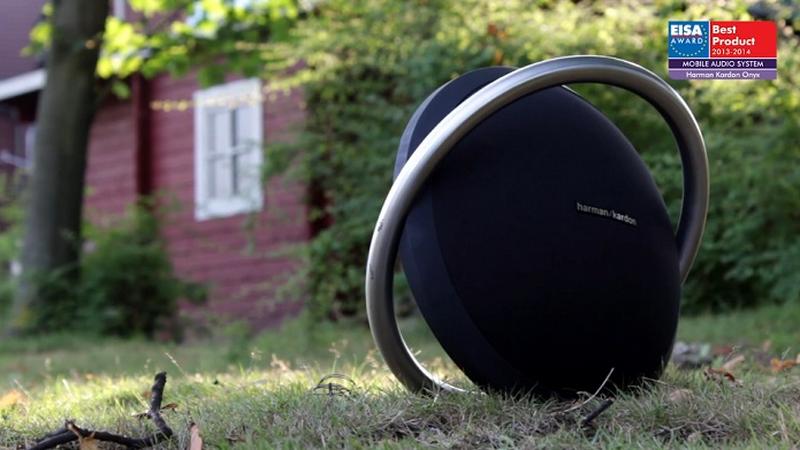
The Onyx looks a bit like an egg at least from the side, but the design as a whole including the steel handle would make it quite attractive within a modern interior, which is why I directly ordered an Onyx as soon as it became available.
The Onyx came in a big but surprisingly light box. I really expected something much heavier, but during unboxing you'll notice that most of the space is just taken up by air, as the speaker is rather compact with only added bulk due to the angled steel handle, which unfortunately is not rotateable, so that you cannot flip it in-line with the speaker to really make it flat for transport. Apart from the handle the speaker just measures 16cm at its thickest spot. It is a real pity that Harman didn't think of such a detail, as a rotateable handle would make the speaker much more convenient for transport so that you could just toss it inside a rucksack or bag. As it is now, it needs a bigger bag to really fit in.


I wouldn't like to carry the Onyx around without any protection despite the convenient carrying-handle. Although the materials are overall really of high-quality, the aluminium passive radiator or even the leathered-back could be easily damaged or scratched without any protection during transport.
I don't understand the choice for a leathered back. Although it might appear pretty slick together with the shiny passive radiator, most of the time you won't even notice it, as the speaker would normally be aimed towards the listener and not with the back-side. This is not a 360° sound system and sound degrades considerably when listened off-axis.

The price for the Onyx is quite steep (499$ or 499€) and among the highest for this kind of portable speaker. Even the go&play costs 1/3 less and I am sure the price for the Onyx could have been lowered, if the some parts were made of simple plastic. Apart from the leathered back the ring around the main body is of a rubbered material and contains all touch-sensitive buttons, while the front consists of a rather cheapish cloth-cover, that can also be removed if necessary.
For my own taste the black cloth-cover degrades the looks of the otherwise high-grade speaker. When touched it becomes dirty pretty fast, and I am sure the cloth will be the first part to show signs of wear, if the speaker is really taken outside often and not only used at home without being moved around. At this price level I would have preferred a wired mesh similar to the go&play to tell the truth.

If the cover is removed the acoustic core of the Onyx is revealed consisting of 2 full-range drivers and 2 tweeters as well as another opposing passive radiator at the front that works together with the one at the back to minize vibrations of the whole speaker. Both reinforce the low frequencies (the backwards movement of the active drivers) that would otherwise be lost within the speaker. A ported design as an alternative would probably be less efficient with such a flat and compact body.
I was a bit surprised to see the actual paper-cone drivers, as they look pretty cheap, like some simple speakers bought from Radioshack.

I expected Harman Kardon to use some more sophisticated and high-quality drivers. It also catched my eye that the drivers were not mounted totally centered but rather offset slightly within their openings. Maybe this is nitpicking, but we are talking about a pricy design-object, where I would expect a bit of perfection.

At the bottom back there are some connection ports as well as a WPS-button for quick router-connection. The Onyx does not only support a simple Bluetooth connection (including a quick NFC connection, which is pretty useless for Apple-users until Apple finally decides to support NFC) , but can also act as an Airplay speaker as well as a DLNA renderer. The Onyx is not bound to the Apple universe, but can equally be used from Android-devices or simple Bluetooth players which don't support any Wifi connection. Harman Kardon claims that the included Bluetooth protocol also supports the much superior Apt-X codec (which again is not supported by iOS devices yet and couldn't be tested by me).
I switched a bit back and forth between Airplay and Bluetooth and didn't notice any big differences in audio, despite only using the worse-quality AAC-codec for Bluetooth, but maybe the tested music was not that revealing.

To tell the truth I haven't figured out if the USB-port is only for charging external devices, or if it can playback music from any attached player as well, but I wouldn't use this feature anyhow because the ports are overall placed in a bit hard to reach place. Every time I wanted to attach the power-cord after having used the Onyx from battery, I always had to take accurate aim to actually fit in the cord. The space between the bottom part of the handle and the recessed ports is quite narrow. I would have welcomed a kind of additional charging cradle, where you could just place the speaker for simple charging. I am sure though, Harman would charge even more for such a feature...

The touch controls at the top of the speaker light all up as soon as the corresponding area is touched. The first time I tried to turn it on, I pressed every single area, including the WPS-button, but nothing happened. It seems you have to keep the area around the power-symbol touched for at least about 3 seconds, then the speaker comes to life! The symbols light up, but go off again after some seconds, the only lights that always remain lit are the power-symbol and the Wifi and Bluetooth symbol. It's strange that Harman didn't also keep the volume-symbols lit. There are 5 distinct volume-dots, that symbolize the current volume-level. If you turn the volume louder, one dot after the other will first brighten up, until it reaches full brightness, then the next dot starts to brighten.
Maybe Harman thought the touch-sensitive area as a whole would be enough and any user would just touch there and then swipe to the left or right in order to get the right volume. But it is not that easy, as you don't see where the minimum or maximum volume is before touching, you might touch the area in the middle and the speaker would scream up with a higher level than wanted. I still haven't found out, if you have to swipe to the right to turn it louder, or if it is enough to simply touch near the desired volume-area. You can also use the +/- areas (which are not lit either until you touch them), but you need to hold them pressed for about a second until the Onyx quickly jumps to a much lower or higher volume.
I found controlling volume through the touch-field being quite cumbersome. I didn't manage to tune volume fine enough like this. Either it was too loud or too soft, or it unexpectedly started to play near maximum volume so I rather preferred using the volume slider on my iPhone or even its volume buttons. The absolute volume level is mirrored on the player by the way (regardless if played through Wifi or Bluetooth) which is quite nice, as you don't need to deal around with 2 separate volume-levels, like you have to do on the Bose Soundlink for example. 2 separate volumes can lead to further sound-processing artefacts, for example if you turn your player to the minimum and turn the Soundlink to the maximum it will sound different, than if the speaker is set low while the player is maxed out. No such effects with the Onyx thank godness.

Establishing a wireless connection is not a big deal with the Onyx. Keep the Wifi-symbol touched for a certain time and the Onyx will setup an own Wifi-network which you can connect to from your mobile device or computer and setup the connection details to your router. By dialing in 192.168.1.1 into the browser you'll get access to the Onyx' configuration site, where you can also start a firmware update or even dig deeper into the settings through the manual configuration tab. A quicker method might be just pressing the WPS-button, but i haven't even tried it like that.
The same goes for Bluetooth, keep the symbol touched and the Onyx will jump into pairing mode.
Both types of connection are confirmed by the same loud "bleep" which is a bit too loud for my taste. If connection is lost or canceled another annoying tone is played. Bluetooth range is quite impressive. The Onyx did repeatedly pair with my iPhone, standing in the opposite corner of our house. Due to the confirmation tones this could be quite distracting, especially if it automatically tried to pair at night when everyone was already sleeping.
I have not figured out if you could turn off Bluetooth or Wifi completely in case you would like to save some battery, as Wifi seems to be active whole the time. The light just turns red if no connection is established but it still seems to be active, because when I return home with the Onyx it automatically connects to my network as soon as it is close enough.
After a certain time the Onyx automatically jumps into standby-mode when no music is played. It is still shown as an available Airplay device, but the Powerlight is red, and the speaker probably running in some kind low-power mode.
If the speaker is streaming through Bluetooth currently while another stream is started through Wifi for example, the newer stream has priority and takes over the speaker.
So, how does it sound?
I hoped it would at least knock my socks off in the same way as the go&play did, when I heard it the first time many years ago. The Onyx sounds good, but it didn't impress me that much as many other speakers did in the meantime. It is more expensive than many other contenders but sounds only marginally better, in case of the go&play even worse.
But let me explain first. When I unboxed the Onyx after coming home from work it was already quite late until i finally managed to turn it on. I couldn't really crank it, but rather had to listen at lower levels thus remained pretty unimpressed.

For direct comparison I put the minuscule Bose Soundlink Mini (which is by far my favorite ultraportable speaker now) besides and switched back and forth between both with matched levels only to find out that the Mini put out a more serious and mature sound than the Onyx. At lower levels (I would say comfortable room-volume for background listening) the Onyx sounds hardly any better than a good kitchen radio with a bit of a honky sound. The sound remains quite mid-focused without any mentionable bass and even treble remains a bit recessed. We are talking about levels within a frame of 15-20% on the Onyx' volume scale, which corresponds to about 30-40% of Bose's Soundlink Mini volume. Of course the Onyx can play much louder than the Soundlink Mini (I would say it reaches about twice the loudness), which is not the question here. If you want some low background music the Onyx just cannot impress. It only starts to really live up to its expectations if you turn it above 30-40%, but it performs best and sounds perfect at about 50-60%, which is pretty loud already and considerably louder and more powerful than the Bose Soundlink Mini at its maximum volume for example. That's still quite impressive for Bose considering the drivers of the Soundlink Mini are just about the size of the Onyx' tweeters.
In the following video I tried to compare both the Onyx and the Soundlink Mini with matched volumes as close as possible. The Onyx was playing at 35%, while the Soundlink was about 70%. Overall the Onyx has a more defined sound, but the Soundlink Mini keeps up pretty well. At lower levels the Soundlink mini manages to produce a more powerful sound, while the Onyx has the edge at higher levels and can also play much louder.
I am not sure if the weaker performance at lower volume is because of the higher inertia of the passive radiators, which don't become fully effective until higher levels are reached, or if Harman just didn't tune the DSP well, as I didn't notice such a strong volume dependent sound degradation with the go&play for example. Harman or JBL are known for their DSP processing and dynamic bass adjustment, but in case of the Onyx something seems to have went wrong.

When directly compared to the Harman Kardon go&play, the go&play produces a deeper and fuller sound. The Onyx might sound a bit more natural, but the go&play is much more enjoyable, bass is tuned lower, i would assume about 10Hz lower. The technical sheet is claiming 55Hz as the low frequency limit for the Onyx and this seems to be more or less the reality. Although you can still hear a bit of "vibration" below 50Hz, it hardly has any amplitude any more. The lowest usable bass-frequency seems to be around 50Hz, while I would estimate the go&play of being able to play down to 40Hz. The Audyssey South of market Audiodock even had usable 35Hz at lower volumes, despite being not really much larger in volume than the Onyx. Interestingly the Audyssey had neither passive radiators nor a bassreflex port and therefore impressed me even more performancewise than the go&play, which was the reason why I finally sold my go&play some years ago. Unfortunately my Audyssey died after one year and I couldn't get an exchange from the store, so I returned it completely, although it impressed me a lot as a speaker.
I tried to compare the Onyx to some other speakers I don't currently own and took it to a store with me, where I was able to listen to it side by side with a Bose Sounddock Portable (I already sold mine some time ago otherwise I would have been able to compare it at home as well), a Libratone Zipp (also sold) and a Cambridge Audio Minx Air 200.

The Onyx sounded more powerful than the Sounddock Portable at higher levels, but as expected the sound was less impressive than the Bose at lower levels. I would say that both played more or less on the same level, with the Onyx having a bit more punchy bass, but the Bose sounding clearer in treble. Not a bad result for Bose, as the Sounddock Portable acoustic design is already several years old, but still holds up pretty well.

The Libratone Zipp lost completely. When the Onyx was at its best at about 50% volume, the Zipp already distorted on heavier bass sounds, nowhere able to reach the levels of the Onyx. The Onyx had a much more punchy sound, the Zipp sounding hollow and tinny. The Zipp had clearer treble due to the ribbon-tweeters, but overall sound was artificial and thin, especially regarding mids.

The Cambridge Audio Minx Air 200 is in another speaker-category, it is larger, not meant as a portable speaker, but costs about the same as the Onyx, that's why I wanted to compare both anyway. At normal levels both sounded pretty similar, it was only at higher levels, that the Minx Air 200 started to have an advantage with a more powerful bass, but I was not able to really listen to both at high levels for long not to be kicked out of the store.

Overall there were no big surprises even compared to many other speakers. The Onyx definitely sounds good, but it doesn't have the "wow"-factor, many other speakers manage to create.
It cannot compete by any means with my Philips DS9800W Soundsphere speakers which I currently use as my main listening solution as the Onyx sounds rather like a mono kitchen-radio when directly compared. It was only at high levels and bass-heavy music that the Onyx produced some distortion. It was not severe, but noticeable. Also bass is not that strong anymore at higher levels than 70%, so that the speaker plays loud, but without the bass power you would expect.
I also noticed slight vibrations of the enclosure with particular piano-notes, nothing too serious, but pure piano music at louder volumes could sound bad on the Onyx. First I thought the front cover was to blame, but it seems the drivers are causing the vibration.
Here an additional outdoor video showing off the Onyx, volume was between 50-80%, where the Onyx sounds best:
My hope was that there were some further adjustments available from the Harman Kardon remote app. I downloaded and installed the app for iOS only to notice that it crashed every time I wanted to start it. Later I discovered that the app indeed worked but only through a Bluetooth connection while Wifi remained turned off. At least now I could try the features, but noticed that there are hardly any additional parameters available for tweaking. The app acts rather like an additional music player.


At the main page all available players appear, in my case only the Onyx. But sometimes the Onyx din't appear at all, I had to restart the app or the speaker so that I finally had it selectable in the app. The app has its own device control panel where you can see the remaining battery as well as the current streaming mode. There is also a stereo-widening option, which doesn't do much harm to the sound, but doesn't broaden it up really much either. It was turned on from the beginning and I kept it turned on, because it sounded quite acceptable without any annoying artefacts (like Liveaudio from the Jambox for example), but don't expect any miracles. The Onyx still sounds rather like a mono sound source, except if putting the nose against the cover.


Although there is another EQ-like symbol at the bottom right of the app, the corresponding panel is empty in case of the Onyx with the exception of a single volume-slider. Maybe there will be further updates which will allow additional EQ-tweaking, but as there are several other Harman devices listed, I would rather assume that those devices might have some further EQ-options which are simply not available for the Onyx. But at least you can even turn off the speaker remotely form the app, if really needed.
My wish would be some simple "loudness" switch, which would compensate for the sound-loss at lower volumes. So far only Bose, B&O or Audyssey really seem to care to optimize sound for low volume output.
Battery life was around the promised 5 hours. I tried to listen at levels near 50% where the Onyx sounded best streaming through Bluetooth and managed slightly above 4 hours until the speaker turned off on its own. I also tried mixed streaming through Wifi and Bluetooth at lower levels (about 20-30%) and it played for 5 and a half hours. So the streaming-unit seems indeed to be the limiting factor here as Harman promises 8 hours with wired connection. A pity as 4-5 hours of portable use are certainly not enough for a day at the beach or a fireside-party in the evening where louder levels might be necessary.
Not sure what happens after some years of usage when the battery starts to lose its capacity even more. It doesn't seem to be replaceable at all. This is quite a drawback with a product costing that much. Maybe the Onyx can be sent in for a replacement at a service-center.
To conclude I would claim that the Onyx is definitely a nice sounding speaker that has its spacy looks but it doesn't give any surprises regarding sound. It can play pretty loud but has its limits, as sound starts to deteriorate above 75%. It also sounds quite sub-par at low levels, so you always feel forced to turn it louder.
I wouldn't recommend the Onyx as a portable Boombox but at the same time there are also much better stationary speakers, like the Philips Soundsphere which meanwhile can be had for about 320$. If not the hardware issues which I also experienced with my model, this would indeed be one of the best sounding Airplay speakers I would recommend to anyone.
As a portable Boombox I would definitely choose the Klipsch KMC-3 over the Onyx. It is larger for sure and doesn't look like a UFO, but it puts out a much more impressive sound and it is cheaper too. The missing internal battery of the Klipsch can be easily fixed with an external Powerbank. Not sure about the new and smaller KMC-1, as I haven't heard it yet, but I doubt the smaller Klipsch can compete with the Onyx regarding high volume output. Even the old Sounddock Portable might be a better solution as it produces similar sound as the Onyx, but is smaller and has better battery life.
I was a bit disappointed with the overall quality of the Onyx. It seems to cheat top-quality but at closer look makes a rather cheap impression. There's a catch with the price which is overpriced by 30-50% in my opinion. The Onyx does by no means produce sound worth 500$ and the leathered back as well as the shiny passive radiator don't compensate for this.
+ spacy and elegant design
+ compact
+ precious materials (especially at the back)
+ all possible wireless streaming modes available (incl. NFC and Apt-x)
+ good sound with punchy bass at medium levels
+ can play pretty loud
+ impressive Bluetooth range
+ app support
+ mirrored volume on speaker and streaming device in all wireless modes (incl. Bluetooth)
- too expensive
- cheap front cover
- handle cannot be rotated for an even flatter design
- sound unimpressive at lower volumes
- starts to sound harsh and distorted at high volumes
- unimpressive battery life (4-5 hours)
- battery not replaceable
- iOS app crashes when connected through Wifi
- no further sound customization through the app
- loud confirmation tones when connecting through Wifi or Bluetooth


domingo, 27 de setembro de 2015
Portable Lautsprecher von der IFA
Jawbone hat die Mini Jambox vorgestellt, die in etwa halb so gross bzw "dick" ist wie die normale Jambox. Keine Ahnung wer die Zielgruppe sein soll, außer vielleicht wie im Video zu sehen: hippe schlanke Mädels auf einer Yacht, oder durchtranierte Rastatypen, die am Hafen auf erstere warten.
War bereits die normale Jambox ein überteuertes billig wirkendes Spielzeug, was vor allem mit dem Erscheinen des Bose Soundlink Mini nochmals verstärkt wurde, wird die Mini Jambox kaum besser klingen als die größere Version, das jedoch zu einem stolzen Preis von 179,-$
Ich vermute im Inneren die selben neuen Schallwandler von Soundmatters, die auch im schlanken FoxL Dash7 zum Einsatz kommen.
In vielen bunten Farben und Mustern erhältlich, soll die Mini Jambox in den nächsten Wochen zu kaufen sein. Ich bin echt gespannt, wie die ankommen wird, wo es bereits um einen Bruchteil ähnliche vermutlich sogar besser klingende Lautsprecher von Cambridge Audio zu kaufen gibt.

Auch Jabra hat nun eine Mini-Version des Solemate vorgestellt. Hat mich schon der große nicht wirklich begeistert, wird der kleine, der diesmal wohl eher der Größe der normalen Jambox entsprechen wird, wohl ähnlich schlecht oder noch schlechter klingen:
 Interessanter sind da schon die Neuvorstellungen von JBL bzw. Harman Kardon, wobei ich hier den Onyx am aufregendsten finde, der sogar ein klein wenig vom Designerbe des go&play fortsetzt:

Der Onyx soll sich mit allen derzeit aktuellen wireless-Protokollen verstehen, darunter Bluetooth mit Apt-X Unterstützung, NFC, aber auch Upnp oder Airplay. Der eingebaute Akku soll 6-8 Stunden Musik erlauben (hier driften die Angaben etwas auseinander).
Mit 2 Tieftönern, 2 Hochtönern, sowie 2 Passivradiatoren aus Aluminium ausgestattet, die von einem 60 Watt Verstärker angetrieben werden, könnte das futuristisch wirkende Ufo durchaus ernsthaften Klang liefern. Leider ähnlich ernsthaft der angekündigte Preis von 499,-$
Trotzdem könnte der Onyx eine richtige Alternative zu klobigen Boomboxen sein, wenn er ansatzweise die Klangfülle vom go&play erreicht, denn der Onyx wirkt durchaus kompakt. Schön wäre es gewesen, wenn man den Edelstahlgriff zusätzlich plan mit dem Gehäuse eindrehen könnte, um für den Transport etwas Platz zu sparen.

Ler mais »
War bereits die normale Jambox ein überteuertes billig wirkendes Spielzeug, was vor allem mit dem Erscheinen des Bose Soundlink Mini nochmals verstärkt wurde, wird die Mini Jambox kaum besser klingen als die größere Version, das jedoch zu einem stolzen Preis von 179,-$
Ich vermute im Inneren die selben neuen Schallwandler von Soundmatters, die auch im schlanken FoxL Dash7 zum Einsatz kommen.
In vielen bunten Farben und Mustern erhältlich, soll die Mini Jambox in den nächsten Wochen zu kaufen sein. Ich bin echt gespannt, wie die ankommen wird, wo es bereits um einen Bruchteil ähnliche vermutlich sogar besser klingende Lautsprecher von Cambridge Audio zu kaufen gibt.

Auch Jabra hat nun eine Mini-Version des Solemate vorgestellt. Hat mich schon der große nicht wirklich begeistert, wird der kleine, der diesmal wohl eher der Größe der normalen Jambox entsprechen wird, wohl ähnlich schlecht oder noch schlechter klingen:
Der Onyx soll sich mit allen derzeit aktuellen wireless-Protokollen verstehen, darunter Bluetooth mit Apt-X Unterstützung, NFC, aber auch Upnp oder Airplay. Der eingebaute Akku soll 6-8 Stunden Musik erlauben (hier driften die Angaben etwas auseinander).
Mit 2 Tieftönern, 2 Hochtönern, sowie 2 Passivradiatoren aus Aluminium ausgestattet, die von einem 60 Watt Verstärker angetrieben werden, könnte das futuristisch wirkende Ufo durchaus ernsthaften Klang liefern. Leider ähnlich ernsthaft der angekündigte Preis von 499,-$
Trotzdem könnte der Onyx eine richtige Alternative zu klobigen Boomboxen sein, wenn er ansatzweise die Klangfülle vom go&play erreicht, denn der Onyx wirkt durchaus kompakt. Schön wäre es gewesen, wenn man den Edelstahlgriff zusätzlich plan mit dem Gehäuse eindrehen könnte, um für den Transport etwas Platz zu sparen.
 |
| (c) Cnet |
Best portable Bluetooth speakers (Oluv's personal favorites 2014)

With this list I want to show you my personal favorite portable speakers that I use on a regular basis including some explanation why I have chosen them over some others and when I use this instead of that. It's been quite a long time I wanted to prepare a kind of best-of list of all portable speakers I know or that I have heard. But after having heard so many, I thought that a real best-of is simply not doable as each speaker has its own strengths or weaknesses. After all those years it seemed I would still not be able to find a single speaker which would satisfy all my needs not until I have heard the new Denon Envaya Mini, which mixed up my whole perspective and made my whole list until now pretty useless. The Denon Envaya Mini finally persuaded me to sell all other speakers I currently own, including JBL Charge 2, Fugoo, Sony SRS-X3 etc. Therefore I would like to present *drum roll* the Denon Envaya Mini as my current favorite portable speaker.
As it had already taken me some time to prepare this whole list, I will nevertheless add all the other speakers below, although I probably wouldn't consider them at all anymore. Please let me clarify that my main goal is high audio quality. Most will have probably noticed that I have a weekness for a full-bodied sound. There must be at least some base for the music with enough bass to make it sound satisfying, otherwise I cannot enjoy music and prefer not to listen at all. I don't care about speakers that can play screamingly loud but fail completely at lower levels, or speakers with tons of nice features that only sound like my old clock radio.
Denon Envaya Mini

Buy it from amazon,com amazon,co.uk or amazon,de

I doubt there is any better sounding speaker available that small right now, therefore the Denon Envaya Mini gets my first vote to become the overall "winner". It is extremely portable, splash water resistant and has a professionally close to hifi tuned sound. It is not the loudest speaker nor the one with the biggest bass, but it sounds as close to flat as possible at that size with full bass response down to 80hz which appears even deeper thanks to some psychoacoustic algorithms. There is some stereo separation and the Envaya Mini sounds perfect at low and at highest levels with hardly any distortion or dynamics compression at all. It should satisfy 70% of most needs, just if you need higher loudness, you will probably wish for something more powerful, this is where my Infinity One jumps in, which you can find next in this list below.
Another alternative to the Envaya Mini would be the the JBL Charge 2. Until I heard the Denon, JBL Charge 2 might have been close to a "near-perfect" portable speaker, but unfortunately JBL managed to screw it up making it unsable at low levels and unlistenable with many tracks because they cause noticeable distortion, otherwise the JBL Charge 2 would probably be the best sounding speaker in its class that I would recommend over all the others more or less on par or above the Denon. I feel still so sorry about all the issues it suffers from, and that JBL doesn't really care to offer any fix. It seems they just recently started to sell a new batch of devices, which don't suffer from any distortion, although they still seem to have some issues at lower levels. Apart from that I also hate the status tones the JBL Charge 2 will play if you turn it on, or when it will connect to a device. The tones are so annoying that you cannot even turn it on in a silent enviroment. The JBL Charge 2 is not usable at low levels, it will sound just poor with bass sounding strange and with additional artefacts noticeable during the first 4-5 volume steps. I usually welcome a mirrored volume control between speaker and device, but in case of the JBL Charge 2 the volume steps are very rough and the speaker becomes too loud too quickly. The JBL Charge 2 has pretty non directional treble response. It still sounds quite good from above or from the side unlike most other similar speakers. I also like the fact that the JBL Charge 2 will retain more bass and sound more dynamic than most other competing models. Even at maximum volume you will be able to hear every drum-kick attack, while the Bose Soundlink Mini or the Sony SRS-X3 will compress them away. Sometimes I would prefer it even louder, especially outdoors, that's why I finally settled for an Infinity One described below.
Other speakers in this smaller class worth having a deeper look: I really liked the Fugoo a lot as an all around speaker but also for use at home from room to room etc. It might not be a very loud speaker and bass could take some stronger punch, but it is small enough to be carried around and thanks to its "jackets" is rugged to be just tossed inside some bag or stuffed inside a jacket pocket without any additional protection or pouch needed. Unfortunately none of the jackets does have any clip-on option without the additional mount-pack. It would have been great if Fugoo had included some simple lug in any of the jackets, so that the speaker could be quickly clipped on somewhere. The Fugoo is also one of the few speakers that really withstands a complete submerge under water, it is not just splash resistant like many others, but entirely waterproof.
Bluetooth connectivity is great and the Fugoo connects automatically to any found device unlike most other speakers, which seem to be still waiting for the latest one.
I also like the fact that the Fugoo remains nearly silent during operation if all voice prompts are disabled. Overall the sound of the Fugoo is quite full-bodied, it is not overly bloated but pleasant to listen to, with a similar bass-amount to many larger speakers like Soundblaster Roar etc, although the sound starts falling apart a little bit above half volume which is not very loud and does not come close to the sound of the Denon Envaya Mini, which is much more serious, and much louder at the same time. If the Fugoo was slightly louder overall with slightly more bass, it would be definitely on my top list if I had to pick just one single speaker, but now the Denon Envaya Mini took this honour and the Fugoo has to go. Another strong contender loved by ones, hated by others is the Bose Soundlink Miniwhich has no problems like the JBL Charge 2, but I found the sound to be too muffled and too directional and sometimes too boomy. The Sony SRS-X3 might be another worthy alternative and I think it sounds best for low volume listening, especially because you can fine-tune the final bass amount with the input-volume of your streaming device, a welcome side effect of the dynamic sound-processing, which becomes confused with lower input levels and dials bass back, because the speaker output needs to be raised. The X3 has some problems at higher volume levels though and battery life is not as stable, especially when cranked. Unfortunately both Sony and Bose play some kind of annoying tones if they are either turned on/off or if they establish a Bluetooth connection. Another alternative might be the Bose Soundlink Colour. The sound is not as mature or not as refined as of all the others, but it is nevertheless a pretty solid speaker with a nicely tuned sound for all volume levels. It will sound good at low and at high levels, without any side-effects or artefacts. Treble is less directional than that from the Soundlink Mini and the Soundlink Colour will not sound that boomy in most cases although mid-bass has quite an obvious boost with some stronger resonance, which can start sounding annyoing with some particular tracks. Also Bluetooth connectivity is one of the best I had experienced so far with automatic reconnection to 2 previous devices after power on, just don't expect any stereo sound as the Soundlink Colour is rather a stereo speaker with mono sound.
Infinity One

Still only available from amazon,com, funnily the Infinity One does not sound really that much better than the Denon Envaya Mini, the Infinity One's sound is just more powerful, which is not surprising given the size being 3 times as large. the Infinity One is basically a blown up JBL Charge 2. The sound is similar between both, with the Infinity One just sounding more blown up. The Infinity One is a bit too large and heavy to be carried around whole the time. But if you know that you will need a portable speaker which manages to deliver enough power at higher levels too, the Infinity One might be the best choice. When the Denon Envaya Mini is already at its top volume, resulting in some heavy bass-loss, although perfectly usable without any distortion, the Infinity One will still have enough headroom, although the Infinity One will suffer from some intermodulation distortion at these higher settings, but the Infinity One will be able to keep much more bass at comparable loudness settings and maximum volume should still be loud enough for any smaller outdoor event. The stronger intermodulation distortion at high levels is the biggest letdown of the Infinity One, it sounds more enforced than the Soundlink III and many bass-heavy tracks may start sounding really harsh because of this, while others might still sound perfect, Infinity should have added some simple tweeters to the front drivers, as the back drivers sound pretty clear as they are fitered for higher frequencies, where intermodlation becomes most obvious. Similar to the JBL Charge 2 the Infinity One will also manage to retain the dynamics of kickdrum attacks, unlike the Soundlink III, which will rather iron out any stronger punches. For house-music I would prefer the Infinity One over the Soundlink III, which might be better for Jazz and acoustic stuff due to less intermodulation distortion problems.
Unfortunately the Infinity One has the same loud status tones and the same mirrored volume control with even rougher steps than the JBL Charge. In case of an iOS device the volume control is not fine enough to really allow any sensitive adjustment. Thank godness the Infinity One does not suffer from any of the processing artefacts which plague the JBL Charge 2. I think that the Infinity One delivers the best performance of all speakers I have tested in this larger speaker-class aroung 1kg, including Bose Soundlink III, Beats Pill XL, TDK A34, Loewe Speaker2go and even the B&O Beoplay A2, which has its own qualities and problems, thus as total package I just regard the Infinity One as the best option right now.
A big problem for all non U.S citicens might be that the Infinity One is only offered in the U.S so you will have to import it on your own if you live outside, which is what I finally did. But for casual listening at home I prefer the Denon most of the time, even though it has slightly less bass, it sounds more natural with more stereo separation and is much easier to carry around.
Other possible alternatives: Bose Soundlink III sounds quite similar to the Infinity One, but has a more directional and more "edgy" sound while the Infinity One sounds rounder and more open. The Infinity One also has the option to be charged through USB in case of need and it can charge external devices too. Overall I prefer the Infinity One over the Bose Soundlink III, although the Bose has the better tuning for low levels with a more profound sound and obvious intermodulation distortion should be less of an issue. Other alternatives might be the TDK A33 which is pretty cheap now or the newer A34 as both are pretty balanced sounding speakers unfortunately with a pretty bad battery and a questionable charging logic. I never manged to make the A33 play for longer than 6 hours even at lower levels, the A34 seems to suffer from the same problem. The Soundblaster Roar is very similar to the TDK A33 in sound but has tons of additional features which you might need or not need. It doesn't play as loud as the TDK, but overall it is the better speaker I think. It doesn't sound as full bodied as the Infinity One or the JBL Charge 2, but the sound is still quite nice, although it won't knock your socks off.
You might also like the Denon Envaya which sounds quite similar to the Bose Soundlink III although not quite as loud but also cheaper. The B&O Beoplay A2 would have been my personal favorite if battery life was more predictable and the sound more constant on higher levels. I really like the design and sound tuning is simply impressive, but I couldn't live with the added distortion on many tracks especially at the given price being one of the most expensive speakers shown here. I would also like to add the Beats Pill XL, which is not a very good sounding speaker per se, but a very powerful one with great features, wireless stereo pairing etc. It is still one of the loudest I have heard at this size and manages to sound pretty controlled when the others are already struggling or reaching their limits with the Pill XL still being much louder than all of them.
Bose Soundlink Wireless Music System 
Although I currently don't use it that much, I still think that this old and discontinued Bose system is a spectacular and underrated portable Bluetooth speaker. It is based on the Bose Sounddock portable which was also discontinued in the meantime but with Bluetooth instead of the Apple-dock.
Thanks to its flat design it is still pretty portable despite being larger than the Infinity One and with just 2kg including the swappable battery it should find its place inside any even smaller rucksack. The Bose Soundlink Wireless Music System is one of the most powerful systems at this size. The amplifier delivers 40Watts (unlike the 25W of the Infinity One), and thanks to Bose's DSP processing they manage to push the loudness level quite above the limits of what the 2 fullrange drivers are able to handle by applying some stronger dynamics compression and dialing bass back. Although there is some stronger distortion at maximum volume the Soundlink Wireless Music System nevertheless manages to fill a large outdoor area with sound if you don't want to carry any larger boombox with you. It sounds very full bodied with the deepest reaching bass although it has a tendency to sound a bit muffled, especially at lower levels and off-axis.
A possible alternative might be the IK Multimedia iLoud, which is able to reach a similar loudness, but not without distortion either. Unfortunately the iLoud won't sound that full-bodied at lower levels and the built in battery seems to have some issues not being able to hold a charge after some time of usage according to my friend who had used his quite often.
Another interesting speaker might be the Harman Kardon Onyx or the much cheaper Onyx Studio which omits auxiliary input, Airplay and DLNA compared to the expensive version. They sound slightly better and are more powerful than the Bose, but are a bit lacking at lower volumes. They are also larger and not that easily portable with the battery life hardly exceeding 4-5 hours at high volumes.
If you need still more power and more loudness, you must have a look at all the larger systems like the Klipsch KMC-3 or some Pioneer Steez units or the JVC Kaboom series etc. But nearly all of them need extra batteries for portable use and will quickly exceed several kilos of weight. Maybe the new Teufel Boomster could do the trick as it has a built in battery which can be even extended by some additional AA-cells. So far I didn't feel the need for such a unit, it is just overkill for home use, I previously had the Altec Lansing IMT800, but didn't use it much because of the size and the hassle with batteries. But my friend loves his KMC-3 and uses it regularly for outdoor parties with friends.
What is still completely missing though are speakers that can be easily put inside a pocket, or attached somewhere thanks to a dedicated clip or carabiner without adding any bulk or becoming tedious. Most of these I have tried so far sound rather tinny, not really comparable to those above, although I am sure with some clever DSP processing and really high-quality drivers even smaller speakers than the Denon Envaya Mini could be brought to respectable output. Here are my best findings for this class:
TDK A12

I think the TDK A12 (micro Trek) produces quite a balanced sound for being that small. It is not the loudest speaker at this size, but it just sounds "right". There is some upper bass which makes it sound appealing, but the TDK is not able to produce any deeper bass, thus it is not really full-bodied and quite a bit too thin for my own taste, but still better than not having a speaker at all. If you put it flat on some resonating surface, you can boost basst slightly, but the passive radiator doesn't really play anything below 100Hz, so don't expect any miracles like with many other vibrating speakers or like with the FoxL Dash 7 that are tuned much lower, but won't produce any hearable bass until they suddenly sound much more mature depending on the surface they are placed on, as shown in my example video for the FoxL Dash 7. Unfortunately most of the time there are no suitable surfaces around outdoors for enhancing the sound.
Therefore the TDK seems to apply some "virtual bass" algorithm. It sounds a bit as if the lower frequencies not reproducable with the tiny driver were subtly added transposed one octave higher (similar to what MaxxBass is doing). The A12 manges to give an even more full-bodied impression than the similar JBL Clip, although bass reaches considerably lower on the JBL Clip, when looking solely at the frequency response measurements. There is also some bass compression going on, maybe a side-effect of the virtual bass algorithm, but when directly compared it is quite noticeable that the TDK does some processing, which is not a bad thing, as any unwanted artefacts are still kept to the minimum.
The TDK A12 has no distortion even at maximum volume, but there seems to be some sample variation as I have tested several different units and on many of them the passive radiators started to rattle heavily at higher volume levels with bass heavy tracks, the resonance-frequency seems to be around 125Hz where rattling is strongest. Because of the single passive radiator at the back side the TDK A12 also has a tendency to vibrate or even creep around when put on certain surfaces. If you attach the included carabiner, this may rattle against the body at higher loudness-levels, that's the drawback of single passive radiator designs.
Battery life is somewhat short, especially at high volume. A nice feature is that you can pair 2 of them for true wireless stereo, in fact I have 2 of them and both cost me less than 60€. Strangely stereo pairing doesn't work that well sometimes. I am not sure if this is the speaker's fault, or if the Bluetooth connection of the iPhone is too blame here, but sometimes when in wireless stereo mode the audio quality is reduced considerably resulting in a sound which resembles that of a lower bitrate mp3-file. Sometimes only one will play, although both confirmed the connection. I have not found any regularity, but in case they behave unexpectedly, I have to go through the entire pairing process again to get rid of it.
Other similar speakers to consider: JBL Clip produces a similar overall sound but can play quite a bit louder. The JBL Clip can be daisy chained with another one with its built-in wire and it has speaker phone included. Due to its rounded design it is easier to put inside a pocket and the carabiner is already built in unlike with the TDK A12, which has the carabiner separate. The battery life of the JBL Clip seems to be even shorter than that of the TDK A12 though, but due to the included bassreflex port instead of the passive radiator the JBL Clip won't vibrate even at highest loudness levels.
I would regard the Mini Jambox as another alternative, although nothing special it is still able to deliver quite a solid sound and will also sound rounder and more full-bodied than both the TDK and JBL, although the maximum possible volume is quite limited. I have yet to find any better sounding speaker that small. Most of them might be louder for sure, but they just don't sound good at normal listening levels. Of course I welcome any other tips!
3 years ago it was still unheard of a beverage can-sized speaker that it would be able to produce any bass down to 60Hz. After the Soundlink Mini which was pretty unique at the time of its release there are meanwhile some other alternatives available. The portable speaker market is evolving pretty quickly. So please just take this personal list as some temporary snapshot which may suddenly turn around with any new speaker released, just like it did, when I heard the Devnon Envaya Mini.
There are some interesting speakers on the horizon like the electrostatic BenQ treVolo (formerly known as eVolo) or the Massfidelity Core, there is also some rumor about an upcoming larger and more powerful speaker from Fugoo, but I am not sure if I will be able to receive any of those units for a review. As soon as I can get my hands onto something interesting I will let you know.
Subscrever:
Mensagens (Atom)