Mostrar mensagens com a etiqueta Creative. Mostrar todas as mensagens
Mostrar mensagens com a etiqueta Creative. Mostrar todas as mensagens
domingo, 27 de setembro de 2015
Review: Creative Sound Blaster Roar SR20 - the Swiss knife speaker

I got contacted by Creative lately if I would like to review a new speaker from them, the "Sound Blaster Roar SR20". I started reading a little bit about it and as some first reviews were already online I got pretty excited, as it seemed to be an interesting portable speaker with infinite and even some funny features.

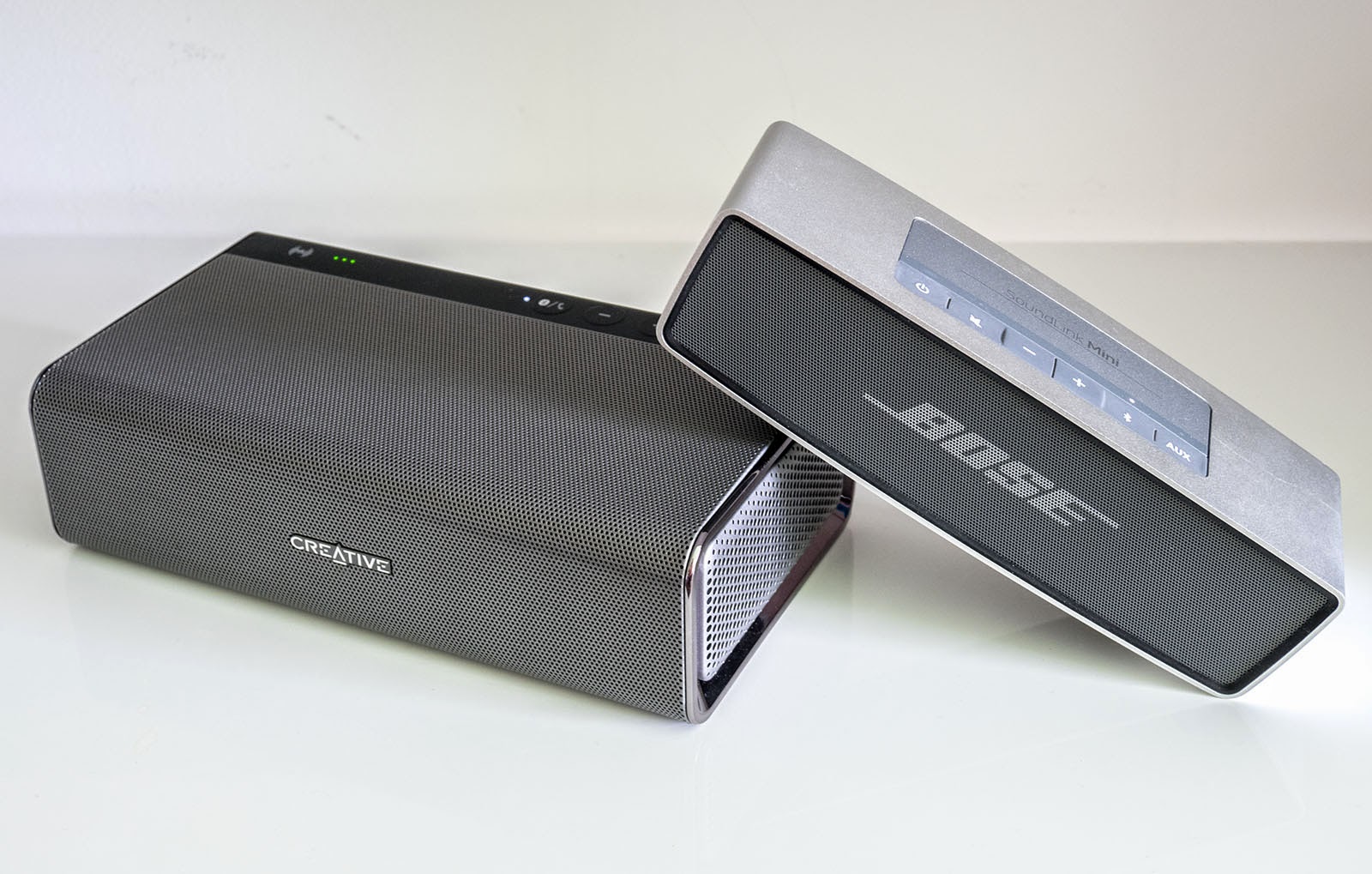
But first some facts: The Roar as I will call it from now on, is a compact portable battery driven Bluetooth speaker about the size of a book. The Roar is not a big speaker, but compared to the Soundlink Mini the Roar is about 2.5 times larger in overall volume. It is rather comparable to the original Bose Soundlink or TDK A33 being a bit "fatter" but overall shorter. It weights 1.1kg which is similar to the other competing speakers this size. It is driven by 3 active drivers (2 tweeters and 1 mids/bass driver) and 2 opposing passive radiators and it has some really strange features I have never seen so far in any other speaker.

There is a built in alarm, which makes you sound like a police-car if turned on, or a "life saving mode", which plays random noises at random intervals to keep you awake, there is also a sleep mode, which gradually turns the volume down for 15 or 30 minutes. But the more useful features are a built in microSD slot for music playback or even for audio recording. A built in handsfree is self-evident, and you can use the microphone, aux-in, or Bluetooth signal as source for recording, even phone calls can be recorded. The speaker has NFC capability, and supports Apt-X for best audio quality. There is an USB-port for charging external devices (devices are even charged when the speaker is turned off), and there is a micro-USB port, which makes the Roar act as an external audio-card when connected to a computer or as a micro SD-reader. Enough features? No, there is another, although the Roar is usually charged by an extra charger, it can also be charged through USB, although charging should take considerably longer like this. And last but not least, the Roar is equipped with an own Roar-button, just like a volume-knob that goes to 11. Also worth mentioning is that the Roar can connect to 2 Bluetooth sources simultaneously, which means that you can stay connected from 2 devices at the same time, as soon as one device stops playback, you can start playing from the other without the need of repairing.
In fact the Roar is just missing a built in flashlight or coffemaker to really make it a Jack of all trades. Feature wise the Roar is probably the best equipped Bluetooth speaker I have seen so far, but I asked myself if the Roar can also convince on the audio side.
 I have heard some speakers from Creative that really sound pretty damn good, I had even bought a set of Creative T12 speakers for my mother-in-law, so that she could listen to some music wirelessly from her Ipad. I was pretty sure the Roar would also deliver and was waiting eagerly to try it out in person.
According to Creative the Roar should become available in Europe later in June and should cost 149€ or 199$ respectively, which is quite a competitive price, considering all the bells and whistles the speaker has built in. My review sample came even with an additional carrying bag and with an micro-SD card. From what I know the bag is going to be an extra, and I doubt the SD card will be included either.
Normally I would have already disregarded a speaker if it had a built in alarm or "life saving mode" rather classifying it as some cheap useless trash (like all those junk-shops in Vienna at Mexikoplatz from the 70s were selling). But the Roar doesn't have any of these attributes, the quality of built is really high and the overall look is pretty elegant. In terms of look and feel, the Roar is indeed a top-notch prodcut. Even the box left some classy impression and reminded me a bit of Apple and their way of packaging.

Inside the box you will find the speaker, the power supply including 2 different plug-adapters and a USB-wire beside some quick-start manuals and warranty-cards. It is a pity that the carrying bag is not included as well, as it gives quite a bit of protection to the speaker when on the go, without compromising on sound. It even looks quite good, all the openings at the back are left free, with the rest of the speaker being covered entirely. You can just leave the speaker inside for listening and don't need to take it out every time, the used materials seem to be acoustically transparent.


In contrast to most other peakers with similar proportions so far (from Bose, TDK, Loewe, Sony etc...) the Roar doesn't stand upright but rather lies flat. The tweeters are at the thin front, while the single mids/bass driver fires to the top, both the passive radiators aim to the sides. This driver configuration should fill any room best as audio is spread to all sides (except to the back). And thanks to this design the Roar will never fall over unlike all the other speakers, which need additional feet or covers to really stand upright. You could take the Roar on the road and just put it on the dashboard, it should stay there. Don't do this with any of the others, trust me, I tried this with the original Bose Soundlink or TDK and the only place where they (mostly) keep still in a car is on the passanger's seat leaned against the back-rest.

Because of this its design the Roar has a larger footprint which has to be considered when placing it somewhere. While I could place the TDK A33 even at some narrow shelf or slot, the Roar needs more space to really lie flat. You could try placing it vertically like a book, but this should compromise sound as one of the passive radiators would be covered, and you would lose stereo imaging, but interestingly I didn't notice lots of problems like this, at least at normal levels. Due to both passive radiators being mounted in an opposing direction, you won't get much rattling or vibration from the speaker and it won't dance around like the TDK A33 at high levels.
The bottom has some slim rubber strips, although I would have preffered the whole bottom covered, as the Roar is still a bit slippery and could slide off the dashboard, when used in a car. I had it in my car several times and had to put it on an additional non-slip mat.

The Roar is designed with the most important controls easily reached at the top, namely the power button, as well as both volume buttons and the pairing button, not to forget the "Roar"-button. All other controls are at the back of the speaker. The Roar even has track-control buttons, but these only work for playback from micro SD-card, which is a pity. Unfortunately neither button is lit. There are 3 small status LEDs which show the actual battery level, and there is also a LED which shows the current bluetooth connection status. But when trying to operate the speaker in darkness, you have no chance to figure out where the volume buttons are, as all buttons feel more or less the same, so instead of turning lower, you could also turn on the "Roar"-mode. The Soundlink Mini has at least the volume buttons elevated, so that you can actually feel where to press.

Usage is pretty straighforward. Keep the power button pressed for half a second and the speaker will come alive with a bit annoying and loud welcome sound. Pairing through Bluetooth is more or less a standard procedure like on any other speaker so far. My Iphone is not equipped with NFC, which would probably make the pairing procedure even easier, but if you keep the Bluetooth button pressed for about 1 second the speaker will jump into pairing mode with some voice promt telling you that "it is in pairing mode, waiting for the device to connect..." Fortunately the voice prompts can be turned off by keeping the - button pressed when turning the speaker on. The welcome tone as well as the turn-off sound or pairing-tone cannot be turned off.
When the speaker is connected to the Phone, you will get a battery-status symbol showing the actual charing level of the Roar, which is really welcome.
Unfortunately volume is not synced through Bluetooth, you will have to deal with 2 separate volume controls, the one from your device and the other one from the speaker.
Worth mentioning that Bluetooth reach was a bit less than with the Bose Soundlink Mini, I got some drop outs when using the Roar in the garden and walking away some meters. When switching over to the Soundlink Mini standing right beside the Roar I still had perfect streaming.
I also encountered some strange streaming drop outs, when streaming from an iPhone 4, where the Roar suddenly became silent. My iPhone was still streaming showing an active connection, but I couldn't hear anything. The only possible fix was to repair the iPhone with the speaker. I had similar problems with the TDK A33. I assume some interference problems with Wifi, when Wifi was turned off, I didn't notice any problems. Maybe the Iphone 4 is more prone to this than more recent models. But apart from the Roar and A33 no other Bluetooth speaker I have ever tried showed similar issues.
If you have a micro SD-card inside the Roar, just start playback with the play-button. To jump between tracks, use the track controls. There is no way for fast forward or rewind though, you can just skip entire tracks. Because if you keep one of the track buttons pressed, you will jump to another folder containing music.
According to the manual the playback order is according to the file date when it was copied. I noticed though, that the tracks playback just as you would expect alphabetically. If your tracks start with track-numbers, they all should play fine and with the correct order.
I also noticed that playback was quite a bit louder when streaming through Bluetooth than from SD-card. I had the same tracks playing from my iPhone streaming through Bluetooth and from SD-Card and Bluetooth was always louder.
When the Roar is connected to a computer with its dedicated USB-wire for the first time, the operating system should install all drivers automatically (tested on Windows XP, and Windows 7). When installation is finished, the Roar usually acts as a card-reader, and you can copy files to the inserted micro SD-card. If you keep the play-button pressed for a second, the Roar will become an external audio device instead, followed by another automatic driver installation. If installed correctly, you should hear the output from your computer coming out of the Roar now.
Creative even provides an own control panel which can be downloaded from their site and can be used to fine-tune the speaker and its DSP. There are lots of different SBX sound profiles which you can customize further even including an extra 10-band Equalizer. More on that feature later.
There is no aux-button or anything like that to switch between different inputs like on many other speakers, because the Roar will play all sources together at the same time. Yes, funny as it is, you start playback from a device connected through aux-in, and you can also play from micro SD-card at the same time, additionally stream from your Bluetooth device and if the Roar is connected to a Computer through USB, it will also play from there. All audio sources will play at once, so no need to switch between them.
The Roar has an automatic power down, when there is no sound playing and no active Bluetooth connection. It will stay on as long as the Bluetooth connection is kept active, even when nothing is being played. This might come in handy for some, who might want to use the Roar for waking up with music from their phone! Many complained about the fact that the Soundlink Mini turned off on its own after some minutes, even when plugged in.
What about sound?
I must confess that the Roar sounds pretty good. It is not a jaw-dropping sound experience you are getting, but the overall sound is balanced, full-bodied and refined enough to put the Roar at the same level of the competition from TDK etc.
The sound is not that bass heavy as that from Bose, even the much smaller Soundlink Mini is able to produce a deeper and more profound bass, at least up to a certain volume level. The Roar can play considerably louder, but it is not the loudest speaker that size I have heard. The TDK A33 is slightly louder as is the Loewe Speaker2go. Great thing is, the Roar doesn't distort, even at its top-volume. There is a hint of volume-pumping at higher levels, which might be a bit annoying, but it depends on the music. It is also not the bass that puts the speaker to its limits, the bass is remarkably powerful and distortion-free up to maximum volume. I have rather the impression as if mid-frequencies were causing the speaker to turn the volume down on its own. Quite a bass-heavy song might become suddenly softer, when a loud piano-note or trumpet/sax etc. comes in. This is mostly noticable at the loudest volume settings. Turn the speaker some notches lower, and it is not obvious anymore. Apart from that the music remains pretty dynamic even at top level, unlike Bose where peaks are always compressed heavily. A problem I noticed was that maximum volume was automatically reduced, when the battery started to get weaker. When volume was automatically reduced, the Roar didn't even manage to reach half of its usual maximum volume. I cannot say how many hours it would play at maximum volume as I also charged my Iphone at the same time with the Roar.
Like on most other similar speakers the Roar reduces bass on higher levels as well. It is not that obvious and disturbing like on the Soundlink Mini, because the Roar doesn't push bass that much at low levels, but compared to mid volumes you can hear that bass power is reduced accordingly to prevent distortion.
Bass on the Roar is certainly powerful, but not as dominant as on the Bose, especially if listening at very low levels, it is never straight-forward, just there to give enough foundation to a song, but the Roar is not light on bass either. Some mixes can really sound "fat" even on the Roar, it is just the deepness you will be missing. For comparison a Sonos Play:1 although not portable and a different kind of speaker should cost about the same, but the Sonos sounds considerably larger with much deeper and more impressive bass response. The Roar has more focus on mids, more than Bose, therefore the Roar might sound a bit boxy in direct comparison. At the same time the bass from the Soundlink Mini reaches slightly deeper. The Roar has hardly any output below 80Hz, while the Mini plays down to 60Hz.
Many who usually claim the Soundlink Mini to be too bass heavy, might actually like the Roar more. The Bass is certainly there, the mids are better defined than on the Bose, and treble is quite natural, although very directional. I would even claim that the treble dispersion on the Roar is more directional than on the Soundlink Mini, which already isn't the most impressive speaker in this regard, to put it gently.
I think this is the biggest problem of the Roar. While sounding pretty clear when aimed directly at the listener, the sound starts to suffer quite a lot as soon as the speaker is tilted slightly up or down. It is not the best speaker for a big listening circle, despite all the drivers spread to various sides. In reality just the one sitting frontally at the same height as the speaker, will get perfect sound.
I am a bit unsure about the "Roar"-function. Although it seems to make the overall sound a little louder, I have the impression as if it achieves this by compressing dynamics stronger (similar as Bose does at high levels), but at maximum volume this will result in even stronger pumping effects than without. A bigger benefit of the "Roar"-button is that it makes the audio broader (probably due to some phase-shift) and clearer at the same time, unfortunately it doesn't seem to have any effect on the bass, while I would have also welcomed some kind of bass-boost. Infact the Roar sounds fuller and more convincing with "Roar" turned off if the volume is equalized. I only liked "Roar" at very low listening levels, as it brightned up the sound and evened out some louder peaks, which might be disturbing when listening at really low volume.
I prepared a video with a direct sound comparison to the Bose Soundlink Mini at various volume levels recorded at optimum position directly aimed at the front of both speakers.
Thanks to the Sound Blaster control panel there is a way of tweaking sound of the Roar, which could improve both bass and treble response considerably, with the annoying constraint that all the settings only work for USB-audio when the speaker is connected to a computer. Neither audio from Bluetooth nor SD-card or aux -in will benefit from these tweaks. All other audio sources will sound as if SBX was turned off completely.

I played quite a bit with the different settings and found that if tweaked well, the Roar would sound clearer and more profound than the Bose Soundlink Mini, which unfortunately it doesn't with its standard audio setting.
Crystalizer set to about 65%, with bass slider pushed to 35% and crossover-frequency set to about 120Hz makes the sound quite mature, and much more impressive than completely without SBX.
I didn't use the additional EQ much, because the basic settings already produce enough impact to really sculpt the sound.
The crossover-frequency acts a bit like a notch-filter. From factory it is set to 80Hz, but I found it to sound better at 120Hz, because it doesn't filter away the deeper frequencies below 100Hz, which are already bit missing, but rather tames the boomy frequencies around 150Hz.

There even is an iOS app called "Sound Blaster Central" which despite recognizing the Roar as device, doesn't provide any audio settings for tweaking in case of the Roar. There is just another player and an alarm inside the app.
I have no idea why Creative didn't take all this serious, because even when you disconnect the speaker from your computer, all audio settings will be reset again.


The Roar would easily be on the same level of Bose or even beat it, if the extensive SBX audio-controls were globally enabled for all inputs and also tweakable from the iOS app. I am not sure if this is just limited by the hardware, or if this could still be made up with some kind of firmware update. As it is now, they are pretty much useless, because they are not even saved when the speaker is deattached from the computer.
Conclusion:
The Roar is a very interesting and nice sounding portable speaker. Featurewise it beats most of the competition with built-in handsfree, NFC, Apt-X and such unique features like micro SD-card playback and even audio recording. I don't care much about "life saving mode", or built-in alarm, but some might have use for that too.
The Roar is perfectly portable, although not as compact as my personal benchmark for portable speakers the Bose Soundlink Mini which even manages to sound more convincing, at least for my taste. Many others might prefer the more neutral tuning of the Roar, with powerful but laidback bass and quite high distortionfree volume, although with some occasional pumping effects. A bigger problem is the rather strong directional treble dispersion, which makes the Roar sound quite muffled when listened off-axis (even more than the Bose Soundlink Mini, which is already known to be not a bright sounding peaker).
Although the sound is customizable through the downloadable Sound Blaster control panel, the settings have no effect at all on audio being streamed through Bluetooth, or coming from Card or even Aux-In. The settings only work when the speaker is acting as external USB sound card for a computer, but every time you deatach it, the settings will be reset to factory defaults.
I definitely liked the sound with active SBX processing more, it is a pity it won't work for anything else than for playback from computer.
Battery life should be as the advertised 8 hours, I couldn't complete a full battery-test, but got a whole day of listening at comfortable listening levels. That fact that you can charge the Roar through USB as well, makes the speaker really versatile, although it took more than 8 hours to fully charge it from my notebook's USB-port. Also charging other devices with the Roar will probably result in a considerable lower battery life. So expect to get about 4-5 hours at medium levels while charging another device at the same time. If priced as announced, the Roar should do really well even considering the strong competition from other brands like TDK, Loewe, Sony etc.
+ great design, perfect build quality
+ broad and unique features
+ balanced and full-bodied sound
+ high volume without distortion
+ charging of external devices
+ recharging through mains supply or USB
- highly customizable SBX sound settings only work for USB-audio
- strong directional treble dispersion
- hardly any bass below 80Hz
- top volume with pumping effects
- volume control not globally synced
- ocassional Bluetooth drop outs (with iPhone 4)
- status sounds too loud/cannot be turned off
- hard to operate in darkness
- convenient carrying bag not included

Best portable Bluetooth speakers (Oluv's personal favorites 2014)

With this list I want to show you my personal favorite portable speakers that I use on a regular basis including some explanation why I have chosen them over some others and when I use this instead of that. It's been quite a long time I wanted to prepare a kind of best-of list of all portable speakers I know or that I have heard. But after having heard so many, I thought that a real best-of is simply not doable as each speaker has its own strengths or weaknesses. After all those years it seemed I would still not be able to find a single speaker which would satisfy all my needs not until I have heard the new Denon Envaya Mini, which mixed up my whole perspective and made my whole list until now pretty useless. The Denon Envaya Mini finally persuaded me to sell all other speakers I currently own, including JBL Charge 2, Fugoo, Sony SRS-X3 etc. Therefore I would like to present *drum roll* the Denon Envaya Mini as my current favorite portable speaker.
As it had already taken me some time to prepare this whole list, I will nevertheless add all the other speakers below, although I probably wouldn't consider them at all anymore. Please let me clarify that my main goal is high audio quality. Most will have probably noticed that I have a weekness for a full-bodied sound. There must be at least some base for the music with enough bass to make it sound satisfying, otherwise I cannot enjoy music and prefer not to listen at all. I don't care about speakers that can play screamingly loud but fail completely at lower levels, or speakers with tons of nice features that only sound like my old clock radio.
Denon Envaya Mini

Buy it from amazon,com amazon,co.uk or amazon,de

I doubt there is any better sounding speaker available that small right now, therefore the Denon Envaya Mini gets my first vote to become the overall "winner". It is extremely portable, splash water resistant and has a professionally close to hifi tuned sound. It is not the loudest speaker nor the one with the biggest bass, but it sounds as close to flat as possible at that size with full bass response down to 80hz which appears even deeper thanks to some psychoacoustic algorithms. There is some stereo separation and the Envaya Mini sounds perfect at low and at highest levels with hardly any distortion or dynamics compression at all. It should satisfy 70% of most needs, just if you need higher loudness, you will probably wish for something more powerful, this is where my Infinity One jumps in, which you can find next in this list below.
Another alternative to the Envaya Mini would be the the JBL Charge 2. Until I heard the Denon, JBL Charge 2 might have been close to a "near-perfect" portable speaker, but unfortunately JBL managed to screw it up making it unsable at low levels and unlistenable with many tracks because they cause noticeable distortion, otherwise the JBL Charge 2 would probably be the best sounding speaker in its class that I would recommend over all the others more or less on par or above the Denon. I feel still so sorry about all the issues it suffers from, and that JBL doesn't really care to offer any fix. It seems they just recently started to sell a new batch of devices, which don't suffer from any distortion, although they still seem to have some issues at lower levels. Apart from that I also hate the status tones the JBL Charge 2 will play if you turn it on, or when it will connect to a device. The tones are so annoying that you cannot even turn it on in a silent enviroment. The JBL Charge 2 is not usable at low levels, it will sound just poor with bass sounding strange and with additional artefacts noticeable during the first 4-5 volume steps. I usually welcome a mirrored volume control between speaker and device, but in case of the JBL Charge 2 the volume steps are very rough and the speaker becomes too loud too quickly. The JBL Charge 2 has pretty non directional treble response. It still sounds quite good from above or from the side unlike most other similar speakers. I also like the fact that the JBL Charge 2 will retain more bass and sound more dynamic than most other competing models. Even at maximum volume you will be able to hear every drum-kick attack, while the Bose Soundlink Mini or the Sony SRS-X3 will compress them away. Sometimes I would prefer it even louder, especially outdoors, that's why I finally settled for an Infinity One described below.
Other speakers in this smaller class worth having a deeper look: I really liked the Fugoo a lot as an all around speaker but also for use at home from room to room etc. It might not be a very loud speaker and bass could take some stronger punch, but it is small enough to be carried around and thanks to its "jackets" is rugged to be just tossed inside some bag or stuffed inside a jacket pocket without any additional protection or pouch needed. Unfortunately none of the jackets does have any clip-on option without the additional mount-pack. It would have been great if Fugoo had included some simple lug in any of the jackets, so that the speaker could be quickly clipped on somewhere. The Fugoo is also one of the few speakers that really withstands a complete submerge under water, it is not just splash resistant like many others, but entirely waterproof.
Bluetooth connectivity is great and the Fugoo connects automatically to any found device unlike most other speakers, which seem to be still waiting for the latest one.
I also like the fact that the Fugoo remains nearly silent during operation if all voice prompts are disabled. Overall the sound of the Fugoo is quite full-bodied, it is not overly bloated but pleasant to listen to, with a similar bass-amount to many larger speakers like Soundblaster Roar etc, although the sound starts falling apart a little bit above half volume which is not very loud and does not come close to the sound of the Denon Envaya Mini, which is much more serious, and much louder at the same time. If the Fugoo was slightly louder overall with slightly more bass, it would be definitely on my top list if I had to pick just one single speaker, but now the Denon Envaya Mini took this honour and the Fugoo has to go. Another strong contender loved by ones, hated by others is the Bose Soundlink Miniwhich has no problems like the JBL Charge 2, but I found the sound to be too muffled and too directional and sometimes too boomy. The Sony SRS-X3 might be another worthy alternative and I think it sounds best for low volume listening, especially because you can fine-tune the final bass amount with the input-volume of your streaming device, a welcome side effect of the dynamic sound-processing, which becomes confused with lower input levels and dials bass back, because the speaker output needs to be raised. The X3 has some problems at higher volume levels though and battery life is not as stable, especially when cranked. Unfortunately both Sony and Bose play some kind of annoying tones if they are either turned on/off or if they establish a Bluetooth connection. Another alternative might be the Bose Soundlink Colour. The sound is not as mature or not as refined as of all the others, but it is nevertheless a pretty solid speaker with a nicely tuned sound for all volume levels. It will sound good at low and at high levels, without any side-effects or artefacts. Treble is less directional than that from the Soundlink Mini and the Soundlink Colour will not sound that boomy in most cases although mid-bass has quite an obvious boost with some stronger resonance, which can start sounding annyoing with some particular tracks. Also Bluetooth connectivity is one of the best I had experienced so far with automatic reconnection to 2 previous devices after power on, just don't expect any stereo sound as the Soundlink Colour is rather a stereo speaker with mono sound.
Infinity One

Still only available from amazon,com, funnily the Infinity One does not sound really that much better than the Denon Envaya Mini, the Infinity One's sound is just more powerful, which is not surprising given the size being 3 times as large. the Infinity One is basically a blown up JBL Charge 2. The sound is similar between both, with the Infinity One just sounding more blown up. The Infinity One is a bit too large and heavy to be carried around whole the time. But if you know that you will need a portable speaker which manages to deliver enough power at higher levels too, the Infinity One might be the best choice. When the Denon Envaya Mini is already at its top volume, resulting in some heavy bass-loss, although perfectly usable without any distortion, the Infinity One will still have enough headroom, although the Infinity One will suffer from some intermodulation distortion at these higher settings, but the Infinity One will be able to keep much more bass at comparable loudness settings and maximum volume should still be loud enough for any smaller outdoor event. The stronger intermodulation distortion at high levels is the biggest letdown of the Infinity One, it sounds more enforced than the Soundlink III and many bass-heavy tracks may start sounding really harsh because of this, while others might still sound perfect, Infinity should have added some simple tweeters to the front drivers, as the back drivers sound pretty clear as they are fitered for higher frequencies, where intermodlation becomes most obvious. Similar to the JBL Charge 2 the Infinity One will also manage to retain the dynamics of kickdrum attacks, unlike the Soundlink III, which will rather iron out any stronger punches. For house-music I would prefer the Infinity One over the Soundlink III, which might be better for Jazz and acoustic stuff due to less intermodulation distortion problems.
Unfortunately the Infinity One has the same loud status tones and the same mirrored volume control with even rougher steps than the JBL Charge. In case of an iOS device the volume control is not fine enough to really allow any sensitive adjustment. Thank godness the Infinity One does not suffer from any of the processing artefacts which plague the JBL Charge 2. I think that the Infinity One delivers the best performance of all speakers I have tested in this larger speaker-class aroung 1kg, including Bose Soundlink III, Beats Pill XL, TDK A34, Loewe Speaker2go and even the B&O Beoplay A2, which has its own qualities and problems, thus as total package I just regard the Infinity One as the best option right now.
A big problem for all non U.S citicens might be that the Infinity One is only offered in the U.S so you will have to import it on your own if you live outside, which is what I finally did. But for casual listening at home I prefer the Denon most of the time, even though it has slightly less bass, it sounds more natural with more stereo separation and is much easier to carry around.
Other possible alternatives: Bose Soundlink III sounds quite similar to the Infinity One, but has a more directional and more "edgy" sound while the Infinity One sounds rounder and more open. The Infinity One also has the option to be charged through USB in case of need and it can charge external devices too. Overall I prefer the Infinity One over the Bose Soundlink III, although the Bose has the better tuning for low levels with a more profound sound and obvious intermodulation distortion should be less of an issue. Other alternatives might be the TDK A33 which is pretty cheap now or the newer A34 as both are pretty balanced sounding speakers unfortunately with a pretty bad battery and a questionable charging logic. I never manged to make the A33 play for longer than 6 hours even at lower levels, the A34 seems to suffer from the same problem. The Soundblaster Roar is very similar to the TDK A33 in sound but has tons of additional features which you might need or not need. It doesn't play as loud as the TDK, but overall it is the better speaker I think. It doesn't sound as full bodied as the Infinity One or the JBL Charge 2, but the sound is still quite nice, although it won't knock your socks off.
You might also like the Denon Envaya which sounds quite similar to the Bose Soundlink III although not quite as loud but also cheaper. The B&O Beoplay A2 would have been my personal favorite if battery life was more predictable and the sound more constant on higher levels. I really like the design and sound tuning is simply impressive, but I couldn't live with the added distortion on many tracks especially at the given price being one of the most expensive speakers shown here. I would also like to add the Beats Pill XL, which is not a very good sounding speaker per se, but a very powerful one with great features, wireless stereo pairing etc. It is still one of the loudest I have heard at this size and manages to sound pretty controlled when the others are already struggling or reaching their limits with the Pill XL still being much louder than all of them.
Bose Soundlink Wireless Music System 
Although I currently don't use it that much, I still think that this old and discontinued Bose system is a spectacular and underrated portable Bluetooth speaker. It is based on the Bose Sounddock portable which was also discontinued in the meantime but with Bluetooth instead of the Apple-dock.
Thanks to its flat design it is still pretty portable despite being larger than the Infinity One and with just 2kg including the swappable battery it should find its place inside any even smaller rucksack. The Bose Soundlink Wireless Music System is one of the most powerful systems at this size. The amplifier delivers 40Watts (unlike the 25W of the Infinity One), and thanks to Bose's DSP processing they manage to push the loudness level quite above the limits of what the 2 fullrange drivers are able to handle by applying some stronger dynamics compression and dialing bass back. Although there is some stronger distortion at maximum volume the Soundlink Wireless Music System nevertheless manages to fill a large outdoor area with sound if you don't want to carry any larger boombox with you. It sounds very full bodied with the deepest reaching bass although it has a tendency to sound a bit muffled, especially at lower levels and off-axis.
A possible alternative might be the IK Multimedia iLoud, which is able to reach a similar loudness, but not without distortion either. Unfortunately the iLoud won't sound that full-bodied at lower levels and the built in battery seems to have some issues not being able to hold a charge after some time of usage according to my friend who had used his quite often.
Another interesting speaker might be the Harman Kardon Onyx or the much cheaper Onyx Studio which omits auxiliary input, Airplay and DLNA compared to the expensive version. They sound slightly better and are more powerful than the Bose, but are a bit lacking at lower volumes. They are also larger and not that easily portable with the battery life hardly exceeding 4-5 hours at high volumes.
If you need still more power and more loudness, you must have a look at all the larger systems like the Klipsch KMC-3 or some Pioneer Steez units or the JVC Kaboom series etc. But nearly all of them need extra batteries for portable use and will quickly exceed several kilos of weight. Maybe the new Teufel Boomster could do the trick as it has a built in battery which can be even extended by some additional AA-cells. So far I didn't feel the need for such a unit, it is just overkill for home use, I previously had the Altec Lansing IMT800, but didn't use it much because of the size and the hassle with batteries. But my friend loves his KMC-3 and uses it regularly for outdoor parties with friends.
What is still completely missing though are speakers that can be easily put inside a pocket, or attached somewhere thanks to a dedicated clip or carabiner without adding any bulk or becoming tedious. Most of these I have tried so far sound rather tinny, not really comparable to those above, although I am sure with some clever DSP processing and really high-quality drivers even smaller speakers than the Denon Envaya Mini could be brought to respectable output. Here are my best findings for this class:
TDK A12

I think the TDK A12 (micro Trek) produces quite a balanced sound for being that small. It is not the loudest speaker at this size, but it just sounds "right". There is some upper bass which makes it sound appealing, but the TDK is not able to produce any deeper bass, thus it is not really full-bodied and quite a bit too thin for my own taste, but still better than not having a speaker at all. If you put it flat on some resonating surface, you can boost basst slightly, but the passive radiator doesn't really play anything below 100Hz, so don't expect any miracles like with many other vibrating speakers or like with the FoxL Dash 7 that are tuned much lower, but won't produce any hearable bass until they suddenly sound much more mature depending on the surface they are placed on, as shown in my example video for the FoxL Dash 7. Unfortunately most of the time there are no suitable surfaces around outdoors for enhancing the sound.
Therefore the TDK seems to apply some "virtual bass" algorithm. It sounds a bit as if the lower frequencies not reproducable with the tiny driver were subtly added transposed one octave higher (similar to what MaxxBass is doing). The A12 manges to give an even more full-bodied impression than the similar JBL Clip, although bass reaches considerably lower on the JBL Clip, when looking solely at the frequency response measurements. There is also some bass compression going on, maybe a side-effect of the virtual bass algorithm, but when directly compared it is quite noticeable that the TDK does some processing, which is not a bad thing, as any unwanted artefacts are still kept to the minimum.
The TDK A12 has no distortion even at maximum volume, but there seems to be some sample variation as I have tested several different units and on many of them the passive radiators started to rattle heavily at higher volume levels with bass heavy tracks, the resonance-frequency seems to be around 125Hz where rattling is strongest. Because of the single passive radiator at the back side the TDK A12 also has a tendency to vibrate or even creep around when put on certain surfaces. If you attach the included carabiner, this may rattle against the body at higher loudness-levels, that's the drawback of single passive radiator designs.
Battery life is somewhat short, especially at high volume. A nice feature is that you can pair 2 of them for true wireless stereo, in fact I have 2 of them and both cost me less than 60€. Strangely stereo pairing doesn't work that well sometimes. I am not sure if this is the speaker's fault, or if the Bluetooth connection of the iPhone is too blame here, but sometimes when in wireless stereo mode the audio quality is reduced considerably resulting in a sound which resembles that of a lower bitrate mp3-file. Sometimes only one will play, although both confirmed the connection. I have not found any regularity, but in case they behave unexpectedly, I have to go through the entire pairing process again to get rid of it.
Other similar speakers to consider: JBL Clip produces a similar overall sound but can play quite a bit louder. The JBL Clip can be daisy chained with another one with its built-in wire and it has speaker phone included. Due to its rounded design it is easier to put inside a pocket and the carabiner is already built in unlike with the TDK A12, which has the carabiner separate. The battery life of the JBL Clip seems to be even shorter than that of the TDK A12 though, but due to the included bassreflex port instead of the passive radiator the JBL Clip won't vibrate even at highest loudness levels.
I would regard the Mini Jambox as another alternative, although nothing special it is still able to deliver quite a solid sound and will also sound rounder and more full-bodied than both the TDK and JBL, although the maximum possible volume is quite limited. I have yet to find any better sounding speaker that small. Most of them might be louder for sure, but they just don't sound good at normal listening levels. Of course I welcome any other tips!
3 years ago it was still unheard of a beverage can-sized speaker that it would be able to produce any bass down to 60Hz. After the Soundlink Mini which was pretty unique at the time of its release there are meanwhile some other alternatives available. The portable speaker market is evolving pretty quickly. So please just take this personal list as some temporary snapshot which may suddenly turn around with any new speaker released, just like it did, when I heard the Devnon Envaya Mini.
There are some interesting speakers on the horizon like the electrostatic BenQ treVolo (formerly known as eVolo) or the Massfidelity Core, there is also some rumor about an upcoming larger and more powerful speaker from Fugoo, but I am not sure if I will be able to receive any of those units for a review. As soon as I can get my hands onto something interesting I will let you know.
Subscrever:
Mensagens (Atom)