Mostrar mensagens com a etiqueta JBL. Mostrar todas as mensagens
Mostrar mensagens com a etiqueta JBL. Mostrar todas as mensagens
domingo, 27 de setembro de 2015
Review: JBL Xtreme - how much bass can you handle?

The JBL Xtreme (buy from amazon) (not to confuse with the older and meanwhile discontinued JBL OnBeat Xtreme) suddenly appeared in an inconspicuous way without any preceding official announcement. There was just a leak on Youtube and some weeks later it was already available on the european JBL site for pre-order, which I did immediately as I had this particular feeling that JBL might really have an interesting product here.
Looking back in the history it took JBL a long way to finally come up with some impressive portable speakers after a period with rather underwhelming devices. Although JBL always had great sounding speakers, their portable speakers were rather lacking, including all the old onTour models, the JBL Flip series, JBL Charge, to finally redefining their standard with the JBL Charge 2. The JBL Charge 2 despite having some initial issues is a pretty good sounding portable speaker in some ways even better than all competing models. The cylindric design with 2 opposing passive radiators at the sides was afterwards used for another Harman speaker: the Infinity One. The Infinity One was something like a blown up JBL Charge 2, bigger, with bigger sound and a more premium finish. Now the JBL Xtreme seems to continue with this obviously successful design and looks like a blown up Infinity One, again larger, heavier and more "extreme". Jump in to find out if the Xtreme can really take it to the extreme?
Let's first look at some technical highlights of the JBL Xtreme. The built in amp should deliver 40W according to the spec-sheet, which would be pretty powerful for a compact speaker although in parentheses you can read: "AC mode", this could hint at some power reduction when run from the internal battery. This is not an uncommon approach for Harman/JBL as many of their speakers sounded considerably worse or less powerful when run from battery, many onTour models come to my mind here, but also the Harman Kardon go&play, which sounded much more full-bodied from AC-power and was louder as well, than when run from 8 D-cell batteries. This trick made it close to unsable when portable operation was intended. The Harman Kardon Onyx was not that different and managed to play louder with more bass and less distortion when it was attached to mains. My fear was that the JBL Xtreme could be similar and my hope was that it would at least deliver an satisfactory amount of power even when run from battery, otherwise what's the purpose of an portable speaker if it has to be kept attached for best performance? We will see later how much power is really lost in battery mode or if at all.
Other highlights are a huge 10.000mAh internal battery which is even able to charge 2 external devices at once thanks to 2 separate USB-ports. The speaker is claimed to be splashproof, it supports multipoint connections to 3 devices simultanously (similar to the social-mode of the JBL Charge 2, just without any additional mode), and finally the Xtreme can be connected to "multiple" other speakers thanks to JBL Connect. Of course we will have a look later how well this really works.
Currently there seems to be a revival of larger portable speakers starting again. Most companies began shrinking their speakers more and more thanks to the overly successful Bose Soundlink Mini and tried to squeeze the most sound out of them with the result that the market is flooded with similar speakers, although still only a couple of these manage a really convincing performance, but people seem to realize now that while some of these might be pretty nice for low level listening at home etc, they are not quite suitable for outoor use where simply more power and loudness is needed. Even a UE Boom which can play quite a bit louder than both a JBL Charge 2 or a Soundlink Mini is simply not good enough sounding to be worth taken to the beach or to the park, a UE Megaboom doesn't sound that much better and speakers like the Bose Soundlink III or even the Infinity One are all struggling at higher levels. I guess only few really want to carry huge boomboxes around with them where you might even have to add half a dozen huge batteries in order to power them. The Klipsch KMC-3 comes to my mind here, a powerful big heavy boombox which can deliver plenty of sound and loudness, but you will probably think twice if you are really going to take it with you if you already have to carry your large backpack stuffed with beer and vodka, when there is still the long march through the pineta to the beach in front of you.

It needs smaller speakers that still manage some real powerful performance and I think this is where the JBL Xtreme jumps in. It is not really compact anymore as it weighs more than 2kgs and is about the size of a large PET-bottle. But in reality it is still pretty well handleable unlike the Klipsch KMC-3 or non quite portable speakers anymore like the B&O Beolit 15 etc. You can still clamp the speaker under your arm, it will also fit in any backpack, it is just that you won't fit it into your jacket pocket anymore, but some jackets won't even accomodate a JBL Charge 2 and btw. who wears a jacket when going to the beach?

Despite being physically bigger than a Soundlink III an Infinity One or RIVA Turbo X, the JBL Xtreme is not less portable because if you can accomodate one of these somewhere you will easily be able to carry the Xtreme instead as well. None of those speakers is really pocketfriendly either, you will always need some kind of bag to take them with you.
From the first leaked images I rather thought the JBL Xtreme to be just a rebranded and redressed Infinity One with a similar size. Although considerably larger, the form-factor is still very close to the Infinity One with all controls on top, the same lugs at the side edges and all the ports still being located at the back. As the JBL Xtreme is claimed to be water proof or splash resistant the ports at the back are indeed protected by some funky zip, the Infinity One had a more common flap.

The battery indicator migrated to the front at the bottom now so at least you don't need to turn the speaker around to check battery status and unlike the uncommon and a bit sensitive ceramic coating of the Infinity One the JBL Xtreme rather remembles a UE Megaboom now due to its fabric finish. According to the quick guide you can wash the speaker under the tap with running water in case it might have collected some dirt. But the quick guide also rules out to submerge it under water completely. So it is not 100% water proof, but it should withstand any water pour or rain. I went for black, because black was looking simply most neutral although the other colors look cool too.

The JBL Xtreme comes inside a major box containing the speaker, an external charging unit and a kind of carrying or shoulder strap. This strap was missing with the Infinity One, despite being equipped with some similar lugs this time you can finally attach the strap to the speaker and use it double folded for letting the speaker hang from your shoulder or pulled out to the complete length to carry it over the neck, or simply using it as a carrying handle.


I actually like the strap and welcome that it is included now, it makes the handling of the speaker more comfortable, because it is not that easy to grab it with one hand now, because of its increased diameter. This was not that easy with the Infinity One either, but as the Xtreme is even thicker, you can imagine that you'll need really large hands to be able to carry it securely with just one hand, at least the speaker is not slippery thanks to the fabric material in contrast to the Infinity One.

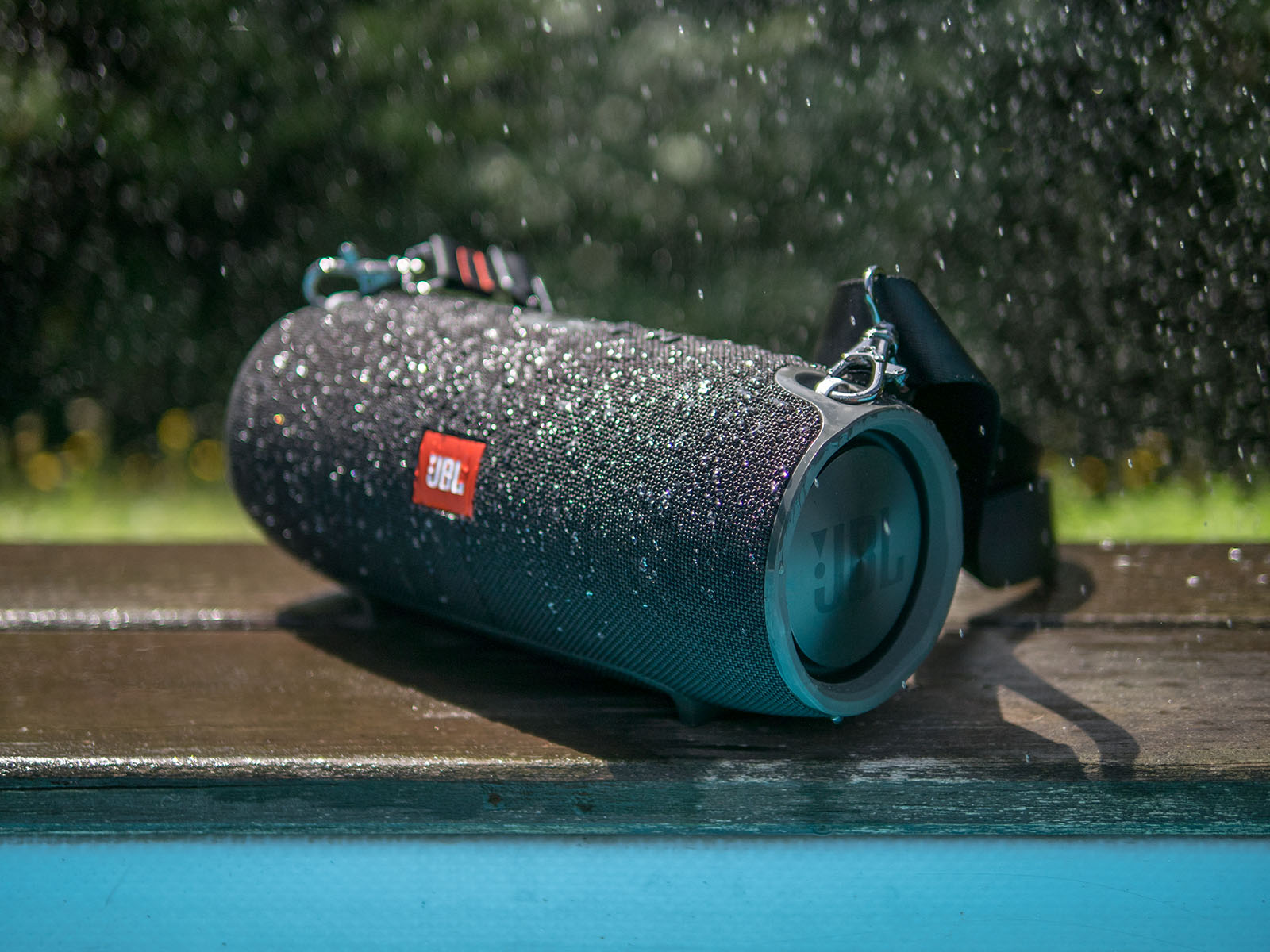
Build quality is really high and the speaker simply feels and looks gorgeous unlike many other speakers that rather resemble an old transistor radio or an old guitar amp from the 60s. With the Xtreme you get the impression of having some weapon in front of you, a kind of sound cannon or something.
I am not quite sure about the durability of the fabric finish and if it might frazzle quickly, but it looks definitely more resistant than the ceramic thing on the Infinity One which scratched easily by just placing the speaker on stone or another hard surface. The fabric might wear out with time as well, for example I would rather avoid bringing it close to some velcro-material although a velcro tape might be indeed a solution to attach other things to the Xtreme, like a second JBL Flip 3 on the back for example, to add a bit of 360° sound...
What I noticed though is that the metal lugs to attach the strap seem to peal off slightly. When I used the speaker with the strap attached more often, I found some residue all around the lugs looking as if the metallic coating was wearing off.

The Xtreme doesn't hide to be rather meant as an outdoor speaker and to be taken outside and placed in some mud, despite the passive radiators being still unprotected. I cannot evaluate the decision about using totally exposed passive radiators again, because on the one hand they look extremely cool when seeing them moving around together with the bass, on the other hand they might be prone to damage if you carry the speaker in your bag together with other hard objects. But the reality and everyday handling of my JBL Charge 2 which has the radiators also exposed showed me that the radiators are pretty insensitive to damage. They might scratch after some time but there is also some additional rubber coating covering the metal part of the radiators which takes a bit more of an effort to really add some visible damage. Also keep in mind that passive radiators are not actual speakers that can be damaged in some way, they are just vibrating weights which are tuned to a resonate with the active drivers at a particular frequency, you just have to be sure not to damage the rubber suspension. It could be perforated by some sharp object and the speaker would lose its air tightness with the passive radiators not working anymore. Therefore I would still suggest to use some additional protection during transport, just for security. Unfortunately no bag is included and it might be hard to find a suitable one. I was able to use one of the XXL lens-bags to fit the Infinity One inside, but so far I have not found anything for the Xtreme except some custom made pouch.

The controls are simple and self-evident. A central power button accompanied by the JBL connect button with the volume buttons spread to the opposite sides of this which makes it easier to find them even in complete darkness. Then you will also find an own bluetooth button and a play/pause button at the other side, which can be also used for receiving or starting calls. Skipping tracks is possible through a double click, but triple click to skip backwards doesn't work just like on the JBL Charge 2. It worked on the Infinity One though. No idea why JBL didn't make it work for the Xtreme as well because skipping backwards can often be desired I guess.

When opening the zip at the back we can have a look at all the ports. You need to push away the zip with your finger or some wire in order to access the ports, as it covers them even when open. Behind the zip you will find the socket for the external power supply. This delivers 19V at 3A which is really powerful, but it obviously rules out any USB-recharging of the speaker as it was still possible with the Infinity One. But even recharging the Infinity One through USB was rather meant as emergency only because it could took a whole day to recharge it completely. Quite unique for a portable speaker, although not what I would call "extreme" are the double USB-ports for charging of external devices. With one device attached the USB-port will deliver 2A, otherwise both ports share the power and deliver 1A each. So far I only charged my iPhone with it and thanks to 2A charging was extremely quick. The speaker has to be turned on to enable charging but as soon as a device is attached and being charged you can turn it off again and it will continue charging until you deattach the device or unplug the USB-wire. Of course charging external devices will suck quite a bit of battery. I noticed that charging my iPhone completely would result in a loss of one or even two dots from the battery indicator. Usually the battery indicator stays off until you touch a button on the speaker, like volume up or down for example, it will also shortly light up on its own when it changes the status from 5 dots to 4 dots etc. But with external devices attached for charging it will remain active whole the time. The battery indicator has to be taken with a grain of salt though. There are 5 dots that drop off until the last dot starts blinking red, but I noticed that it takes quite long until the first goes off, while afterwards it can be pretty quick going from 3 dots to a red blinking one. This was not that different on the JBL Charge 2 or on the Infinity One, but on the JBL Xtreme it seems even more striking. The only thing that makes this even more weird is that if you attach the speaker for charging when 1 red dot was lit, it may happen that the 4th dot will already start flashing after 15 minutes of charging time, then it takes nearly 3 more hours to charge the speaker completely until all lights will go off. I am really not sure what to think about this, just don't take this indicator too serious and rather see it as a very rough guide how much battery is left. JBL claims up to 15 hours of battery life, and of course I tested this with the speaker cranked to maximum. I got 5:15 until the speaker turned off playing my standard playlist that I use for testing all other speakers too. Considering how loud the JBL Xtreme can play and how powerful it sounds, this is a great value falling just 45min short of the 6 hours the RIVA Turbo X would play and at the same time much better than the 1 hour the Beoplay A2 was able to play, which according to Bang&Olufsen should play for 24 hours. Never trust any claims until you haven't proven them by yourself!

Another port we have omitted so far is labelled with "service". This seems to be a standard Micro USB and is probably meant for any future updates. I am not sure why the port is necessary because there is also a JBL Connect app available for iOS and Android devices and according to the descrption of the app updates should be also possible like that. Let's hope JBL will really issue some updates in future as there are still several bugs or simply annoyances that should be worked on.
Now let's turn the speaker on and see what happens. First thing you will hear is some loud and disturbing welcome tone. Unlike with all previous Harman/JBL devices that all played the same tone, this time JBL went for some strange guitar slap, something like "chakaboommm", it is really loud and annoying. If the speaker is not in pairing mode already after the first power on you can force pairing with a press of the bluetooth button, the speaker will then play a repeating guitar tone symbolizing a kind of sonar-like searching. Finally if a device has successfully paired you will hear another guitar-arpeggio not much better than all the other tones. Alltogether I am really disappointed by all these loud and unnecessary tones. I really hope there will be a way how to disable them or at least make them hardly hearable after some future update. As it is now it is simply unacceptable, you cannot turn the speaker on silently or turn it off, as it will play a similar guitar slap again. I really don't know who started this competition for the most hilarious speaker-tones, the most extreme might be the pairing confirmation tone of the Pill XL, which thank godness is no longer with us.

If there has to be a tone in any case then please something subtle and soft like the "click" from Bang&Olufsen. For these tones alone I would willingly degrade the rating of the JBL Xtreme by one mark if we were at school. Putting the tones aside for a moment, you will notice that you can pair up to 3 devices with the JBL Xtreme that can stay connected simultaneously and alternate playback. Each speaker can steal the playback of another speaker. So it might happen that if device A is currently playing while device B receives an SMS, the alert tone will interrupt the playback of device A. You just have to keep that in mind if intending to connect several devices at once. Maybe this is the reason why JBL didn't go for a more aggressive pairing strategy. The JBL Xtreme will never connect to more than 1 device on its own. It is the same as it was with the JBL Charge 2 and many other speakers supporting multipoint connections. It is just Bose with their current speakers that manage an automatic connection to 2 devices at once. With the JBL Xtreme you always have to force any additional connection from the other devices, even when they were already paired before. When the speaker is currently playing and you want to pair another unknown device, simply press the Bluetooth button and the speaker will jump into pairing mode still continuing playback from the current device. In this case there will be no pairing tones etc, which of course is welcome as it won't interrupt the ongoing music.
But it is still a pity that JBL didn't manage a smarter connection policy. After power on the speaker will always look for the latest device that was connected. If that is not present but some other already paired ones, it won't even try connecting to these. Pretty annyoing and it forces you to establish a manual connection directly from those devices by digging into the Bluetooth menu and selecting the speaker from their device list. At least this is the case with iOS devices, I heard rumors that with Android devices the speaker will indeed connect to any of the currently present ones, you just have no influence on which is going to be selected. It misses any logic that only Bose seem to deal with this problem, while other companies simply don't care?
Bluetooth reach seems pretty stable with quite a wide range. It is definitely more reliable than it was the case with the Infinity One. When connection is lost it seems as if the speaker was trying to reconnect when still within a certain timeframe. If this timeframe exceeds, you will have to reconnect manually. A letdown for many might be missing NFC or AptX support. The JBL Xtreme doesn't support AptX. Nevertheless I didn't notice any streaming quality issues so far. I am using an iPhone, thus I have no possibility to use AptX anyhow. But it could be that with other devices the speaker might fall back to some inferior compression Codec which could indeed reveal compression artefacts etc. With an iPhone the audio quality is top notch, and I couldn't notice any difference in sound if attached through auxiliary input or if streamed through Bluetooth.
As with all recent JBL/Harman speakers volume control is mirrored between speaker and iOS devices. There are 32 dedicated volume steps when controlled directly through the speaker and when top volume is reached the speaker will play some strange (a kind of muted guitar) tone. It doesn't do this though when controlled through the iOS device. A UE Boom or Megaboom will always play a loud honk when top volume is reached regardless if you control it through your iPhone or through the speaker. At least Ultimate Ears provides an option to turn off all these tones with their speakers, I hope JBL will do the same. Volume curve is set quite sensibly, you can control the loudness in very fine steps even at low levels, something that was is not possible with the JBL Charge 2, but the lowest volume step could still be a bit softer especially for particular scenarios like listening at the bedside etc.
A problem which may be related to the mirrored volume control with iOS devices could be the fact that the JBL Xtreme always swallows the first 1-2 seconds of a track after playback is started or even when skipping to the next track. This can be pretty annyoing as it is close to impossible to hear the first second of a song now, according to some others this does not happen in case Android devices are used for streaming, therefore I assume it might be a problem with the synced volume, as the song always fades in after the swallowed first second.
Update: This problem with the first seconds of a song missing, was fixed with recent firmware update, although it still happens that the Xtreme will but away the intro of a song, when playback is started. This does not occur between track changes, but when there is no playback for several seconds and is started again, the first seconds of a song will still be missing. But this does happen with lots of different speakers as well, JBL Charge 2 did the same thing, and as far as I remember the Bose Soundlink Mini too.
Last but not least the JBL Xtreme has the option of handsfree of course, but to tell the truth, I haven't even tested it yet. It probably works as with every other speaker equipped with handsfree, but I rarely use it at all.
Another thing worth mentioning is the loud hiss you can hear when the speaker is on. There seems to be some higher amound of hiss with most recent JBL speakers, I also noticed it on the JBL Flip 3. The JBL Charge 2 had some hiss as well, and in case of the JBL Xtreme you can easily hear it with the ear closer to the speaker when no music is playing. Many speakers mute any possible hiss when no music is being played, the JBL Xtreme doesn't thus for anyone sensitive to that kind of noise, this may be annoying, although I personally didn't find it that disturbing, you can really only hear it in very silent enviroments with very low volume playback.

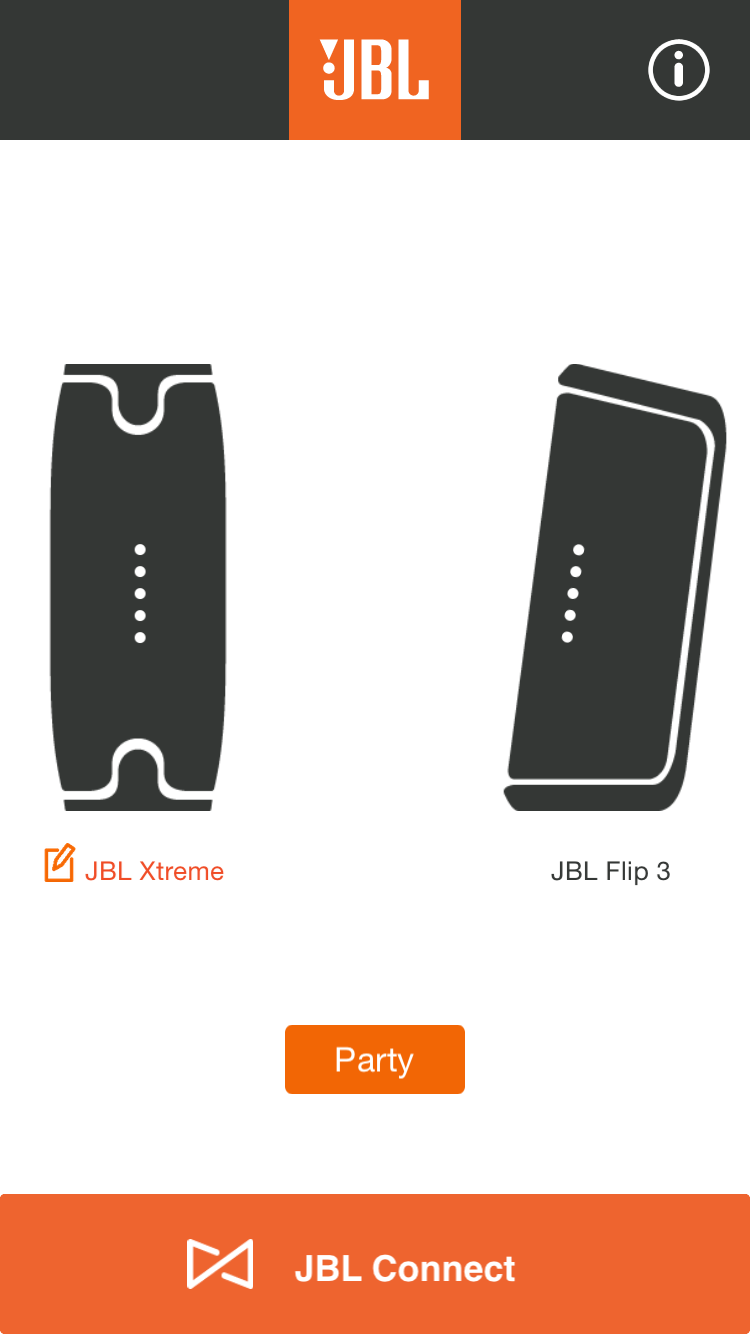
"JBL Connect" is a new feature which I would like to elaborate on a bit more in detail. Just skip it, if you are not interested. The Xtreme together with the new JBL Flip 3 are the first JBL speakers to have JBL Connect implemented. According to the quick-guide as well as to the JBL website this feature enables you to connect multiple speakers for either doubling the sound, which is called "party mode" or to create real stereo with one speaker playing the left channel while the other one taking over the right one. Unfortunately in JBL-language "multiple" means two, I was not able to connect three or more speakers at once, just two. But the good thing is, you can connect a JBL Xtreme to a JBL Flip 3 as well, although in this case you will be missing the stereo-option, they will just connect in "party-mode".
The JBL Connect App is really simple and you actually don't need it to use JBL Connect at all, but the app is the only option to switch between party or stereo. It also allows to swap both stereo channels, and it provides you the ability to rename a speaker, in order to be able to distinguish them, otherwise you would have 2 equally named speakers in your list. The app should also allow firmware updates, but so far I couldn't test it, as there wasn't any update yet.
Without the need of using an app connecting two speakers is pretty straightforward. Each enabled speaker has an own appropriate button, just press it on both speakers that you intend to connect together and they will jump into an own kind of pairing mode. If one speaker is already playing some music, it will not play any additional tones, otherwise you would hear the same pairing tone you usually hear when Bluetooth pairing is active. The other speaker will of course play these tones, which is a bit annoying. But as soon as both are finally connected, the second speaker will start playing together with the first one. In my case (I am using an iPhone 6) there is some delay and the music can even cut out for several seconds before both speakers really start playing completely in sync. Usually the first one should continue playing when the second one is turned off, although even in this case there might be a short pause, it is just not very smooth overall. I also heard reports from others that it seems to work seemlessly with Android-devices. As soon as both speakers are paired, the second one will simply jump-in without any break. It really might depend on the type of device that is connected to the speaker.
You can control volume through any of the connected speakers or through your streaming device of course, it should always be in sync. Although one speaker acts as a kind of "master" the other one rather being a "slave", also the "slave" can take over the master for playback. Imagine your device being paried and connected to speaker A, while your wife's device is paried and connected to speaker B. If you connect both speakers together now, they will still play as a pair regardless if speaker A is receiving a stream from your device or speaker B some music from your wife's device. Track changes directly from the speaker are only possible through the "master" though.
Usually JBL Connect should not cause any problems but if other nearby Bluetooth speakers or devices are active as well, there might be some interference. An iPhone can be connected to 2 or even more Bluetooth devices at the same time, although streaming can only be switched between 2 of them, older iOS versions didn't have any limit and you could be connected to multiple Bluetooth speakers at once and switch between all of them through the "Airplay"-switch. I have the impression that if an iPhone has 2 simultanous Bluetooth connections active this might also cause some interference with JBL Connect and the music starts to stutter and cut out repeatedly. The worst thing is if both speakers are already paired with your iPhone and you intend to use them with JBL Connect feature, instead they will probably both connect to your iPhone first, then if they finally connect to each other I noticed that JBL Connect can become unreliable as well. The range for JBL Connect is not too long. It should work within 5-6 meters, but can become unstable with obstacles in between, it will be shorter if both speakers are placed closer to the ground and it will be longer if they are hang elevated. Also important may be the position of the streaming device, for better reliability it should rather be placed closer to the master instead of the slave, otherwise interrputions may appear as well.
All together I am not too impressed with JBL Connect in its current status. The functionality is great, but it simply seems to be unstable too often without any obvious reason. If the connection becomes unstable it might help to turn off both speakers and reestablish the connection again. I also had the impression as JBL Connect worked better with two JBL Flip 3 than with two JBL Xtreme or one JBL Xtreme and one JBL Flip 3, so the JBL Xtreme may be the more affected unit.
Unfortunately the JBL Connect app is not that great either and it sometimes takes much too long for the app to discover any connected speakers. It even warns you that no playback should occur during the connection, and in case the speakers are currently playing they may also start stuttering if the app is launched. There should be some improvement to really make this as seemless and fluid as possible, as it is now the JBL Connect app can become a bit frustrating. Just avoid using it as both speakers usually remember the last connection mode anyhow. If both speakers were connected in stereo, the next time they will connect as a stereo pair again, thus no need for starting the app at all.
I really hope for some future update that may improve stability of JBL Connect as the potential is outstanding. Pairing 2 JBL Xtreme as stereo pair gives you a much more impressive sound experience than the playback through just a single speaker. Setting them apart several meters fills the area with a huge sound stage in front of you. But even connecting one JBL Xtreme with one JBL Flip 3 can make sense, just imagine the JBL Flip 3 acting as a back speaker for the JBL Xtreme. This way you can achieve a kind of 360° sound dispersion, just place the JBL Flip 3 at the back of the JBL Xtreme turned around to the other side. The problem with pairing a JBL Xtreme and a JBL Flip 3 together is just volume divergency between both speakers. At very low levels the Flip 3 will be too loud compared to the JBL Xtreme, while at higher levels the JBL Xtreme will be too loud.
I am still not quite sure if connecting "multiple" speakers will really be possible in future, but it would definitely be desirable. Just imagine two Flip 3 connected as stereo pair and another Xtreme acting as a kind of subwoofer. I really hope but I doubt that JBL will get it going. Logitech may produce crappy sounding speakers, but they have all the features one can dream of. Now it's JBL's turn to prove that they really take it serious. I prepared a simple video to demonstrate JBL Connect in action:
Before discussing the probably most important part of how it sounds, let's first have a look at the inner workings of the JBL Xtreme: The 40W bi-amp mentioned at the beginning is driving two 63mm mid-drivers and two 35mm tweeters. The passive radiators have a diameter of 72mm. Thanks to the dedicated tweeters this means that the JBL Xtreme doesn't have to rely solely on full-range drivers to produce both bass and treble, thus the likeliness for intermodulation distortion as it was the case with the Infinity One is minimized, treble dispersion should also be less directional as it is more common with fullrange drivers. In contrast to the Infinity One which also had drivers at the back (although filtered for treble), the JBL Xtreme has only drivers at the front, thus no sound coming out at the back. I am not sure if this is good or bad, but 360° sound would of course be a nice feature to have, I really got spoiled a bit with the close to omnidirectional sound dispersion of the Beoplay A2, I was not that impressed by the claimed 360° sound of the UE Boom or Megaboom as those suffered from treble loss considerably if not exactly one driver was facing the listener. The upcoming Fugoo XL will also provide 360° sound, so you will probably just need to put it somewhere and don't care about re-aiming at the listener anymore, as you should get great sound from all angles.
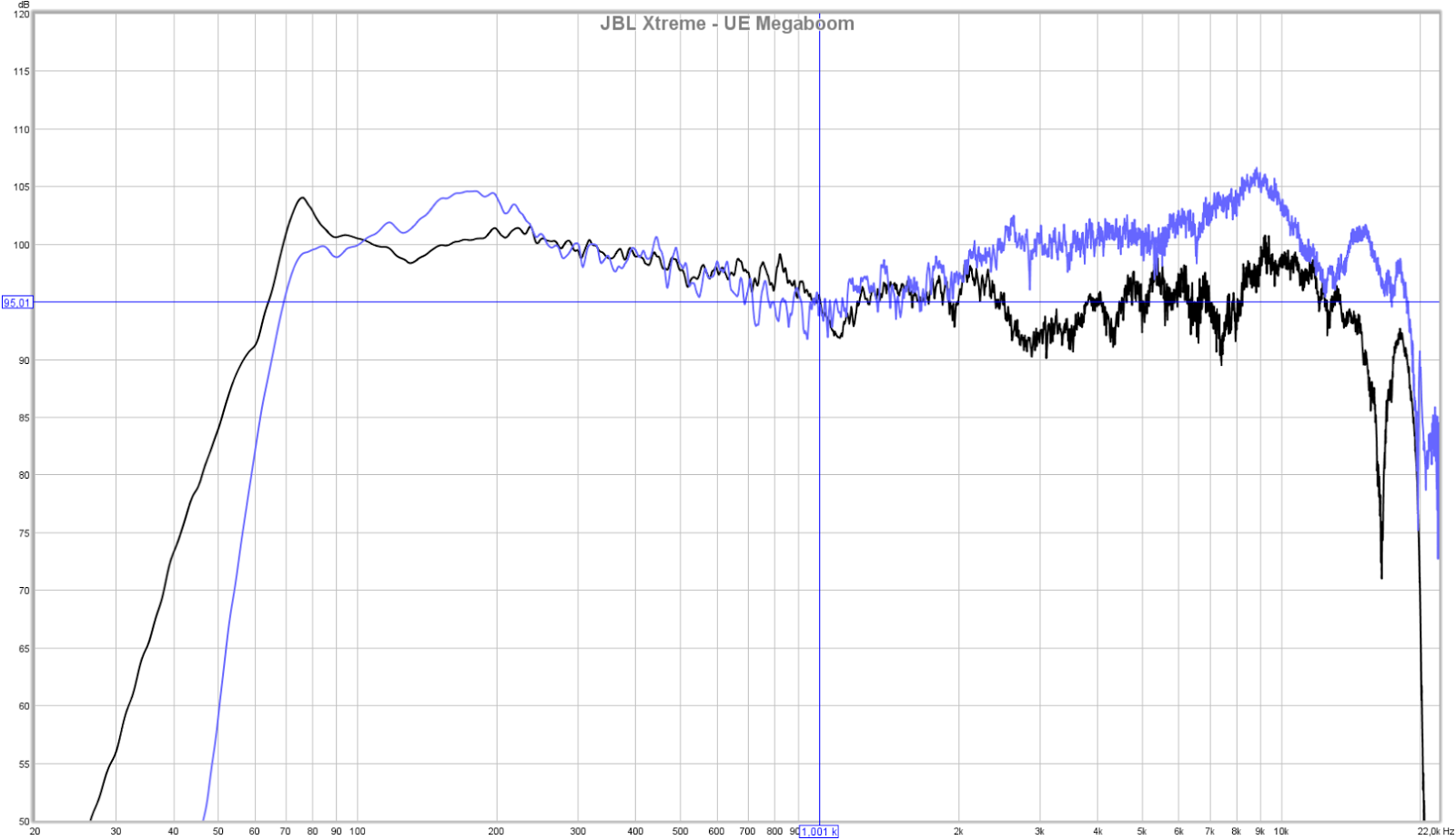
When playing the first tunes you will immediately feel the punch in your gut, the JBL Xtreme seems to be a kind of bass factory. This thing is really powerful and heavy sounding. Despite the sheer amount of bass it still has enough refinement to the overall tuning that it simply sounds "good". When listening to a Beats Pill XL, a UE Megaboom, a Soundlink III or many other speakers that come to my mind, you will always have the impression that something is just not right. The Megaboom sounds honky, the Pill XL sizzling and muffled at the same time, the Soundlink III muffled and boomy... But the JBL Xtreme sounds really familiar and right, it is just the huge bass that jumps at you in the first moment. But after getting used to it, all other speakers will suddenly start sounding tinny. The JBL Xtreme doesn't make a secret out of it to be a real outdoor speaker. While many other outdoor speakers even have an own switch labeled "outdoor mode" or something like that, this switch usually does exactly the opposite of what I would expect from an outdoor speaker, it makes them just louder by pulling out the non existing bass even more. Especially outdoors when there are no walls, no ceiling but just the ground that can act as reflective surface bass will be the first thing that gets lost pretty quickly into all directions. At home you can put the speaker in a corner, closer to a wall, you can even make a Mini Jambox suddenly sound "big" when put in a corner, but as a matter of course with the JBL Xtreme this would be counterproductive because you would enhance the already strong hitting bass even more. The JBL Xtreme sounds perfectly rounded especially outdoors standing completely free. You will hear and feel every bass note even from some distance without having to crank the speaker close to maximum. Unlike some other companies JBL has the tradition not to apply any loudness compensation to their speakers. This is not different with the JBL Xtreme, but as the sound is that full-bodied to begin with, it will still manage to sound full-bodied at low levels. Many other speakers that won't apply any dynamic Equalizing will always sound slack and lifeless at low levels until not a particular loudness level is reached. This was exactly the impression I also had with the RIVA Turbo X which didn't manage to impress me at low levels. Other companies apply various kinds of dynamic equalizing, some even manage to overdo it as is the case with the Bose Soundlink Mini. Funny thing is, the Soundlink Mini may even sound fuller than the JBL Xtreme at very low levels, Bose boost bass that much that the Soundlink Mini can start sounding "bigger" than the JBL Xtreme, it is just that if you start increasing volume the Soundlink Mini will gradually start reducing bass again until not really much will remain at levels close to maximum. The difference to other speakers is that the JBL Xtreme keeps the bass level equal up to some certain point which will rather give you the impression as it became more and more bass heavy when turning volume up. Of course from some certain level up the JBL Xtreme will start reducing bass as well (unlike the RIVA Turbo X, which keeps the same level up to maximum) but this level is already pretty high and comparable to maximum volume of all the smaller speakers. The JBL Xtreme starts dialing bass back slightly at levels above 60% below that you still get that crazy bassboost which makes it sound extremely huge and powerful. But even at higher levels it still manages to sound powerful enough to remain impressive. At maximum volume bass reduction is more obvious together with some dynamic processing, but both are much less intrusive than it was the case with the Infinity One, which hardly had any bass left at its maximum volume, while dynamic compression was so strong, that any peaks got lost completely. Analyzing the sound deeper will reveal that the bass does not reach overly deep, it has a strong peak at 75Hz, and rolls off pretty quickly below that. This legendary 75Hz peak can also be found on the JBL Charge 2 and the Infinity One and is probably just a psychoacoustic trick to simulate deeper bass without really the need of any deeper response. The stronger boost at 75Hz obviously tends to mask the missing lower frequencies. The JBL Xtreme rather resembles the sound of a Klipsch KMC-3 or a Beolit 15 than that of speakers in its own class, outdoors you will hardly notice the lower bass advantage of the KMC-3, except when really listening close or with particular tracks that contain lots of low-bass content. Although a Beoplay A2 might reach deeper than the JBL Xtreme, it only really does so at low levels, at higher levels distortion would become too strong and bass reduction is the only way to prevent the drivers to overdrive, which in case of the Beoplay A2 obviously didn't quite work anyhow as seen from my tests. Any track with stronger bass content, especially with electronic drum kicks will distort when played through the Beoplay A2 already at half volume. The same is true for the Sony SRS-X33 or X55, which both pretend to produce an impressive amount of low frequency response, while in reality they both start struggling at any level above half producing ugly distortion which I cannot quite understand how such products could hit the market at all. JBL probably went for this tricky 75Hz-peak tuning as it might be easier to control a driver with a high-Q peak at a fixed frequency than one that is forced to play deeper. This way JBL probably also manage a higher possible loudness level without the sound falling apart. The JBL Xtreme is one of the loudest speakers in its class but doesn't brake any loudness records. It is about as loud as the Beats Pill XL, which was no slouch either, but the Xtreme manages to retain much more and deeper bass than the Pill XL and simply sounds much more impressive regardless of loudness level. Although it has to be said that the Pill XL doesn't apply any obvious dynamic compression at maximum volume and manages to remain still pretty distortionfree, while the Xtreme limits some stronger peaks and compresses dynamics to achieve this loudness. Still the result is much more convincing than that what Beats managed to offer. I am not even talking about all the other speakers in this class, including the Bose Soundlink III, the Infinity One, the UE Megaboom, the B&W T7 etc. which are all simply in a class or two classes below not only regarding loudness level, but also overall sound quality as all lack the power of the JBL Xtreme. Nevertheless the JBL Xtreme could get along with a bit more loudness. A Harman Kardon Onyx Studio is quite a bit louder than the JBL Xtreme, although only when attached to mains. The JBL Xtreme shows hardly any difference in sound or loudness when it's run from battery or from wall power. I had to attach and de-attach it several times to really notice some slight difference.
Maybe the JBL Xtreme is not the best speaker for analytical listening at home, bass can be simply too much, especially if you listen at levels close to half when there is still no bass reduction of any kind applied. For indoor use I found "bass reducer" EQ-setting on the iPhone to be quite helpful for taming the bass a little bit, you still feel the deeper pounding without the boominess. But take the Xtreme outdoors and I have yet to hear a better speaker, the bass is just spot on. Of course you will achieve a higher loudness with the Klipsch KMC-3, but if looking at the size/weight difference between both, this is not a big surprise, not even mentioning that the KMC-3 needs either batteries or an external power bank to be used outdoors. A B&O Beolit 15 will hardly play louder than the JBL Xtreme, although the Beolit 15 manages to retain more bass at higher levels and it will sound quite a bit more restrained than the JBL Xtreme. One of the closest competitors for the JBL Xtreme could be the already several years old Bose Soundlink Wireless System, or the even older Bose Sounddock Portable. Both weigh above 2kg and are larger than the previously mentioned speakers. Listenting to both, I would give the JBL Xtreme the edge in overall sound quality. The Bose will play quite a bit louder, in reality it nearly manages to reach the loudness of the much larger Klipsch KMC-3, but the Bose will sound extremely forced with lots of distortion to reach this loudness, you can hear that it is simply pushed too much. When turned down and matched to the maximum volume of the JBL Xtreme, I would still take the JBL over the Bose as it simply will sound more convincing and more powerful with less distortion and less compression. Having said this, I am still very impressed by the performance of the old Bose design which is dated back 8 years when the Sounddock portable was released.
Of course such a strong overall bass boost doesn't come without problems. Up to exactly half volume I didn't notice any anomalities, but one or two notches above half some slight distortion might creep in. This is especially noticeable with stronger peaks like those from particular bass-drum sounds, I noticed it with many songs. You hear a slight "clicking" sound and the bassdrum won't sound 100% clean anymore. This distortion will go away at even higher levels, probably because bass is started to be reduced. While maximum volume can sound a little forced, the JBL Xtreme will still remain more or less free of stronger distortion effects. It is just this narrow range above half volume where it tries to still remain as full-bodied as possible, but starts struggling a bit. I haven't noticed such problems with neither the JBL Charge nor the Infinity One although especially the latter suffered from strong intermodulation artefacts that were much more obvious than the slight problems of the JBL Xtreme.
So far we only talked about bass as this seems to be the main selling point of the JBL Xtreme, you either love or hate it. My wife hates it as it is too much "humming" for her taste, but she already found the Denon Envaya Mini too bass heavy, thus she might not be the best point of consultation.
I find the entire tuning to be really well done, it is tasteful and refined to really be enjoying, and despite the slightly overdone bass, the Xtreme sounds considerably more convincing than most speakers in its class as it can also cover a much wider loudness range. While most other speakers will already reduce bass or do other funky stuff to achieve a higher loudness, the JBL Xtreme will still go strong. The treble has some nice definition without the metallic character of the JBL Charge 2. It is also less directional than that of the Infinity One, although treble seems to be emitted more to the bottom than to the upper side of the speaker, which is what I would have expected. The Infinity One has the drivers tilted upwards to project sound up, but with the JBL Xtreme you get the clearest treble if you tilt the speaker backwards, so that the area below the JBL logo is aiming towards you. I found this really strange, as the speaker sounds definitely better and more sparkling if it is placed elevated. If you put it below the treble will rather be chocked at the ground, maybe the engineers had some intention to do exactly as is, maybe treble should be dispersed at the base the speaker is placed on, I am really not sure, but I prefer the sound if the speaker is tilted back, or if I listen to it from below.
I already mentioned that the Xtreme sounds also pretty nice when listened at very low volumes even without any added loudness, it doesn't get the boomy character of the Bose which tends to drown the treble thanks to an excessive bass boost at low levels, while other speakers including the JBL Charge 2 may even become a bit tinny sounding. The JBL Xtreme is definitely not a flat sounding speaker, but it makes lots of fun and doesn't have any colorations that may make it sound unpleasant or weird. It only starts sounding a bit harsh at levels close to maximum. Although no stronger mids-emphasis is visible from the measurements at high levels, some slight resonant coloration becomes pretty obvious with music. Next you can see the frequency response of the entire volume range including the measurement at top volume when attached to mains which is hardly different to the top volume measurement from battery.

Just for the sake of completness the frequency response of the JBL Xtreme (black) directly compared to the Infinity One and to the UE Megaboom below:

I also prepared several videos which you can all see with the following playlist, starting with a general introduction of the JBL Xtreme including a short first and heavily unfair comparison against the JBL Charge 2. Next comes a direct comparison against the Beats Pill XL to make everyone the decision easier of returning their Pill XL after Apple has recalled all units. One indoor and one outdoor video puts the JBL Xtreme against the UE Megaboom, then you will see one video with the JBL Xtreme and Bose Soundlink III side by side and finally the JBL Xtreme together with the Harman Kardon Onyx Studio, a kind of brother to brother competition, as both speakers are maybe even tuned by the same fathers... er... engineers.
My personal verdict: the JBL Xtreme sounds huge and it is what the Infinity One should have been from the very beginning. Putting both side by side makes the Infinity One suddenly look and sound pretty lost, although the Infinity One already managed to stir up the competition quite a bit, the JBL Xtreme finally manages to turn the market inside out. At 299€ (not sure about the upcoming pricing in the U.S) it was released at an extremely competitive price while offering extreme sound quality putting most similar speakers to shame. The JBL Xtreme may be larger and heavier than those, but it still remains prefectly portable and shifts the limits of sound and loudness you can get out of a portable speaker. The strong bass boost may not suit everyone's taste, but keep in mind that this is ought to be an outdoor speaker tuned for outdoor use, where low frequencies are usually drowned away earlier than indoors. The JBL Xtreme is built with a rugged textile finish it is water proof and has an impressive battery life that should allow for more than 5 hours of music when cranked to maximum volume, values that some other portable speakers hardly even reach at whispering levels. I can willingly accept the extra weight and size compared to most competing models priced the same or even higher, because the JBL Xtreme simply outperforms all of them. It is not faithful to the original recording, but is rather tuned for fun and power. If you want a flat sounding speaker, check out the RIVA Turbo X, the JBL Xtreme is rather a party speaker that makes you dance not a speaker that makes you want to lean back and listen to a symphony of Beethoven. Imagine the possibility to pair 2 of these monsters for wireless stereo and you will definitely be the king of the beach.
There are still some slight quirks like the unnecessary status tones which are much too loud or the fact that the first second of a track is swallowed especially with iOS devices. Also JBL Connect is not always 100% stable and would need some update. But I am pretty sure that JBL will sort this out soon, as the JBL Xtreme is obviously easily updatedable through the own JBL Connect app unlike the JBL Charge 2 which caused quite a confusion for most owners who wanted to update their device to the latest 1.4.1 firmware, but didn't get any support from JBL. Let's hope JBL will take it more serious now. I am not quite sure which speaker may become a serious contender to the JBL Xtreme, the closest I can imagine could be the upcoming Fugoo XL, which I hope I will be able to put through its paces when it will finally become available. Until then the JBL Xtreme is hard to beat and already now a classic and certainly one of the few portable speakers that I can really highly recommend without hesitations.
+ huge sound
+ bass, even more bass, did I already mention bass?
+ louder than most competition
+ tasteful overall sound tuning
+ sturdy build quality
+ water resistant
+ great battery life
+ multipoint pairing to 3 devices at once
+ stereopairing with a second speaker through JBL Connect
- a bit too big and too heavy
- doesn't brake any loudness records
- bass can be a bit overpowering sometimes, especially indoors in smaller rooms
- bass not reaching really deep
- some obvious distortion with strong bass kicks at levels slightly above half
- sound becomes quite harsh with resonant upper mids at levels close to maximum
- welcome and status tones much too loud, cannot be disabled
- some noticeable background noise
- No NFC, no AptX support
- JBL Connect not always 100% stable


Review: JBL Charge 2+ where's the plus?

It's time for an update of the JBL Charge 2. After Bose added "II" to their new Soundlink Mini, Sony made an X33 out of the old X3, now JBL added a "+" to the new JBL Charge 2 which in contrast to the other two seems to be the better portable speaker for the upcoming summer especially because of its claimed water resistance. I thought I will do a detailed review of the Charge 2+ but after trying it out, I would say that it is the same speaker as it was before without the "+". Not much has changed or improved at all, therefore if you are really interested in all the details about the JBL Charge 2+ you can also read my original review of the JBL Charge 2, just simply ignore all my ranting about any distortion or DSP issues of the first version, as the JBL Charge 2+ has none of those problems. But when buying a Charge 2 you can always check if the latest firmware is installed. The latest firmware (1.4.1) finally fixed all problems for the Charge 2 as well and made both sound and perform virtually identical. If you have a JBL Charge 2 with the latest firmware, in reality you have a JBL Charge 2+ just without the alleged water resistance. The JBL Charge 2 can be meanwhile found for much less (Deutsche Telekom started offering it for 88€ recently), therefore I would rather go for the old unit, as I don't really believe any of the JBL Charge 2+ water resistance claims. If you are still interested jump in to read what has changed or what hasn't changed at all between the two.

Putting both side by side you will just notice the different new logo. They both feel the same, have the same materials, and even the ports at the back are completely equal. Despite the water protection of the new JBL Charge 2+ all ports are completely unprotected and exposed in the same way as they were before. If the Charge 2+ was really water proof or resistant or whatever, they would have covered the ports in some way like on most other speakers with some kind of water protection. The Denon Envaya Mini, the Infinity One and all the other speakers I know that are water proof have the ports protected by a flap or cover.


Of course I wanted to know how both sounded. There were already some rumors on Youtube and elsewhere on the net that the new Charge 2+ should sound better, louder, etc. When I got the JBL Charge 2+ I still had 1.4.0 installed on my own Charge 2 but finally let it update by a nearby service center. The result was that with the latest firmware 1.4.1 my Charge 2 sounded nearly the same as the JBL Charge 2+.
The only noticeable difference is a slightly higher treble boost on the Charge 2+, but without direct comparison and switching back and forth repeatedly, you won't notice it at all, they still sound the same. With firmware 1.4.1 bass was slightly reduced on the Charge 2 and brought to the same level as the JBL Charge 2+. Even the loudness of the volume steps is equal now, as with the update my Charge 2 became slightly louder during the first volume steps which are completely matched to the Charge 2+ now. This means the Charge 2+ as well as Charge 2 are both not really comfortable to use at low levels. With an iOS device volume control is mirrored between speaker and streaming device and you are getting only 16 dedicated steps. While the first volume step might be too low, the second can be already too loud, the stepping becomes only finer from the 5th step upwards and during the last 3-4 steps there is hardly any change in overall loudness anymore. It really looks as if JBL deciced to apply an inverse logarithmic volume curve, totally absurd if you ask me, they did exactly the same with the Infinity One btw, so it seems to be a trend with their speakers and I wonder how some upcoming products from them will behave in this regard.
This remains a strong negative point and although I really welcome a synced volume control, as you always have the whole volume range available regardless if controlled through the speaker or through your player, JBL does everything to make this great option annoying. They haven't improved anything since the release of the JBL Charge 2, but could have definitely refined the volume-curve further since then.
I measured both JBL Charge 2+ (black) and my own JBL Charge 2 (grey) at all available volume steps and as you can see they are more or less equal, some slight differences might result in an inaccurate positioning or simply sample variation. The only obvious difference that is probably a result of different tuning is the higher treble peak from the Charge 2+. Overall loudness and overall sound quality remained exactly the same:


How does the JBL Charge 2+ sound? I would say that it still belongs to the best perfomers in its class. The bass doesn't reach that deep, like on the Sony SRS-X33 or the Bose Soundlink Mini for example, but the strong obvious peak at around 75Hz seems to compensate for this and makes the bass appear more punchy and stronger than it is in reality. The interesting thing is, that although there is some bass reduction at high levels, JBL managed to retain more bass at maximum volume with the JBL Charge 2 and 2+, than most other comparable speakers like the Bose Soundlink Mini II, the Sony SRS-X33, Denon Envaya Mini etc. as you can see in the following measurement that I composed with all of them when set to maximum loudness. The JBL Charge 2+ (black curve) has still the loudest response below 200Hz, with the high peak at 75Hz definitely giving it even more advantage over the others.

I also think that this noticeable basshump before rolling off is based on a psychoacoustic trick to fool the human ear of hearing more bass, at the same time JBL doesn't need to boost the lower bass part that much as Bose for example, and while the Bose starts struggling at levels above half with the bass becoming distorted (as shown in the THD-measurement) because the small drivers cannot quite keep up, the JBL is still going strong up to maximum volume. In contrast to the others JBL doesn't apply any loudness compensation at low levels, it measures always the same but interestingly it never sounds "thin", it is just that it won't sound as "fat" as the Bose or the Sony.
At high levels JBL also applies some more clever dynamics processing than the competition. The compressor starts kicking in from about 8-9th volume step but is still hardly noticeable, the good thing is that the compressor is set up with a very fast attack and lets the strong peaks rather unprocessed, you will still feel and hear all the kick-drum hits even at maximum volume, while Bose and Sony tend to iron them out with their compression algorithms producing rather a mushy result. You will notice a huge difference with Dance-music. The JBL will simply sound much more driving than all the others. The only other speaker that hardly applies any dynamic compression is the Denon Envaya Mini, but this one has less bass to begin with and therefore will sound thinner than the others. But with the Denon you will still hear the music nearly unprocessed even at maximum volume, while with the JBL you will notice pumping and compression effects. Of course the Denon has definitely some kind of limiter built in as well to protect any unwanted driver-overload, but this rather acts unnoticable in the background, with far less impact than the dynamic compression from all the other devices.
The mids are pretty flat on the JBL with hardly any coloration. It sounds really neutral and doesn't give you any strange sounding vocals. It is just the treble which sounds a bit metallic. I guess that the high treble peak at around 15kHz is to blame for this, but at the same time it is probably the reason that the Charge 2+ doesn't sound muffled at all even when listened off-axis. There is some treble roll-off above 9kHz which is boosted at 13kHz again, this is not optimal but overall JBL did a pretty good job with the tuning. Although the JBL Charge 2+ does not sound that neutral as the Denon Envaya Mini, the JBL sounds definitely more fun in most cases and just gives you the impression of listening to a larger speaker. It doesn't have the exaggerated bass of the Bose, but in contrast to the Bose the JBL Charge 2+ has everything under control with no distortion or farting on kick-drums etc, regardless of loudness level.
Despite 2 separate drivers, the JBL Charge 2+ sounds pretty constrained, you won't get any real sound stage out of it, the drivers are much too close to each other, and JBL doesn't seem to apply any stereo enhancing tricks either. It is rather a speaker to be placed somewhere and walk around, but not meant for critical listening with the speaker standing directly in front of you.
I also prepared a short video showing both JBL Charge 2 and JBL Charge 2+ in action, some even think to hear better stereo separation of the new Charge 2+. If you really think to hear any differences it is definitely just an illusion. In a blind test I probably wouldn't be able to hear the difference, although I noticed the higher treble peak indeed:
The JBL Charge 2+ is definitely a solid performer and currently one of the best in its price range. But all points of criticism from the JBL Charge 2 remain still valid for the JBL Charge 2+ as well because there was no change at all. First the very rough volume control at low levels. The Charge 2+ still only tries to connect to the most recent device only and ignores all other present devices, so that you have to force a connection manually every time. It is still standing pretty wobbly, hardly placeable on uneven surfaces. It happened to me several times that outdoors with some slight wind it was simply tossed over and landed on the lawn. Although my own unit meanwhile hit the ground several times now, it is still without any obvious damage. The unprotected passive radiators are often cause for concern for many owners or potential buyers, but meanwhile I am pretty safe to claim that the JBL Charge 2+ would also easily survive any unprotected transport, it is built really well.
On the plus side is the great battery life which will give you more than 6 hours at maximum volume, ability to connect with 3 devices at the same time and the strong acoustic performance with a punchy well tuned sound at all loudness levels. If you don't mind the slightly larger size, I would definitely choose the Charge 2+ over the Bose Soundlink Mini II, the Sony SRS-X33 etc. If you don't need the water protection which I would see rather disputable anyhow, lookout for a JBL Charge 2 on sale and you will get the same device just cheaper!
+ impressive overall tuning with a nice and natural frequency response
+ sparkling treble with wide dispersion
+ great punchy bass
+ manages to keep more bass at top volume than the competition
+ low distortion
+ low distortion
+ synced volume control with the streaming device
+ far Bluetooth reach
+ long battery life
+ track control possible through the "call-button"
+ track control possible through the "call-button"
+ charging of external devices
- no real improvements over the old model
- water resistance questionable as all ports are completely unprotected
- very strong volume jumps at low levels, only 16 volume steps overall
- noticeable dynamics compression at higher levels
- doesn't automatically reconnect to previously paired devices other than the last paired device
- social mode has to be activated every time after power-on
- status tones too loud
- doesn't stand very stable
- no protecting cover or bag included
- no advanced features like NFC, AptX, wireless stereo pairing etc...
News: Finally! JBL Charge 2 - 1.4.1 firmwarefix

Finally with the latest firmware the JBL Charge 2 manages to be what it should have been from the very beginning back in September, when it still suffered from teething troubles.
Until now I couldn't fully recommend the JBL Charge 2 without reservations, as the issues were too disturbing and it remained rather a "also-ran" speaker among all the others.
In the meantime there was lots of discussion on Youtube regarding all those problems with many users complaining about their units still to distort, while others claimed to have no problems at all. There were theories established about serial-numbers which would indicate when the unit was manufactured and when it would be without issues. I was enjoying all this similar to reading a crime thriller.
Then finally someone from Japan came up with an undocumented trick to check the currently installed firmware on his JBL Charge 2. He finally claimed that only the latest firmware "1.4.1" would fix all problems, while all firmwares below suffered from this or that DSP-issue.
To check your firmware you have to power on your JBL Charge 2 and be sure that it won't connect to any nearby Bluetooth-device. Now press the Bluetooth button and volume + button simultaneously and keep them pressed for some seconds to finally hear a nice female voice that will tell you the firmware number, something like that: "one four one".
If you don't hear "one four one", you should get your device updated. I own a "refurbished" version that I bought back in December after returning my very first unit from September, and while my current unit didn't have all these distortion problems of the very first unit, it was still close to unsable at lower levels during the first 4-5 volume steps. After checking my firmware it said: 1.4.0, therefore I decided to update my model as soon as possible.
Unfortunately Harman never planned to make the devices user-upgradeable, thus you should contact an authorised service center. I contacted Harman directly to ask them how to proceed and 2 days later I got their response where they told me the responsible center in my area. I already knew DEC Service Center in Vienna, as they are also responsible for Panasonic repairs and I had some repeated issues with my Lumix cameras or lenses. The next day I took my JBL Charge 2 and left it there for an update. After 10 minutes I already got it back with 1.4.1-firmware installed and had a chat with the responsible technician who was well aware of the problems.
According to him this whole thing was getting quite fuzzy, as there were many users who complained about the problems, but at the very beginning even the technician wouldn't acknowledge them. There was no statement from Harman either until January where they finally issued an official update-service. A special updater-software for 1.4.1 version was provided to all service centers with a time-limit of 1 week to be downloaded, otherwise a permission for a new download had to be requested again. Login has still to be done through some Harman server etc, so this whole thing still sounds a bit "obscured" for me and I don't understand that Harman didn 't even care to contact their customers to inform them about the update. I had contacted Harman several times about this, at the very beginning they suggested to return the speaker, when I asked afterwards if there would be any update, they could have at least responded now. Given the fact that the update was already out nearly half a year, while some new owners checking their firmware are still hearing "one three eight", this is really annyoing! They could have at least communicated it in one way or the other.
Update: Check out how you can upgrade the firmware on your own here!
But the most important fact is, that the JBL Charge 2 is completely issue-free now. I measured the JBL Charge 2 with my previous 1.4.0 firmware and measured it again after the update to 1.4.1, and what you can see from the measurements is that the first 3 steps were entirely screwed up with the old firmware (green) that was incapable of producing and clean output below 150Hz while with the new firmware (blue) it measures ok. Unfortunately the very rough volume-steps that were already present with the previous versions became even stronger now. The first volume step is louder now than it was before and the 3rd volume step is nearly as loud as the 4th step from the old version. So if you intend using your JBL Charge 2 at low levels, it might be a hassle to achieve the correct loudness as the first step might be too soft, while the second one too loud already especially when using an iOS device where volume control is mirrored between speaker and player:

The new firmware also seems to come with some minimal sound-adjustments. I matched the 5th volume step for both by pulling the old version some dB up, and as you can see the new firmware took away a little bass in the region up to 300Hz (the strong peak at around 75Hz remained exactly the same though) but usually you shouldn't notice any difference at all without having a direct comparison. The other slight deviations visible are probably measuring errors due to slightly different placement (again green firmware 1.4.0 and blue 1.4.1):

After the update I would say that the JBL Charge 2 is in the top-line of current portable speakers, with a great punchy sound at all volume levels, class-leasing battery life and a lower price tag than most competition, especially now after the new Charge 2+ has been issued. Thanks to the Charge 2+, the Charge 2 can be even found far below 100$/€ which is quite a bargain. Grab one, if you were still undecided.
Many will ask if it is any better than the Denon Envaya Mini? I would say yes, if the total package is considered, as the Charge 2 makes more fun, has a much more solid battery which can also charge other devices and meanwhile it also cheaper, while the Denon became more expensive. The Denon might have a flatter and more true sound, but the JBL fares really well with its obvious bass and treble-peak that both make it more consumer oriented.
If you want to know if the Charge 2+ sounds any better than the Charge 2, stay tuned as I will compare them both directly soon.
Review: JBL Flip 3 - the UE Boom killer

According to JBL the Flip together with the Flip 2 are their most popular portable speakers. To tell the truth, neither of them really managed to impress me. They were rather tinny sounding, the first version had also quite harsh treble response with some honky upper bass boost, although the second version was smoothened out a bit, it still sounded far from impressive and the battery life was pretty underwhelming as well. Now JBL came up with a completely new design more similar to the new JBL Xtreme or JBL Charge 2. Let's have a look if the JBL Flip 3 (buy from amazon) is really an improvement over the predecessors.

The catchy title of my review was chosen on purpose. There are still lots of people who really think the UE Boom to sound good. Some even claim it to be the best portable speaker available. With so many great alternatives on the market right now, I cannot quite follow their attitute, but if you really like the sound of the UE Boom, the Flip 3 is a much better sounding speaker, besides being cheaper as well. Although the JBL Flip 3 still has some design elements of the previous Flip models, it is pretty obvious that it rather aims at directly competing with the UE Boom.


It supports multipoint pairing to 3 devices at once, and last but not least it can be paired with another one for wireless stereo or to double the sound, besides it can also be paired with a JBL Xtreme. These two speakers are the first JBL speakers to actually have JBL Connect integrated. The most important change though is probably the acoustic design. While the former Flips were ported bass-reflex designs, the JBL Flip3 uses dual passive radiators to enhance bass response. The amplifier delivers 16W which would be even more powerful than the JBL Charge 2, and my hope was that the JBL Flip 3 would be a kind of shrinked JBL Charge 2, smaller, cuter with slightly less bass. But before talking about the sound quality, let's first have a look at some details.

The Flip 3 is available in many funky colors. For my taste they all look pretty good, but initially I decided to go with black, as it would match my black JBL Xtreme best. In the meantime I returned the black and have a yellow unit now, more on this "exchange" later. As you can pair 2 of them and use them as a stereo system, the choice of different colours for both can definitely become tough. Yellow/blue, red/teal, black/grey, it would be interesting if JBL could once publish a list with the most popular colors.
The Flip 3 comes within a stylish compact box. With exception of the speaker and a micro-USB cable you will not find much inside, just the common quick-guides, warranty cards etc. This means there is no charging adaptor included. But thanks to a micro-USB port for charging the Flip3 can be charged from any USB source. The Flip 3 has also an own cord mounted which acts as a carrying loop. I really love this loop as it makes the usage of the speaker much more versatile. I can attach the speaker to anything, or let it hang from other objects. When I go hiking with my son, I often tether the Flip 3 to our rucksack, or let it hang from my trouser-belt. Thanks to the loop there are endless possibilities how to utilize it, which is how a portable speaker is meant to be used.

There are so many "portable" speakers with glossy surfaces, or delicate brushed metal finishes which scratch immediately if put on stone or sand or even when carried inside a bag. I think the choice of materials for the JBL Flip 3 is really sensible. The textile finish is equal to the one used for the Xtreme. It really seems to be insensitive to any kind of wear.

The other parts of the speaker seem to be made out of some kind of soft plastic or maybe hard rubber, not this rough rubber you'll find at the UE Boom or Megaboom, which also tends to absorb scratches very quickly. The rubber material of the JBL Flip 3 looks much mure durable, it is also slightly transparent, which looks really cool when put against some light source.

As usual my son fell in love with the speaker immediately and of course after some time he managed to drop it on flagstone not only once. Although I was shocked in the first moment, after examining the speaker closer I couldn't find any sign of damage or dent, I wasn't even able to say where exactly it hit the ground. I wouldn't recommend dropping the Flip 3 repeatedly, but it seems to be built to taking some pounding. Doing so with the Bose Soundlink Mini managed to create a big dent into one of the edges, although it only fell on grass and not stone.
There are still the exposed passive radiators at the sides, but I think the fear of damaging them is exaggerated by many. Just be careful not to perforate the rubber suspension with some sharp objects. The radiators will even work well with a dent, besides they are covered by an additional rubber coating, so that they won't scratch that easily. Of course you must be careful how to place the speaker when in use. If there are nearby objects touching the radiators you will hear a rattling sound.

One of the main design elements of the Flip 3 is that it's completely round, but this design also comes with one of the biggest problems as the speaker has no stable base to be placed horizontally, it rather rolls away. There seems to be a slight centroid difference at the bottom part of the speaker, so that if you place it down as it should, it usually remains stable. You can also help by using the loop as additional support, just place it behind the speaker and it should prevent it from rolling around. If placed "correctly" the JBL logo should aim directly towards you. This way you will also have the drivers in best position, which will of course result in better sound, with better treble, although the Flip 3 is not a very directional speaker to begin with. You can even try placing it with the logo aiming exactly upwards. This way, you might lose some slight treble definition, but you can hear the speaker from any angle like that. It becomes a kind of 360° speaker and I would even say with better results than the UE Boom, because the UE Boom's 2 drivers facing the opposite sides of the speaker are extremely directional, resulting in big areas at the front and back of the speaker with a more muffled sound. There is no way to really get acceptable sound from all angles with the UE Boom, thus I really prefer the JBL Flip 3 placed like that, as it will give you a much better 360° experience although the Flip 3 was not designed to be 360° speaker at all. Of course when used like this it should be placed below the listener for the best dispersion. If you are sitting around with friends outdoors in a lawn somewhere, just put it on the ground in the center with the logo aiming up and everyone should get good sound. Placing it directly at the ground will additionally enhance bass response a little bit. Think of the JBL Flip 3 as a non 360° speaker with hidden 360° ability.
A more stable form of placement is to set it up vertically, thus the name "Flip", although I would have rather called it "Roll" maybe, but then JBL might get into problems with Ultimate Ears and their "UE Roll"..., but funnily the UE Roll does not roll around at all...
Of course when placed vertically you will lose any stereo separation, but I prefer this way of positioning when used together with another paired speaker for stereo. It simply stands and won't roll away thanks to some wind etc.

The overall design and user interface is well-thought-out. You have a distinct band at the back of the speaker which blends into the side fame and divides the textile covering. The band contains the power button and the JBL Connect button as well as the ports hidden behind some additional flap. All the other elements are located within the textile part beside or above the band (depending on how you look at it), these buttons are elevated and can be easily recognized as such without the need of looking. Here you will find the Bluetooth button, both volume buttons, and a combined call/playback button. This is the usual button for accepting or starting calls, or for starting music and skipping to the next track with a double press. Skipping backwards with a tripple press doesn't work by the way just like it didn't with the JBL Xtreme which is a pity. The band at the back also contains the battery indicator with 5 distinct dots showing the current battery state, diminishing one after the other until the last one starts blinking red or lighting up when the speaker is being charged. Similar to the JBL Xtreme the battery indicator is only a very rough guide and usually it takes quite long until you lose the first dot, but then it can become very quickly to go down from three to a red blinking one.

According to the specs the built in battery has 3000mAh, which doesn't sound much, but despite a half as strong amp and a similar battery capacity the Denon Envaya Mini delivers a much shorter run-time. I hardly managed to squeeze out more than 2:30 hours out of the Denon at maximum volume while the JBL Flip 3 played for 3:30 being much louder at the same time. At normal levels 10 hours and more are indeed easily doable, unlike the Denon where you will hardly reach 9 hours at levels close to half. Many even complain to only get 5-6 hours. The JBL Flip 3 has really a solid battery, I used it during our long hikes at higher levels and had to recharge it after some days only.

After powering on you will notice the same new welcome tones we already heard from the JBL Xtreme. They are simply much too loud. No idea who went for this brillant idea to include such striking tones, but forget to use the Flip 3 in quiet areas. Every time you turn it on or off, it will attract all attention: first you get this guitar slap when turned on, then you want to pair your device and it will play this repeated guitar note signalazing the pairing procedure and finally another guitar arpeggio is played when your device is finally connected. Too many tones and much too loud tones for me and I hope JBL will once decide to give the user an option for disabling them, but from what I heard Harman tries to serve all different markets and many asian areas are simply seem to be crazy about this kind of bling-bling stuff.
The entire bluetooth functionality is completely equal to that of the JBL Xtreme. Fhe Flip 3 can connect to three devices at once. Devices that were already paired can simply select the Flip 3 as destination and it will automatically connect, even when another connection is already active. Each connected device can "steal" the playback from another one, this means that when one device is currently playing music while another connected device receives an SMS and plays back a tone, the playback will interrupt because the Flip 3 will rather play the SMS-tone from the other device.
As with all JBL devices so far, automatic reconnection doesn't quite work. It always tries to connect to the latest connected device only, but ignores all other ones, even when the last connected device is not present. You always have to force a manual connection from the other devices in such a case. Other speakers have no problems finding all other paired devices, let's hope that JBL will update this strage as well with some future firmware. The Flip 3 seems to be user upgradeable either through USB or through the own JBL Connect app available for iOS and Android. Therefore upgrading the speaker shouldn't be such a hassle as it was with the JBL Charge 2. Apart from that Bluetooth connection remained pretty stable with a reasonably far reach, I had no issues with hickups or connection drops etc.
Volume is mirrored between speaker and streaming device, at least with iOS devices, but also Sony players like the A15 or Sony Xperia mobile phones have mirrored volume control. It is just all other Android devices that still have a separate volume control. Usually mirrored volume control is very useful as you have the entire volume-range available from both player and speaker. This way dynamic sound adjustments can also be fine tuned better by the manufacturer, as they can tune the sound for each single step to get out most of the speaker. Many speakers simply sound different when set to maximum volume, while the volume of the player is rather set low, which would rather result in bass-loss, other speakers do the exact opposite (the Damson Vulcan or TDK Trek Flex come to my mind here) which will only play full bass when turned up completely. Unfortuantely in case of the Flip 3 the mirrored volume control failed a little bit. The Flip 3 has only 16 volume steps unlike the Xtreme which has 32. But the bigger problem is that the very 1st volume step is already pretty loud, it is comparable to volume step 30 of the Denon Envaya Mini, which has 100 steps.

With the mentioned streaming devices you simply have no way to turn the speaker even lower, a big oversight by Harman. This is strange because already the JBL Flip 2 was a disaster in this regard. The Flip 2 also had mirrored volume control, but it already reached half volume half way, the last 8 steps didn't increase volume really much. Now they seem to repeat the same error again, but with another result. I really hope JBL will provide some update for this as well. This problem becomes even more obvious if you intend to use 2 Flip 3 connected together for wireless stereo or for "party mode". Two will be even louder than a single speaker thus at the lowest volume setting they can be too loud for simple background listening.
As already described in detail for the JBL Xtreme review, the JBL Flip 3 also has the ability to be paired to another speakers that supports "JBL Connect". So far only the Xtreme and the Flip 3 have this option, but upcoming JBL products will certainly have this option as well. If you want to know more about JBL Connect, have a look at my JBL Xtreme review, or watch this video, where I try demonstrating the functionality:
Obviously this is not a direct JBL Charge 2 contender. First I thought the Flip 3 would be a scaled down Charge 2, with slighty less bass etc, but it sounds much more different. It rather sounds like a Flip 2, but better, smoother, with less harsh treble and and more bass extension. I think that as the Flip series is the most popular speaker from JBL (at least this is what they claim in their videos) they didn't want to change too much, but simply improve on the existing sound. If they made the Flip 3suddenly sound like a Charge 2, they would probably scare off existing owners who might be interested in upgrading their older devices, but don't like bassheavy sound etc. But what JBL did is really make it sound like a Flip 2, just better and more mature, with better features and water resistance and also much better looking in my opinion.
The Flip 3 is still not a bass heavy speaker, it sounds just right, but doesn't reach that deep with bass like some others including the Bose Soundlink Mini, The Sony SRS-X33, The Charge 2 etc. The JBL Flip 2 is rather similar to the Soundlink Colour, although not as boosted and more natural sounding. Yet you get some real response down to 80Hz with everything below being rather negligible. The strongest peak is between 90-100Hz, still pretty impressive as most other speakers (including the UE Boom) have hardly any response at 100Hz anymore, albeit a stronger boost above, which makes them simply sound boomy without providing any real bass at all. I would rather compare the JBL Flip 3 with the Denon Envaya Mini, the Denon has still a deeper reaching bass and slightly more punch, but this is only noticeable at low levels. Besides some funky psychoacoustic tricks from Maxxaudio which enhances bass response even further, Denon also applies some loudness compensation and adds boost to lower frequencies at low levels, the JBL Flip 3 doesn't do this, therefore it may appear thinner sounding than the Denon at low levels, but it is still far from anemic sounding, it just doesn't have that strong "wow"-factor of the Denon, which together with the very spatial stereo enhancing algorithms really manages to create a huge sound. At levels close to half and above they are more or less on par in bass response, as the Denon starts reducing bass pretty soon. The Denon may have a smoother sound, the JBL boosts upper mids slightly but remains also clearer when listened off-axis. That's the reason why it will still sound acceptable when just placed on the ground with the drivers facing upwards. This way you can "misuse" it as a 360° speaker, the Denon becomes rather dull if not listened exactly from front. When listened outdoors the slight bass advantage of the Denon Envaya Mini is not noticeable at all anymore, I even prefer the Flip 3 as it manages to sound more punchy. Bassdrums have a more defined impact and it will play considerably louder, still with hardly any distortion or obvious processing. Of course it won't have much bass left at maximum volume either, but it will still sound better than the UE Boom reaching about the same loudness but with less distortion and less obvious dynamic processing. The UE Boom may be slightly louder on some tracks, but the Flip 3 sounds more restrained, the UE Boom produces obvious artefacts and distortion at maximum volume.
The Flip 3 keeps the same frequency response up to about its 10th volume step, as already mentioned there is no additional bass boost at low levels. From the 10th step upwards bass level is kept the same with everything above becoming louder, therefore the Flip 3 won't sound that full-bodied anymore when cranked, but it will still sound convincing. Take two Flip 3 and connect them for stereo, and the sound will become be even better.
Put against a JBL Charge 2, this will of course sound more impressive at first. Bass is boosted more and reaches deeper, but the Flip 3 has more natural sounding treble without this metallic character. Also mids sound more natural on the Flip 3, it is just the strong bass of the Charge 2 that is missing. I personally would have preferred the deeper response of the Charge 2, but without that obvious boost, this would really make the Flip 3 stand out. It stands out already now as it sounds considerably more serious than most other speakers in this class. It rather reminds me of a Fugoo, just cheaper, lighter and louder.
Before having a look at the frequency response measurement of the Flip 3, I would like to mention that I had tested 2 different units that I bought separately: a black one and now a yellow one. I ordered the yellow about a week after the black one, because my black one started to behave strange when put into the sun. After some minutes standing in the heat it started to distort and the passive radiators were pushed out, probably because of the higher air pressure inside when hot. You can see both my videos showing with this problem, my first video where I was still not sure if this was a general issue and an updated second video where I already had the chance to compare both units extensively.
The yellow unit doesn't have these problems even when put into the sun for some hours. Surprisingly I was contacted by Harman because of this and they assured that after having tested several samples especially in regard to this problem the issue was not repeateable, so meanwhile I think that the black unit I got might have simply been defective. Nevertheless I preferred the sound of the black unit, as long as it didn't become hot. The bass had a slightly stronger emphasis and at the same time the treble was smoother. The yellow unit has less bass-punch, while at the same sounding a bit more distorted than the black unit, as I could test both units side by side, these differences were easily noticeable, without this direct comparison you probably wouldn't have noticed any sound difference at all.
So let's first have a look at the frequency responses of both units at exactly half volume:

You can see a rather balanced and flat response with only some stronger treble boost at the upper end for the yellow unit. This treble boost was not existent on the black unit, but this treble peak is also responsible for some slight intermodulation at high levels with bass heavy tracks, something I didn't encounter with the black unit.
Looking at the entire available volume-range (black unit) it is also clearly visible from the measurement that the Flip 3 cannot keep the bass amount at higher levels, blue being half volume and red maximum volume. It starts to reduce bass from around 60% or above volume step 10:

Here a side by side comparison of both frequency responses for the Flip 2 (pink) and the Flip 3:

And of course the obligatory comparison against the UE Boom, which proves that the audio produced by the UE Boom is simply questionable, not even taking the price into account. You can see two measurments for the UE Boom, one with the speaker turned around to the side and only the left driver facing the microphone (blue), and another measurement with both drivers facing the sides (red) which results in an overly dull sound:

As usual I prepared some videos for you with binaural audio to be heard through headphones. First a comparison against the old Flip 2. Although they still sound similar, I think the improvement over the old model is more than obvious:
Very interesting the comparison against the Denon Envaya Mini. While I would definitely give the edge to the Denon indoors and at low levels, at high levels the JBL Flip 3 sounds more impressive with more punch and more loudness:
The JBL Charge 2 sounds of course much more full-bodied, but starts to struggle at higher levels. You notice some stronger dynamic processing swallowing all peaks while trying to retain as much bass as possible. Nothing that you will notice with the JBL Flip 3 which in addition will play much louder at the same time:
For me the Flip 3 defines some kind of "standard" for a small portable speaker around 100€ (a German store had already offered it for 88€). I have yet to hear a better one in this class, sure the JBL Charge 2 will play more bass heavy, another one might play even louder, although the loudness of the JBL Flip 3 is already pretty impressive without falling apart at its maximum volume, but the Flip3 is tuned really well and as common for JBL tasteful to sound natrual while still offering a bit of liveliness and quite a bit of punch in the bass, which is often so much missing from speakers that small. You won't mistake the Flip 3 for a bigger speaker, it definitely doesn't try to play beyond its size or limits, but the sound is still fullbodied enough with a nice bass amount to really make listening to music satisfying, unlike many other competing models inlcuding the highly rated UE Boom, which simply cannot compete in regard to overall sound quality.
The Flip 3 is compact enough to be carried around all the time, fits in a bigger trouser pocket or thanks to the included loop can be attached to a belt, a rucksack or just hang somewhere. I really love the design and the choice for many different colors should meet everyones taste. I would regard the Flip 3 as a kind of "Volkswagen" among portable speakers. A speaker that is affordable, but delivers solid performance without obvious flaws.
JBL really packed this speaker full with features. The battery life is great, although it won't come close to that of the JBL Charge 2, which has twice the capacity. But you should never worry about running out of juice, as it was mostly the case with the Denon Envaya Mini.
A very neat feature is JBL Connect, to use 2 Flip 3 as a stereo system, or to use a Flip 3 together with a JBL Xtreme to enhance its sound even more, or to act as a back-speaker to provide more of a 360° sound experience.
The JBL Flip 3 gets my strong recommendation for anyone looking for a perfect all-around portable speaker that can be used outdoors or even become wet without damage. The sound is solid although doesn't set any new benchmarks. It simply sounds good and can play pretty loud without distortion.
+ great rugged and water resistant design
+ handy loop for attaching the speaker to be taken around
+ balanced sound with punchy bass and sparkling treble
+ louder than most competition
+ very little distortion up to maximum volume with no noticeable dynamics processing
+ treble response with low directivity
+ solid battery life
+ affordable
+ multipoint connections with up to 3 devices simultaneously
+ JBL Connect for wireless pairing with another speaker
+ volume mirrored between speaker and iOS devices
- status tones much too loud, cannot be disabled
- first volume step too loud on iOS devices (only 16 volume steps)
- too much bass reduction at higher levels
- some noticeable hiss at low levels
- No NFC, no AptX support
- JBL Connect not always 100% stable
- tends to roll around when placed horizontally
Subscrever:
Mensagens (Atom)